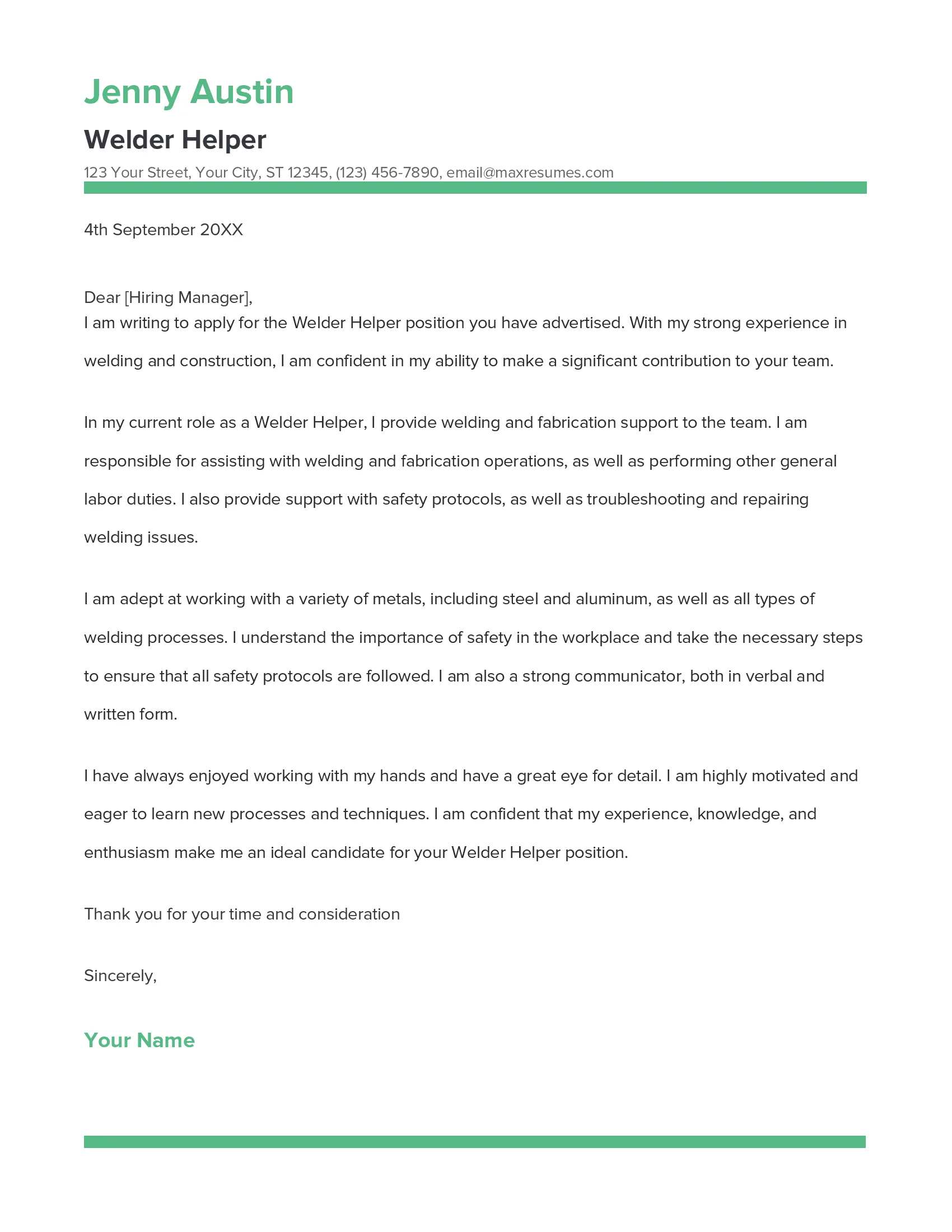
The Importance of a Welder Cover Letter
In the competitive field of welding, a well-crafted cover letter can be your key to unlocking new opportunities. It’s not merely a formality; it’s your first impression, a chance to introduce yourself and showcase why you’re the perfect fit for the job. A strong welder cover letter complements your resume, providing context, personality, and a compelling narrative that highlights your skills and experience. It allows you to go beyond the bullet points of your resume and connect with the hiring manager on a personal level. Think of it as your personal sales pitch, designed to convince the employer that you possess the skills, experience, and enthusiasm to excel in the role. A well-written cover letter demonstrates your attention to detail, professionalism, and genuine interest in the position. It’s an opportunity to stand out from the crowd and make a lasting impression. Ignoring it is a mistake, embracing it is a must.
Highlighting Welding Skills and Certifications
Your cover letter is the perfect place to shine a light on your welding skills and certifications. These are the cornerstones of your qualifications, and they should be presented clearly and concisely. Start by identifying the specific welding processes you’re proficient in, such as GMAW, GTAW, SMAW, and FCAW. Then, delve into the types of materials you’ve worked with, including steel, aluminum, and stainless steel. Detail your experience with different joint designs and welding positions. Be sure to include any relevant certifications, such as AWS certifications, and their expiration dates. This demonstrates that you’re not just skilled, but also committed to meeting industry standards. Mention any specialized skills, such as blueprint reading, quality control, or the use of advanced welding equipment. The goal is to paint a comprehensive picture of your abilities and showcase how they align with the job requirements.
List Your Welding Certifications

Providing a detailed list of your certifications in your cover letter is vital. Certifications are a direct demonstration of your competence and adherence to industry standards. Include the name of the certifying body, the specific type of certification (e.g., AWS D1.1), and the expiration date. If you have multiple certifications, list them in a clear and organized manner. This ensures that the hiring manager can quickly verify your qualifications. For each certification, briefly mention the welding process or materials covered. If your certifications are valid across different jurisdictions, be sure to specify this. By explicitly stating your certifications, you eliminate any ambiguity and immediately signal your professionalism and dedication to safety. This will give you an edge. Make sure you have all the requirements before the application.
Showcasing Your Welding Experience
Your welding experience is the foundation of your cover letter and resume. Instead of simply listing job titles and dates, use the cover letter to tell a story of your career progression and accomplishments. Start by providing a brief overview of your experience in the welding field. Mention the types of projects you’ve worked on, the industries you’ve served, and the size and complexity of the projects you’ve tackled. Highlight any leadership roles or responsibilities you’ve held, such as supervising other welders or managing projects. Emphasize the skills you’ve developed over time, such as problem-solving, attention to detail, and the ability to work independently and as part of a team. Describe the types of materials and equipment you are familiar with. Remember, your cover letter is your chance to demonstrate to a hiring manager the depth and breadth of your hands-on experience.
Quantify Your Welding Accomplishments
Quantifying your accomplishments in your welder cover letter is important because it adds credibility and demonstrates the value you brought to your previous employers. Instead of just saying that you improved efficiency, state by how much. Use numbers and data to support your claims. For example, you might state that you ‘reduced welding time by 15% by implementing a new welding technique’ or ‘increased production output by 20% through improved weld quality’. Showcasing your results also provides specific examples of your skills in action. Focus on measurable outcomes such as reduced rework, improved quality, or increased production rates. Also, include any projects that was a success and the role you had in it. Be sure to tailor the numbers to the specific job requirements. This helps employers see the tangible benefits of hiring you.
Tailoring Your Cover Letter

Customizing your cover letter for each job application is a crucial step in the job search process. Generic, one-size-fits-all cover letters rarely impress hiring managers. Instead, carefully review the job description and identify the key skills, experience, and qualifications the employer is seeking. Then, customize your cover letter to directly address these requirements. Highlight the aspects of your background that most closely align with the job requirements. Use keywords from the job description to make your application more relevant and increase the chances of your application being seen. In the same way, showcase your interest in the specific company and the position. Mention any research you’ve done on the company and how its values and goals align with your own career aspirations. Make it clear that you’re applying for this specific job because you genuinely believe you’re a good fit. Show why you stand out from the others.
Address the Specific Job Requirements
When tailoring your cover letter, specifically address the requirements outlined in the job description. This shows the hiring manager that you’ve thoroughly read and understood the position. Identify the key skills, experience, and certifications the employer is looking for and provide examples of how you meet those requirements. If the job description emphasizes specific welding processes or materials, be sure to highlight your proficiency in those areas. If the employer is looking for someone with experience in a particular industry or project type, draw on your relevant experience and provide concrete examples of your accomplishments. If they are looking for someone with leadership skills or the ability to work independently, provide specific instances where you’ve demonstrated these qualities. Tailor your descriptions as well. Address the requirements to show the hiring manager you pay close attention to details.
Using Action Verbs
To make your welder cover letter more compelling, use action verbs to describe your skills, experience, and accomplishments. Action verbs create a sense of dynamism and show that you are a proactive and results-oriented individual. For example, instead of saying ‘Responsible for welding’, you could say ‘Welded’, ‘Fabricated’, ‘Assembled’, or ‘Repaired’. Instead of ‘Worked on’, use verbs like ‘Managed’, ‘Supervised’, ‘Led’, or ‘Coordinated’. Use action verbs to quantify your accomplishments, such as ‘Increased production’, ‘Reduced waste’, or ‘Improved efficiency’. By using strong action verbs, you can make your cover letter more engaging and demonstrate your impact in previous roles. This will make your application more noticeable.
Formatting and Professionalism

The presentation of your welder cover letter is almost as important as its content. A well-formatted cover letter that’s free of errors demonstrates professionalism and attention to detail. Choose a professional font, such as Times New Roman, Arial, or Calibri, and use a standard font size (11 or 12 points). Maintain consistent formatting throughout the document, including the use of headings, bullet points, and white space. Use clear and concise language. Write short, direct sentences and paragraphs. Avoid jargon and overly technical terms. Use a business letter format, including your contact information, the date, the hiring manager’s name (if you know it), and the company’s address. Proofread your cover letter carefully for any grammatical errors, typos, or inconsistencies. Ensure that your cover letter is easy to read and visually appealing. A well-formatted and professional cover letter reflects positively on your skills and qualifications. Remember this when formatting.
Proofreading and Editing
Proofreading and editing are essential steps in ensuring your welder cover letter is polished and error-free. Before submitting your application, carefully review your cover letter for any grammatical errors, typos, or inconsistencies. Read your cover letter aloud to identify awkward phrasing or sentences that don’t flow smoothly. Ask a friend, family member, or career counselor to review your cover letter as well. A second pair of eyes can often catch mistakes that you might miss. Pay close attention to details, such as proper punctuation, capitalization, and the use of action verbs. Ensure that the formatting is consistent throughout the document and that the language is clear and concise. A well-proofread and edited cover letter conveys professionalism and attention to detail. It shows that you’re committed to producing high-quality work, which is essential in the welding industry.
In conclusion, a well-crafted welder cover letter is a crucial element of your job application. It’s your chance to make a strong first impression, highlight your skills and experience, and demonstrate why you’re the ideal candidate. By following the tips outlined in this guide, including tailoring your letter, showcasing your certifications, and using action verbs, you can create a compelling cover letter that captures the attention of hiring managers and increases your chances of landing your dream job.