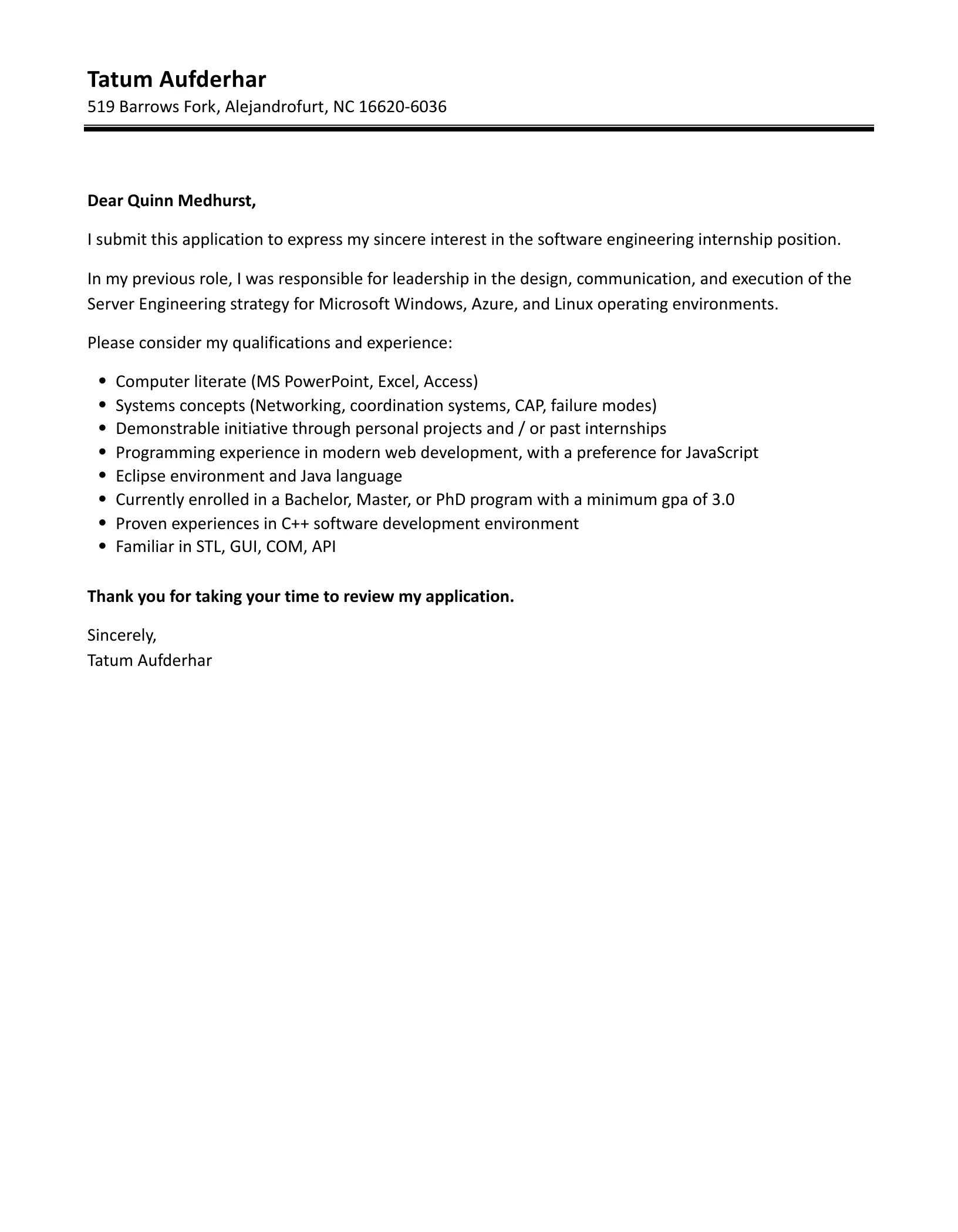
Why a Standout Software Engineering Internship Cover Letter Matters
In the competitive world of software engineering, securing an internship can be a challenging task. A well-crafted cover letter is your first chance to make a strong impression on potential employers. It serves as a crucial introduction, allowing you to showcase your passion, skills, and suitability for the role. A standout cover letter differentiates you from other applicants, demonstrating your genuine interest and making the hiring manager want to learn more. It isn’t just about listing qualifications; it’s about telling a compelling story of why you are the best fit for the internship and what you can bring to the team. By taking the time to create a personalized and engaging cover letter, you significantly increase your chances of landing an interview and ultimately securing the coveted software engineering internship.
Highlighting Your Software Engineering Skills
Your cover letter is the ideal platform to highlight the software engineering skills that make you a strong candidate. Recruiters seek individuals who possess both technical expertise and essential soft skills. The best cover letters will showcase a blend of both. When describing your skills, provide specific examples of how you have applied them in previous projects or coursework. This helps demonstrate your practical experience and ability to translate theoretical knowledge into tangible results. The key is to move beyond a simple list of skills and provide concrete examples that illustrate your proficiency, problem-solving abilities, and your capacity to contribute to a team. For an outstanding cover letter, keep the hiring manager in mind and relate your skills directly to the internship’s responsibilities.
Technical Skills to Showcase in Your Cover Letter

Technical skills are the backbone of any software engineering role. When writing your cover letter, emphasize your proficiency in relevant technical areas. Begin by highlighting the programming languages you know and their level of expertise. Mention any specific frameworks or libraries that you are familiar with, such as React, Angular, or Django, as these often indicate a deeper understanding of certain technologies. Include details about your experience with software development tools, such as IDEs (Integrated Development Environments), version control systems (Git), and debugging tools. If the internship description mentions specific technologies, ensure that you highlight your experience with those particular tools and technologies. Emphasizing your technical knowledge will prove you are prepared for the hands-on work involved in the software engineering internship.
Programming Languages Proficiency
Your command of programming languages is critical. List the languages you know (e.g., Python, Java, C++, JavaScript) and indicate your proficiency level for each (beginner, intermediate, advanced). Provide examples of projects where you have used each language. Quantify your achievements whenever possible, for instance, “Developed a Python script to automate data analysis, reducing processing time by 30%.” If you have experience with object-oriented programming (OOP) or functional programming, mention it, as it often is a significant advantage. Highlight any experience with the specific programming languages mentioned in the internship description, as this shows you meet the primary requirements. Include any experience with specialized languages, such as SQL for database management or Swift/Kotlin for mobile app development, as they may be relevant. The goal is to show that you have the skills to be productive quickly.
Software Development Tools and Technologies
Apart from programming languages, familiarity with various software development tools and technologies is essential. Describe your experience with IDEs like Visual Studio Code, Eclipse, or IntelliJ IDEA. Specify your proficiency with version control systems, especially Git, and detail any experience using platforms like GitHub or GitLab. Mention your experience with testing frameworks (e.g., JUnit, pytest) and debugging tools. If the internship requires knowledge of specific technologies, such as cloud platforms (AWS, Azure, Google Cloud), or containerization (Docker, Kubernetes), include this information. Note any experience you have with databases (SQL, NoSQL) and database management tools. Quantify your experience whenever possible, such as “Used Git to manage code repositories for over 50 projects.” Highlighting your experience with these tools demonstrates that you can work effectively in a software development environment.
Emphasizing Soft Skills for Software Engineering Internships

While technical skills are important, soft skills are equally crucial for a successful software engineering internship. These skills demonstrate your ability to work effectively within a team, communicate ideas clearly, and adapt to new challenges. When describing your soft skills, focus on examples that showcase your practical application. Discuss how you collaborated with team members on projects, how you overcame challenging situations, and how you took initiative to solve problems. Remember to tailor your language and use action verbs to show what you have done in a real-world scenario. Highlighting these skills in your cover letter helps you demonstrate your value and adaptability, making you an excellent candidate. By emphasizing both your technical and soft skills, you make it clear that you are well-rounded.
Communication and Teamwork Skills
Strong communication and teamwork skills are vital in software engineering. In your cover letter, provide instances where you effectively communicated with teammates or stakeholders. Detail how you collaborated on projects, highlighting your ability to share ideas, and listen to feedback. Mention any experience with Agile or Scrum methodologies. Use examples where you resolved conflicts or contributed to a positive team environment. Describe your experience presenting technical information to non-technical audiences. By illustrating these teamwork and communication capabilities, you show your potential to contribute positively to team projects and effectively convey your ideas.
Problem-Solving and Analytical Abilities
Software engineering often involves problem-solving and analytical thinking. In your cover letter, showcase your ability to analyze complex problems and develop effective solutions. Describe situations where you faced a technical challenge and explain how you approached it. Highlight your critical thinking skills and your capacity to devise innovative solutions. For instance, detail how you debugged a piece of code or optimized an algorithm for better performance. Mention any experience with data analysis or using analytical tools. By demonstrating your problem-solving skills, you show that you can think critically and overcome obstacles, which are essential attributes for a software engineering intern.
Structuring Your Software Engineering Internship Cover Letter

The structure of your cover letter is just as important as its content. A well-organized cover letter is easy to read and allows the hiring manager to quickly find the information they need. Start with a professional header, followed by a compelling opening paragraph, then several body paragraphs to detail your experience and qualifications. Finish with a strong closing paragraph and a call to action. Make sure the letter is well-formatted, with clear sections, and a consistent font, to enhance readability. A structured cover letter makes a positive impression and highlights your ability to communicate efficiently and effectively.
Header and Contact Information
Your header should include your name, contact information (phone number and email address), and the date. If possible, include the name of the hiring manager and the company’s address. Ensure your email address is professional and your contact information is up-to-date. A header is necessary, as it helps the hiring manager easily identify and contact you. Keeping this section clean and simple creates a professional image and makes it easy for the recruiter to follow up with you.
Opening Paragraph (Grab the Reader’s Attention)
Your opening paragraph is your chance to make a great first impression. Start by stating the position you are applying for and how you learned about it. Then, write a brief but compelling statement that shows your interest and enthusiasm for the role. Instead of a generic opening, try to highlight something specific about the company or the internship that excites you. Briefly mention your key qualifications and why you are a good fit. The opening paragraph needs to be concise and grab the reader’s attention immediately. A well-crafted opening will make the hiring manager want to read on and learn more about you.
Body Paragraphs (Showcase Your Achievements)

The body paragraphs should contain detailed examples that support your qualifications. Use these paragraphs to showcase your skills and experience. Start by mentioning relevant projects or coursework, highlighting the technologies you used and your contributions. Provide specific examples of your achievements. Whenever possible, quantify your results using metrics. For example, you might say, “Improved the efficiency of the database by 20% by optimizing SQL queries.” Each paragraph should focus on a particular skill or experience, making your cover letter easy to follow. Emphasize achievements and responsibilities, making it clear what you have accomplished.
Closing Paragraph and Call to Action
Your closing paragraph should reiterate your interest in the internship. Summarize your key qualifications, and reaffirm your enthusiasm for the role. Always include a call to action, such as requesting an interview or expressing your interest in discussing your application further. Thank the hiring manager for their time and consideration. Keep the closing paragraph concise and professional. A well-crafted closing paragraph leaves the reader with a positive impression and encourages them to take the next step in the hiring process.
Tailoring Your Cover Letter for Software Engineering Internships
Customization is crucial to a successful cover letter. Generic cover letters rarely impress hiring managers. Tailor your cover letter to each specific internship you apply for. Start by carefully reviewing the job description and identifying the key requirements and skills they are looking for. Customize your cover letter to emphasize those specific qualifications. Include examples of how your experiences and skills align with the requirements. Tailoring the cover letter demonstrates that you have taken the time to understand the role and the company’s needs. Customization will help you stand out from the crowd and show that you are genuinely interested in the opportunity.
Researching the Company and Internship

Before writing your cover letter, research the company and the specific internship. Visit the company’s website, explore their products or services, and learn about their culture. Understand the company’s mission, values, and recent projects. Research the specific internship responsibilities and requirements. This information will help you tailor your cover letter to highlight your skills and experiences that align with the company’s needs. By demonstrating that you know about the company, you show your enthusiasm and that you are serious about the opportunity.
Matching Your Skills to the Job Description
Carefully read the job description and identify the key requirements and skills the company is looking for. Highlight the skills and experiences in your cover letter that match the job description. When discussing your skills, provide specific examples of how you have applied them in previous projects or coursework. Use keywords from the job description to emphasize your qualifications. Tailoring your skills to meet the job requirements shows that you have taken the time to understand the role and that you possess the necessary abilities to succeed.
Using Action Verbs and Quantifiable Results
To make your cover letter more impactful, use strong action verbs to describe your accomplishments and responsibilities. Verbs like “developed,” “implemented,” “managed,” “collaborated,” and “optimized” help to portray your actions. Whenever possible, quantify your achievements by providing specific results. Instead of saying “Improved efficiency,” try “Improved efficiency by 15% by implementing a new algorithm.” Quantifying your achievements with metrics shows the impact of your work. Using action verbs and quantifiable results will make your cover letter more persuasive and demonstrate your value to the employer.
Proofreading and Formatting Your Cover Letter

Proofreading and formatting are essential steps for a professional cover letter. A well-formatted and error-free cover letter shows attention to detail. Proofread your letter carefully to ensure there are no typos or grammatical errors. Check for consistency in your formatting. Use a clear and easy-to-read font. Make sure that there is a consistent use of headings, spacing, and bullet points. Ask someone to review your cover letter for you, as a fresh set of eyes can often catch errors that you might have missed. A well-proofread and formatted cover letter will help to make a positive impression on the hiring manager and boost your chances of getting an interview.
Common Mistakes to Avoid in Your Cover Letter
There are several common mistakes that can weaken a cover letter. Understanding these mistakes will help you avoid them and create a more effective application. Some of the most frequent errors include a lack of customization, using generic language, and having typos or grammatical errors. Addressing these mistakes will help you make a better impression and increase your chances of landing an interview for a software engineering internship. Always proofread your cover letter to avoid making these easy-to-fix mistakes.
Lack of Customization
One of the biggest mistakes is not customizing your cover letter for each application. Sending a generic cover letter to multiple companies is a sure way to be overlooked. Tailor each cover letter to the specific company and internship. Highlight your experiences and skills that align with the role’s requirements. Show that you have done your research. A customized cover letter demonstrates that you are genuinely interested in the opportunity and that you have taken the time to understand the company’s needs. Always make sure your cover letter isn’t a template.
Generic Language
Using generic language is another common mistake that can weaken your cover letter. Avoid using cliché phrases and general statements that don’t provide any specific information. Instead, use specific examples to showcase your skills and experiences. Instead of saying “I am a team player,” describe how you collaborated on a team project and the results of that collaboration. Replace vague descriptions with concrete details and quantifiable results. Specific language will make your cover letter more engaging and show your unique value.
Typos and Grammatical Errors
Typos and grammatical errors can make a bad impression. These errors show that you do not pay attention to detail. Always proofread your cover letter carefully, and consider having someone else review it for you. Use grammar and spell-checking tools, but don’t rely on them entirely. Read your cover letter aloud to catch any awkward phrasing or errors. A well-proofread cover letter demonstrates professionalism and enhances your credibility. Double-check everything before submitting your application.
The Importance of a Strong Portfolio or Projects
Including a portfolio or describing your projects is extremely important. It provides concrete evidence of your abilities. A strong portfolio shows potential employers that you can apply your technical skills to real-world situations. This is often one of the most crucial aspects for landing a software engineering internship. Projects demonstrate your capabilities more effectively than just listing your skills. A portfolio makes it easier for the hiring manager to see your work and understand your technical expertise.
Including Links to Your Portfolio
If you have an online portfolio, include a link to it in your cover letter. Your portfolio should showcase your best projects, demonstrating your technical skills and coding abilities. A portfolio link offers a direct way for the hiring manager to view your work. If you do not have a portfolio, consider creating one to showcase your projects. Sites like GitHub and GitLab are excellent for hosting your code. Include links to your profile to make it simple for the hiring manager to access your projects. Providing direct access to your work boosts your chances of getting noticed.
Describing Relevant Projects
Even if you do not have an online portfolio, you should still describe your relevant projects in your cover letter. Mention your projects in detail. Explain the purpose of the project, the technologies you used, and your contributions. Provide specific examples of what you accomplished. Highlight any challenges you faced and how you overcame them. Quantify your results when possible. Include the link to the project on GitHub and GitLab. By detailing your projects, you give the hiring manager a clear understanding of your technical capabilities and your ability to apply your skills.
Final Tips for a Winning Cover Letter
In summary, a well-crafted cover letter is essential for securing a software engineering internship. Focus on highlighting your skills, tailoring your cover letter, and showcasing your projects or portfolio. Proofread carefully, and make sure the cover letter is well-formatted and easy to read. Following these tips will increase your chances of landing an interview and ultimately getting your dream internship. Remember that your cover letter is your introduction. Therefore, make it count. By investing time and effort into crafting a great cover letter, you make a strong first impression and increase your chances of success.