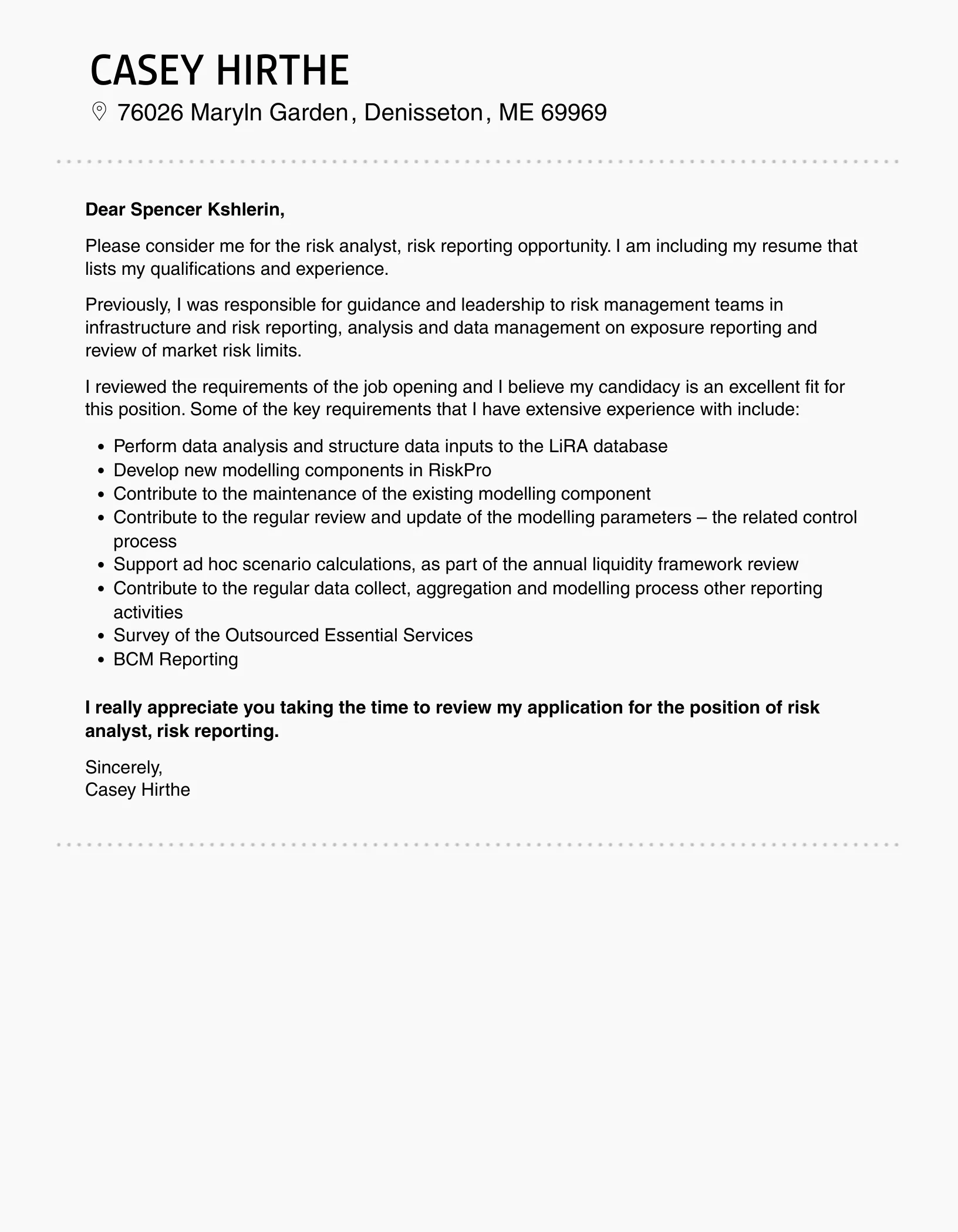
Crafting a Compelling Risk Analyst Cover Letter
A well-crafted cover letter is your first opportunity to make a strong impression on a potential employer. For a Risk Analyst role, this document is especially important. It’s where you translate your skills, experience, and personality into a compelling narrative that showcases why you are the perfect candidate for the job. It’s not just about listing your qualifications; it’s about demonstrating your understanding of risk management, your analytical capabilities, and your ability to contribute to the company’s success. The cover letter serves as a personal introduction, providing context to your resume and highlighting the value you bring to the table. Therefore, taking the time to create a standout cover letter is crucial.
Researching the Company and Role
Before you begin writing your cover letter, thorough research is essential. Start by researching the company you’re applying to. Understand their industry, their core values, and their recent achievements. Visit their website, read their press releases, and explore their social media presence. This will help you tailor your cover letter to their specific needs and demonstrate your genuine interest in the organization. Next, analyze the job description carefully. Identify the key requirements, skills, and responsibilities. Note the specific keywords and phrases used in the job posting. This information will be invaluable as you craft your cover letter and showcase your ability to meet the company’s needs. Demonstrating that you’ve done your homework shows initiative and a sincere interest in the position.
Understanding the Hiring Manager’s Needs

Put yourself in the hiring manager’s shoes. What are they looking for in a Risk Analyst? What are their priorities? What challenges are they likely facing? By understanding their needs, you can frame your cover letter to address those concerns directly. Consider the company’s strategic goals and how the Risk Analyst role contributes to achieving them. Highlight how your skills and experience align with the hiring manager’s expectations. For instance, if the company emphasizes data-driven decision-making, showcase your experience with statistical analysis and risk modeling. If the company has a strong emphasis on compliance, emphasize your knowledge of relevant regulations and your experience in ensuring adherence. This approach makes your cover letter more impactful and demonstrates your ability to add value to the team from day one.
Highlighting Relevant Skills and Experience
Your cover letter is the perfect place to highlight the skills and experience that make you a strong candidate for the Risk Analyst role. Start by identifying the key skills mentioned in the job description, such as risk assessment, data analysis, regulatory compliance, and communication. Then, provide specific examples from your past experiences that demonstrate your proficiency in those areas. For example, if the job requires experience in financial modeling, describe a project where you developed and used financial models to assess risk. If the role requires strong communication skills, describe instances where you effectively communicated complex risk information to stakeholders. Tailor your descriptions to show a clear match with the job’s requirements, highlighting not just what you’ve done, but how well you’ve done it and the positive outcomes you achieved.
Quantifying Achievements for Impact
Whenever possible, quantify your achievements. Instead of simply stating that you ‘improved risk management processes’, provide concrete data. For example, you could write, ‘Streamlined the risk assessment process, resulting in a 15% reduction in processing time.’ Or, ‘Developed a new risk mitigation strategy that reduced potential financial losses by 10%.’ Use numbers, percentages, and specific metrics to showcase the impact of your work. This adds credibility to your claims and provides tangible evidence of your abilities. Quantifiable achievements make your cover letter more persuasive and demonstrate your ability to deliver results. When reviewing resumes and cover letters, hiring managers are often more impressed by facts and figures that prove performance.
Focus on Analytical and Problem-Solving Skills

Risk Analysts must possess strong analytical and problem-solving skills. In your cover letter, demonstrate these abilities by providing examples of how you have analyzed data, identified potential risks, and developed solutions. Describe situations where you used your analytical skills to uncover hidden patterns or trends. Detail how you approached complex problems and what steps you took to find effective solutions. Use phrases like ‘analyzed data to identify’, ‘developed solutions to mitigate’, or ‘problem-solved by implementing’. Show your ability to think critically, make informed decisions, and develop innovative strategies. Remember that the role requires not only identifying risks but also finding ways to manage them effectively, so it’s important to emphasize both your analytical and problem-solving capabilities.
Showcasing Experience in Risk Management
Clearly articulate your experience in risk management. Explain the types of risks you have managed, whether financial, operational, or strategic. Provide specific examples of risk assessment, risk mitigation, and risk monitoring activities you have performed. Mention any relevant industry experience, such as experience in the financial services, healthcare, or technology sectors. Highlight your familiarity with risk management frameworks and methodologies, such as COSO or ISO 31000. If you have experience in specific areas of risk management like credit risk, market risk, or operational risk, make sure to explicitly state this. Show that you have a deep understanding of the risk landscape, and that you can apply this knowledge to protect the company from potential threats.
Demonstrating Knowledge of Risk Assessment Methodologies
Detail your knowledge and experience with various risk assessment methodologies. This could include techniques such as Failure Mode and Effects Analysis (FMEA), hazard analysis, or Monte Carlo simulations. If you have experience using risk management software or tools, be sure to list them. Examples might include specialized risk analysis programs, statistical modeling software, or data visualization tools. Explain how you have used these methodologies to identify, assess, and prioritize risks. Highlight your ability to analyze data, identify patterns, and develop risk mitigation strategies. Demonstrate your understanding of the importance of risk assessment in decision-making and your ability to provide valuable insights to management. Showing that you are knowledgeable about assessment methodologies sets you apart.
Emphasizing Communication and Collaboration Skills

Risk Analysts need excellent communication and collaboration skills. In your cover letter, emphasize your ability to communicate complex information clearly and concisely, both verbally and in writing. Provide examples of how you have communicated risk information to various stakeholders, including senior management, colleagues, and external auditors. Describe instances where you have collaborated with cross-functional teams to develop and implement risk management strategies. Highlight your ability to build relationships, work effectively in a team environment, and influence others. You should show your strong communication skills; and also the ability to explain your analysis and findings so others can understand them and take action. You are responsible for sharing your findings with others in the company.
Tailoring the Cover Letter to the Job Description
The most effective cover letters are tailored to the specific job description. Carefully review the requirements, skills, and keywords listed in the job posting, and ensure that your cover letter addresses them directly. Use the same language and terminology as the job description whenever appropriate. Provide specific examples of how your skills and experience align with the job’s requirements. Customize your cover letter for each position you apply for. Avoid using a generic template. This demonstrates your attention to detail and your genuine interest in the specific role. Personalizing your cover letter to the needs of the specific employer is the best way to ensure your application stands out from the crowd.
Structuring Your Cover Letter for Success
A well-structured cover letter is easy to read and makes a strong impact. Start with a professional header, including your contact information and the date. Address the hiring manager by name if possible; otherwise, use a professional greeting, such as ‘Dear Hiring Manager’. The body of your cover letter should be concise and to the point, typically spanning three or four paragraphs. Use a clear and concise writing style, and avoid jargon. Use bullet points to highlight key skills and accomplishments. Close with a strong call to action, such as requesting an interview. Your formatting should be clean and professional, with standard margins and a readable font, such as Times New Roman or Arial. The letter is your professional introduction so make sure to format it properly.
Writing a Strong Opening to Capture Attention

The opening paragraph is your chance to make a strong first impression. Instead of using a generic opening, such as ‘I am writing to express my interest…’, try something more engaging. Highlight a key skill or accomplishment that aligns with the job’s requirements. Show your enthusiasm for the role and the company. Consider mentioning something specific that attracted you to the opportunity. Your opening should grab the reader’s attention and make them want to learn more about you. Make it clear that you understand the company’s needs and you are prepared to meet them. This initial impression will set the tone for the rest of your cover letter and encourage the hiring manager to continue reading.
Presenting Your Value Proposition
In your cover letter, clearly articulate your value proposition. What unique skills, experiences, or qualities do you bring to the table? How can you contribute to the company’s success? Focus on what you can offer the employer, rather than simply listing your qualifications. For example, if the company is expanding into a new market, highlight your experience in assessing and mitigating risks in that area. Show the hiring manager that you are not just another applicant, but a valuable asset that can help the company achieve its goals. Convince them that you are the best candidate by clearly stating the value you will bring to the role.
Using Action Verbs to Describe Accomplishments
Use strong action verbs to describe your accomplishments. Instead of saying ‘responsible for’, use verbs such as ‘managed’, ‘developed’, ‘implemented’, ‘analyzed’, ‘improved’, or ’led’. Action verbs add energy and impact to your writing, and make it clear what you have accomplished. Quantify your achievements whenever possible. For instance, instead of saying ‘improved efficiency’, say ‘improved efficiency by 10%’. Using action verbs and quantifiable results will make your accomplishments more convincing and show that you are results-oriented. Make sure to vary your verbs to avoid repetition. This will show how effective you are and the impact your efforts had.
Closing with Confidence and a Call to Action

Close your cover letter with confidence and a clear call to action. Thank the hiring manager for their time and consideration. Reiterate your interest in the role and the company. Express your enthusiasm for the opportunity and your belief that you are a good fit. End by stating that you are eager to discuss your qualifications in further detail and that you are available for an interview. You could also mention your availability for a phone call or a meeting at their earliest convenience. Ensure you have proofread your letter carefully before sending it, and that your contact information is up-to-date. Closing with a strong call to action ensures you’re making a strong final statement that supports your case.