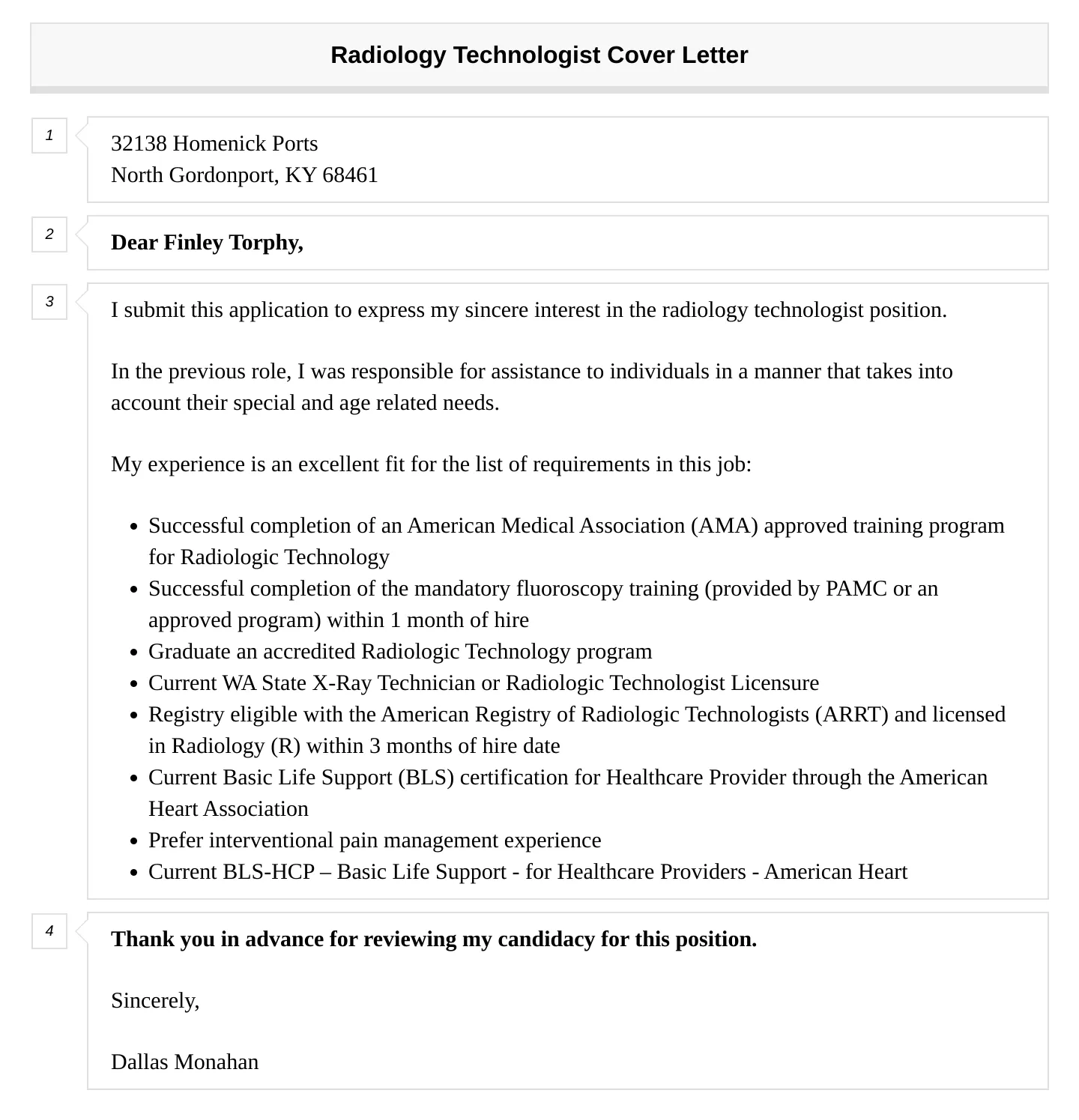
Why You Need a Radiology Technologist Cover Letter
A Radiology Technologist cover letter is your first opportunity to make a strong impression on a potential employer. It’s more than just a formality; it’s a critical tool that can significantly boost your chances of landing an interview. The cover letter allows you to expand on your resume, providing context to your skills, experience, and qualifications. It demonstrates your communication skills, your personality, and your genuine interest in the specific role and the organization. Think of it as your personal introduction, where you can showcase your enthusiasm and explain why you are the ideal candidate. Without a well-crafted cover letter, you might miss out on opportunities to highlight your unique selling points and leave the hiring manager with a less complete picture of your suitability for the position.
What to Include in Your Radiology Technologist Cover Letter
A comprehensive Radiology Technologist cover letter should include several key elements. These components work together to present a cohesive and compelling case for your candidacy. Each section serves a distinct purpose, contributing to the overall effectiveness of your application. By thoughtfully crafting each section, you can ensure that your cover letter resonates with the hiring manager and effectively communicates your value proposition.
Contact Information

Begin your cover letter with your contact information. Include your full name, phone number, email address, and LinkedIn profile URL (if applicable). This information should be prominently displayed at the top of the letter, making it easy for the hiring manager to reach you. Ensure your email address is professional and up-to-date. Double-check all details for accuracy to avoid any communication issues. This section sets the stage for the rest of your letter, ensuring the recipient knows how to connect with you if they are interested in your application.
Professional Summary
Your professional summary is a concise overview of your key qualifications and career goals. It should immediately capture the reader’s attention and summarize your most relevant skills and experiences. Aim to provide a brief yet compelling snapshot of your professional background. Highlight your years of experience, specific areas of expertise (e.g., X-ray, CT scans, MRI), and any notable achievements. Tailor this section to align with the job description, ensuring you emphasize the skills and experiences that are most relevant to the position. A well-written summary sets the tone for the rest of your letter and convinces the reader to learn more about you.
Highlighting Your Skills and Experience
This section is where you delve deeper into your specific skills and experiences, providing concrete examples of your capabilities. Mention your proficiency in performing various radiology procedures, such as X-rays, CT scans, MRIs, and fluoroscopy. Highlight your knowledge of patient positioning, radiation safety protocols, and equipment operation. Include any experience with specialized imaging techniques or patient populations. Quantify your achievements whenever possible, such as the number of patients you’ve assisted or improvements you’ve made in workflow efficiency. Use action verbs to describe your responsibilities and accomplishments. This section showcases your ability to perform the job’s core tasks and demonstrates your value to the employer.
Quantifiable Achievements

Showcase your achievements with quantifiable data. Instead of simply stating that you improved patient satisfaction, provide specific numbers, such as ‘Increased patient satisfaction scores by 15% through improved communication and reduced wait times.’ If you have reduced exam times or minimized radiation exposure, include these details. Quantifiable achievements provide concrete evidence of your abilities and demonstrate the impact you’ve made in previous roles. These metrics provide tangible proof of your capabilities and make your application more compelling. This data-driven approach helps you stand out from other applicants by showing the real-world results you’ve achieved.
Showcasing Your Certification and Education
Clearly state your certifications and educational background. Include your ARRT (American Registry of Radiologic Technologists) certification, any state licenses, and the name of the institution from which you graduated. Mention any relevant coursework or specializations. Highlight any continuing education or training you’ve completed to stay current with industry standards and technology. This demonstrates that you meet the required qualifications for the position and are committed to your professional development. By presenting your credentials clearly, you assure the employer of your compliance with industry standards and your dedication to lifelong learning.
Expressing Your Enthusiasm
Conclude your cover letter by expressing your enthusiasm for the position and the organization. Explain why you are interested in this specific role and what attracts you to the company. Demonstrate your understanding of their mission and values. Mention how your skills and experience align with the company’s needs. Indicate your eagerness to contribute to the team and make a positive impact. This section shows that you are genuinely interested in the opportunity and are not simply sending out a generic application. By expressing your passion, you create a memorable connection with the hiring manager.
Formatting Your Radiology Technologist Cover Letter

Proper formatting enhances the readability and professionalism of your cover letter. A well-formatted cover letter is easy to read and visually appealing, making a positive impression on the hiring manager. Formatting is essential for guiding the reader’s eye and ensuring that the critical information stands out. Formatting is not just about aesthetics; it is about presenting your qualifications effectively and professionally.
Choosing the Right Font and Font Size
Choose a professional and legible font, such as Times New Roman, Arial, or Calibri. Keep the font size between 10 and 12 points for easy readability. Ensure the font is consistent throughout the document. Avoid overly decorative or unusual fonts that can distract from the content. Professional fonts are designed to make the text easy to read and are widely accepted in business communications. A consistent font and appropriate font size help create a polished and professional look, which improves the overall impression your cover letter makes.
Proper Letter Spacing and Margins
Use single or 1.15 line spacing to provide ample space between lines of text. Set margins to 1 inch on all sides. This creates a balanced and uncluttered appearance. Proper spacing and margins make your cover letter easy to read and visually appealing. Ensure that the text is not too dense or too sparse. Adequate spacing and margins help to create a professional and organized layout. Properly formatted spacing and margins contribute to a positive first impression, showing that you pay attention to detail.
Proofreading and Editing

Proofread your cover letter carefully for any typos, grammatical errors, or spelling mistakes. Use a grammar checker and ask a friend or colleague to review your letter. Ensure that your letter is clear, concise, and error-free. Errors can undermine your credibility and leave a negative impression. Thorough proofreading demonstrates your attention to detail and your commitment to quality. Proofreading and editing are essential steps to ensure your cover letter is polished and professional.
Cover Letter Template and Examples
Utilize cover letter templates as a starting point. There are many online resources and templates specifically designed for Radiology Technologists. You can modify these templates to reflect your skills and experiences. Adapt templates to fit your specific background and the job requirements. Use cover letter examples for inspiration, but customize each letter to avoid a generic feel. A well-adapted template, combined with personalized content, will help you create a compelling and effective cover letter. Remember to always tailor the template to the specific job and your unique qualifications.
Tailoring Your Cover Letter
Customize your cover letter for each job application. Review the job description carefully and highlight the skills and experiences that match the employer’s requirements. Demonstrate that you understand the specific needs of the role and the organization. Tailoring your cover letter shows your genuine interest in the position and increases your chances of getting an interview. Generic letters are often overlooked; personalized letters demonstrate your attention to detail and your commitment to the opportunity. Make sure your letter addresses the specific needs and requirements outlined in the job description.
Keywords to Include in your Cover Letter

Incorporate relevant keywords from the job description throughout your cover letter. Keywords help your application get noticed by applicant tracking systems (ATS) and demonstrate that you possess the required skills. Examples include specific imaging techniques (X-ray, CT, MRI), radiation safety, patient care, and equipment operation. Naturally integrate these keywords into your sentences without making them feel forced. Including keywords improves the visibility of your application. Keyword optimization increases the likelihood that your cover letter will be reviewed by a human recruiter.
Reviewing Cover Letter Examples
Study cover letter examples for Radiology Technologists. Analyze how successful candidates highlight their skills, experience, and achievements. Pay attention to the tone, structure, and language used in these examples. Use the examples as a guide, but don’t copy them verbatim. Instead, adapt the best practices to your unique background and the specific job requirements. Learning from successful cover letters can significantly improve your own. Examine several examples to understand the different approaches and styles that can be effective.
Common Mistakes to Avoid in Your Cover Letter
Avoiding common mistakes is crucial for making a positive impression. Several errors can undermine your application and decrease your chances of getting an interview. It is essential to be aware of these pitfalls and ensure they do not appear in your cover letter. Avoiding these mistakes helps you present yourself in the best possible light. Addressing common errors can dramatically improve the quality of your cover letter and set you apart from other candidates.
Generic Cover Letters

Do not send a generic cover letter. Tailor each letter to the specific job and the organization. Hiring managers can easily identify generic letters, which indicate a lack of interest. Personalize your letter by mentioning the company’s name, the specific role, and why you are interested in that particular opportunity. Demonstrate that you’ve researched the company and understand their needs. Generic letters are often discarded because they show a lack of effort. Personalizing your cover letter demonstrates your genuine interest and attention to detail.
Typos and Grammatical Errors
Avoid typos and grammatical errors. Proofread your cover letter meticulously. Use a grammar checker and ask someone else to review your letter. Errors can damage your credibility and make you appear unprofessional. A clean, error-free cover letter demonstrates your attention to detail and your commitment to quality. Typos and grammatical errors are easily avoided with careful proofreading. Ensure your writing is clear, concise, and correct. These errors often make a negative first impression and can easily disqualify you from consideration.
Ignoring the Job Description
Do not ignore the job description. Customize your cover letter to address the specific requirements and keywords mentioned in the job posting. Highlight your skills and experiences that directly match the employer’s needs. Failure to address the job description shows a lack of attention to detail and can result in your application being overlooked. By tailoring your cover letter to the job description, you demonstrate your understanding of the role and your ability to meet the employer’s expectations. Align your cover letter with the specific requirements listed in the job posting. This makes your qualifications more relevant and showcases your ability to meet the employer’s expectations.
Frequently Asked Questions about Radiology Technologist Cover Letters
Understanding the frequently asked questions about Radiology Technologist cover letters can help you write an effective application. Addressing these common questions can also help you prepare for potential interview questions. Answering these questions helps you present a more complete picture of your qualifications and ensures you are prepared for the job application process.
How long should my cover letter be
Keep your cover letter concise, ideally one page. Aim for a length of 250-400 words. Focus on the most important information and avoid unnecessary details. Make every word count to ensure the reader’s attention. A concise cover letter is easier to read and digest. Prioritize the most relevant information to make the most significant impact. A well-written, brief cover letter demonstrates your ability to communicate effectively and efficiently.
What skills should I highlight
Highlight skills mentioned in the job description, such as proficiency in X-ray, CT scans, MRI, and patient care. Mention radiation safety, equipment operation, and any specialized techniques you’re familiar with. Emphasize any certifications and education that are relevant to the role. Prioritize the skills that directly align with the employer’s needs. Including the right skills can increase your chances of getting noticed. Demonstrate your ability to perform the core tasks of the job by highlighting relevant skills.
How do I address the cover letter
If you know the hiring manager’s name, address the letter to them. If not, use a general greeting like ‘Dear Hiring Manager’ or ‘Dear [Department Name] Team’. Avoid generic greetings that lack personal touch. Research the company to find the hiring manager’s name to show you are dedicated. A personalized greeting makes a more positive first impression, while a generic greeting is less effective. Make sure to use the proper salutation to show you are attentive to detail.
Final Thoughts
Writing a compelling Radiology Technologist cover letter is a crucial step in the job application process. By including the essential elements, formatting your letter properly, and avoiding common mistakes, you can significantly increase your chances of landing an interview. Remember to tailor your cover letter to each job, highlighting your skills and experiences in a way that resonates with the employer. A well-crafted cover letter helps you stand out and showcase your value. Take the time to prepare a polished and professional cover letter and it will make a positive impact on your job search. Use all the tips and techniques discussed to craft a cover letter that effectively represents your qualifications and abilities.