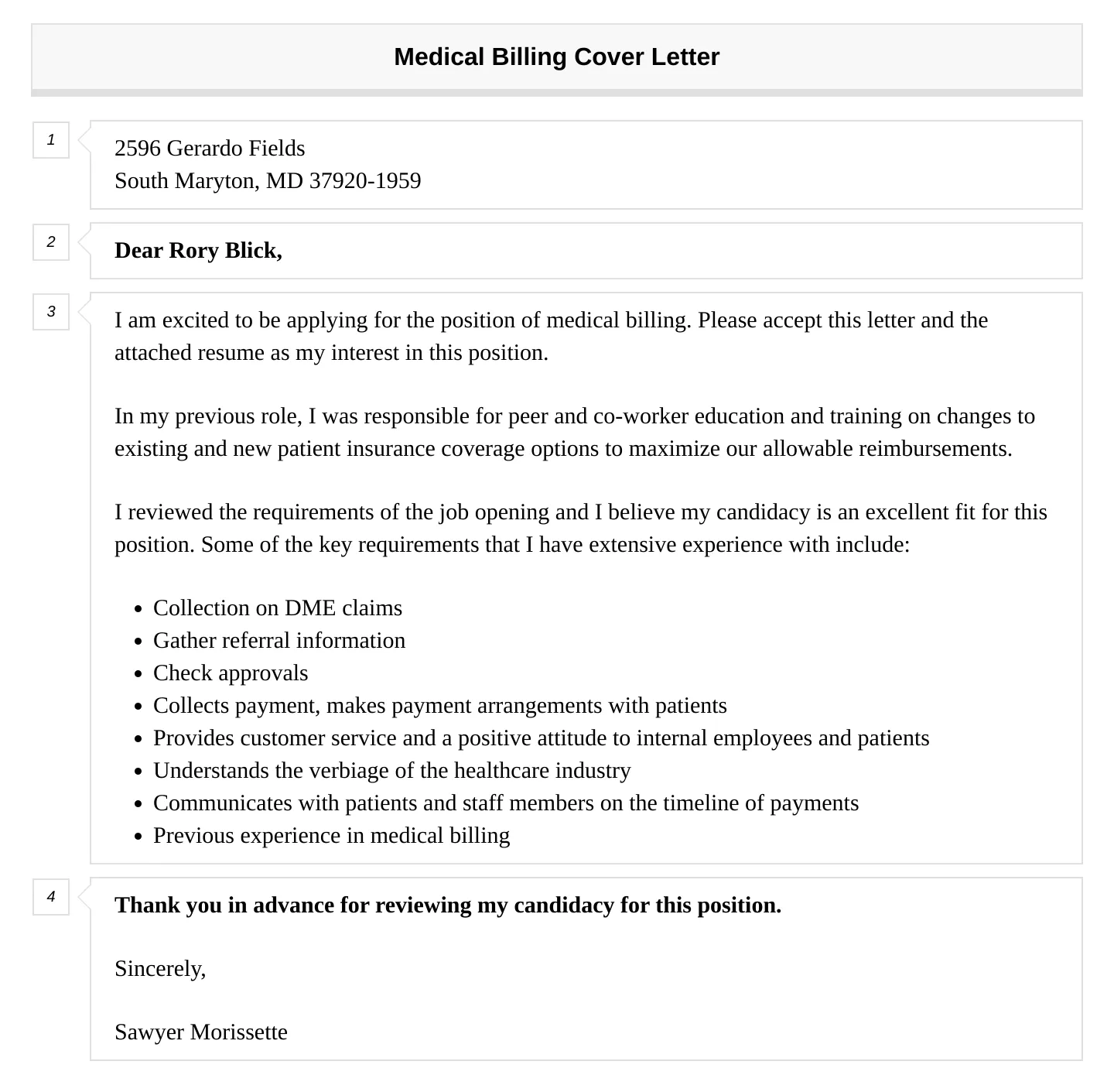
Crafting a Compelling Medical Billing Cover Letter
A well-crafted medical billing cover letter is your first impression on a potential employer. It’s an opportunity to showcase your skills, experience, and enthusiasm for the role. Unlike a resume, a cover letter allows you to tell your story, explaining why you’re the perfect fit for the position and how your unique qualifications align with the company’s needs. It should be more than just a summary of your resume; it should be a persuasive document that compels the hiring manager to want to learn more about you. The tone of your cover letter is crucial; it should be professional, enthusiastic, and tailored to the specific job description. The goal is to highlight your relevant experience and skills in a way that resonates with the employer and demonstrates your value.
Highlighting Relevant Skills for Medical Billing
Medical billing requires a specific skillset, and highlighting these skills is critical in your cover letter. Start by reviewing the job description and identifying the key skills the employer is seeking. Common skills include proficiency in medical billing software (e.g., Epic, Cerner, Meditech), understanding of medical coding (ICD-10, CPT, HCPCS), knowledge of insurance regulations and claim submission processes, strong attention to detail, and excellent communication skills. When describing your skills, don’t just list them; provide specific examples of how you’ve utilized these skills in previous roles. For instance, instead of saying “Proficient in medical coding,” you might say, “Utilized ICD-10, CPT, and HCPCS codes to accurately bill and process over 500 claims per month, resulting in a 98% claim acceptance rate.”
Medical Billing Experience and Achievements

Your cover letter should clearly outline your relevant experience in medical billing. Focus on your past roles and responsibilities, emphasizing the tasks and duties that align with the job requirements. Provide specific examples of your achievements, such as successfully managing a high volume of claims, reducing claim denials, or improving the revenue cycle. Quantifying your accomplishments is essential; use numbers and data to demonstrate your impact. For example, if you improved claim processing efficiency, state the percentage increase. If you reduced denial rates, specify the percentage decrease. These quantifiable achievements not only demonstrate your competence but also provide concrete evidence of your ability to deliver results. Use action verbs to describe your accomplishments and focus on the positive outcomes of your work.
Formatting Your Cover Letter for Medical Billing
The format of your cover letter is just as important as its content. It should be well-organized, easy to read, and visually appealing. Use a professional font like Times New Roman, Arial, or Calibri with a font size of 10-12 points. Ensure your cover letter is properly structured with clear sections, including your contact information, the date, the hiring manager’s name (if known), a compelling opening, a body that highlights your skills and experience, and a strong closing. Use clear headings and subheadings to break up large blocks of text and make it easier for the reader to scan. Maintain consistent formatting throughout the document, including margins, line spacing, and bullet points. A well-formatted cover letter demonstrates attention to detail and professionalism, essential qualities in medical billing.
Essential Sections of a Medical Billing Cover Letter
Every medical billing cover letter should include the following essential sections: Contact Information and Opening. This section includes your name, address, phone number, email address, and the date, followed by the hiring manager’s name, title, and the company’s address. A compelling opening should immediately grab the reader’s attention, stating your interest in the position and briefly highlighting your relevant skills and experience. Body Paragraphs: The body of your cover letter should expand on your skills, experience, and achievements, providing specific examples to support your claims. Closing Paragraph: The closing paragraph should reiterate your interest in the position, thank the reader for their time and consideration, and include a strong call to action, such as requesting an interview. Don’t forget to proofread your letter for any grammatical errors or typos, as these can reflect poorly on your professionalism.
Contact Information and Opening

Your contact information should be at the top of the cover letter, making it easy for the employer to reach you. Include your full name, address, phone number, and professional email address. Following this, include the date and the hiring manager’s name and title, along with the company’s address. The opening paragraph is crucial. It should clearly state the position you’re applying for and how you learned about the opportunity. Immediately capture the reader’s interest by highlighting one or two key skills or experiences that align with the job requirements. For example, you might start by stating your extensive experience with a specific medical billing software or your proven track record in reducing claim denials. The goal is to make a strong first impression and encourage the hiring manager to continue reading.
Highlighting Key Skills
When highlighting your key skills, align them with the requirements listed in the job description. Use action verbs to describe your abilities and provide specific examples of how you’ve used those skills in the past. For example, instead of simply stating “Proficient in claims processing,” you might say, “Successfully processed over 1,000 claims per month, ensuring accuracy and timely submission.” Show, don’t just tell. Back up your claims with quantifiable results whenever possible. If you have experience with specific medical billing software, coding systems (ICD-10, CPT, HCPCS), or insurance portals, be sure to mention them. Tailor your skills to match the employer’s needs, making it clear that you have the skills and experience to excel in the role. Show them how your skillset is a perfect match for their requirements.
Quantifying Achievements
Quantifying your achievements is one of the most effective ways to demonstrate your value to a potential employer. Whenever possible, use numbers and data to illustrate the impact of your work. For instance, instead of saying you “improved claim processing efficiency,” state that you “increased claim processing efficiency by 15% within six months.” If you reduced denial rates, specify the percentage decrease. If you successfully managed a high volume of claims, provide the exact number or range. These figures provide concrete evidence of your abilities and show that you’re capable of delivering measurable results. Using numbers also makes your accomplishments more credible and memorable. Consider using bullet points to list your achievements and make the information easy to digest. Be specific and provide context for each achievement to make it more impactful.
Closing with a Strong Call to Action

The closing paragraph of your cover letter should reiterate your interest in the position and leave a lasting positive impression. Thank the hiring manager for their time and consideration, and express your enthusiasm for the opportunity. Include a strong call to action, such as requesting an interview. State that you are eager to discuss your qualifications further and are available at their earliest convenience. Providing your availability shows that you’re proactive and ready to move forward in the hiring process. You can also mention that you have attached your resume for their review and look forward to hearing from them soon. A well-written closing paragraph reinforces your professionalism and increases your chances of getting an interview.
Tailoring Your Cover Letter to the Job Description
Tailoring your cover letter to each job description is essential to demonstrate that you understand the specific requirements of the role and have the qualifications the employer is seeking. Carefully review the job posting and identify the key skills, experiences, and qualifications the employer is looking for. Customize your cover letter to highlight those specific elements. Use the same keywords and phrases from the job description to show that you understand the position and are a good fit. Make sure to emphasize how your skills and experience align with the employer’s needs. Avoid sending a generic cover letter. Instead, take the time to research the company and the role. Tailoring your cover letter shows that you are genuinely interested in the position and have taken the time to understand the company’s requirements, significantly increasing your chances of getting hired.
Researching the Company and Addressing the Hiring Manager
Before writing your cover letter, research the company to understand its mission, values, and culture. Demonstrating this knowledge shows your genuine interest in the company. If possible, address your cover letter to the hiring manager by name. This personal touch makes your cover letter more engaging and shows that you’ve taken the time to learn about the company and the role. If you can’t find the hiring manager’s name, use a professional greeting like “Dear Hiring Manager.” In the body of your cover letter, mention the company’s name and show that you understand its business and goals. Explain why you are interested in working for that specific company and how your skills and experience align with its values. This shows that you have a specific interest in the company, making you stand out from other applicants. Research the company’s website, social media profiles, and recent news to gather information.
Common Mistakes to Avoid in Your Cover Letter

Several common mistakes can hurt your chances of getting hired. Avoid generic cover letters; tailor each letter to the specific job description. Do not include typos or grammatical errors; always proofread your letter carefully. Avoid using overly long paragraphs; keep your writing concise and to the point. Do not include irrelevant information that doesn’t relate to the job requirements. Avoid using jargon or acronyms that the hiring manager may not understand. Don’t be overly enthusiastic or boastful; maintain a professional tone. Do not send the same cover letter for every job; customize each one to the specific position. Finally, avoid simply restating your resume. Use your cover letter to expand on your skills and accomplishments, providing context and demonstrating your unique value. A polished and well-written cover letter can significantly improve your chances.
Proofreading and Editing Your Cover Letter
Proofreading and editing your cover letter is crucial to ensure that it’s free of errors and presents you in the best possible light. Before submitting your cover letter, carefully review it for any typos, grammatical errors, or formatting issues. Read it aloud to catch any awkward phrasing or sentence structures. Consider asking a friend, family member, or career advisor to review your cover letter for feedback. They can provide a fresh perspective and identify any areas that need improvement. Pay close attention to the details, such as the spelling of the hiring manager’s name, the company’s name, and any dates or numbers. Ensure that your contact information is accurate and up-to-date. A well-proofread cover letter demonstrates attention to detail and professionalism. Ensure a perfect presentation to make a positive impression.
Ensuring Accuracy and Professionalism
Accuracy and professionalism are paramount in a medical billing cover letter. Ensure that all the information you provide is accurate and truthful. Avoid exaggerating your skills or experience, as this can damage your credibility. Maintain a professional tone throughout the letter. Use formal language and avoid slang or casual expressions. Be respectful in your tone and show a genuine interest in the position. Proofread your cover letter carefully to catch any errors. A well-written, accurate, and professional cover letter can significantly increase your chances of getting hired in the medical billing field. Demonstrate your competence and your suitability for the job. Accuracy is key to making a positive first impression on the employer.