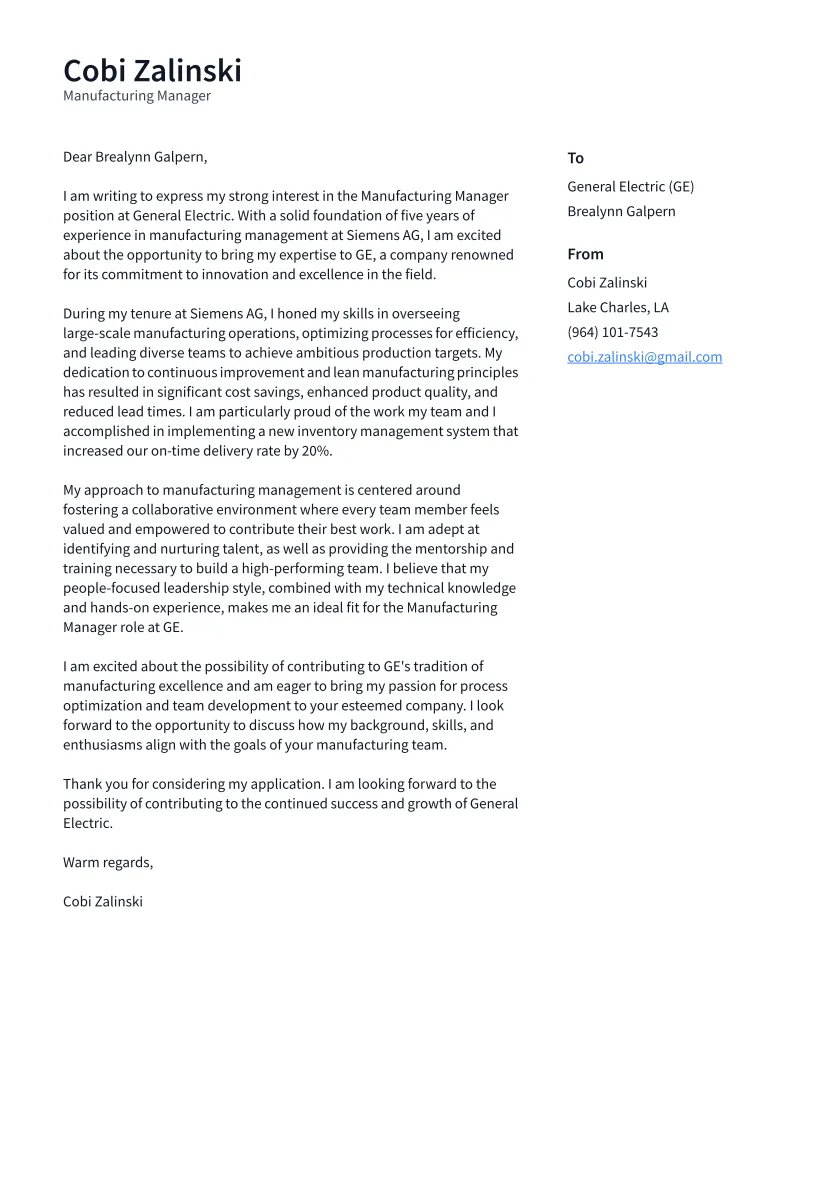
Understanding the Importance of a Manufacturing Cover Letter
In the competitive landscape of the manufacturing industry, a well-crafted cover letter is more than just an optional extra; it’s your first opportunity to make a strong impression. It provides a platform to articulate your unique value proposition and demonstrate your understanding of the specific requirements of the role and the company. A cover letter allows you to move beyond the bullet points of your resume and tell a compelling story, showcasing your passion, motivation, and suitability for the position. In essence, a cover letter serves as your personalized sales pitch, designed to persuade the hiring manager that you are the ideal candidate. It also allows you to show your communication skills, attention to detail and understanding of the manufacturing job requirements.
Why a Cover Letter is Crucial for Manufacturing Jobs
Manufacturing jobs often require a specific skill set and a demonstrable ability to contribute to a team. A cover letter allows you to highlight these attributes in a way that a resume alone cannot. It enables you to connect your past experiences with the requirements of the job, demonstrating how your skills and knowledge align with the company’s needs. This tailored approach is crucial in a field where precision, problem-solving, and technical expertise are highly valued. Furthermore, it allows you to showcase your understanding of the manufacturing process, quality control, safety protocols, and other industry-specific knowledge. A cover letter is your chance to go beyond the basics and demonstrate your commitment to the manufacturing industry.
Highlighting Your Skills and Experience

Your cover letter is the ideal place to showcase the skills and experiences that make you a strong candidate. Rather than simply listing your qualifications, focus on providing specific examples of how you have applied your skills in previous roles and the positive outcomes you achieved. Quantify your accomplishments whenever possible. For instance, mention how you improved efficiency, reduced costs, or enhanced product quality in a previous position. This approach not only grabs the reader’s attention but also offers concrete evidence of your capabilities. By providing relevant examples, you make a clear case for why you are the best fit for the role, and you give the hiring manager solid reasons to bring you in for an interview. Tailor your examples to match the job description, emphasizing the skills and experiences that are most relevant to the specific role. Highlight the skills that are most important for manufacturing roles.
Technical Skills for Manufacturing
Technical skills are the bedrock of any successful manufacturing career. In your cover letter, be sure to highlight any technical skills you possess that align with the job requirements. This could include proficiency in operating specific machinery, knowledge of manufacturing processes like CNC machining or welding, and familiarity with CAD software or other design tools. If you have experience with quality control procedures, such as inspecting parts for defects or using measuring instruments, be sure to mention it. It’s also important to emphasize any certifications or training you have received, such as certifications in safety protocols or specific manufacturing processes. By clearly stating your technical capabilities, you immediately signal your readiness to contribute to the company’s operations. Make sure you can demonstrate your technical skills and highlight these in your cover letter
Soft Skills for Manufacturing
While technical skills are essential, soft skills are equally important in the manufacturing environment. These include communication, teamwork, problem-solving, and attention to detail. In your cover letter, provide examples of how you have demonstrated these skills in previous roles. For instance, describe a time you collaborated with a team to resolve a manufacturing issue, or how you effectively communicated with colleagues to ensure the smooth operation of a production line. Highlight your ability to follow instructions accurately, your commitment to safety protocols, and your willingness to learn and adapt to new challenges. These skills are crucial for navigating the fast-paced and collaborative nature of manufacturing jobs.
Tailoring Your Cover Letter to the Job Description

The most effective cover letters are tailored specifically to the job you are applying for. Begin by carefully reviewing the job description and identifying the key skills, experiences, and qualifications the employer is seeking. Use this information to customize your cover letter, highlighting the aspects of your background that directly align with the job requirements. Avoid using a generic cover letter. Instead, personalize your letter by mentioning the company’s name, the specific role you are applying for, and the reasons why you are interested in working for that particular company. Demonstrate your understanding of the company’s mission, values, and products, and explain how your skills and experience can contribute to their success. Tailoring your cover letter demonstrates your enthusiasm for the opportunity and showcases your ability to align with the company’s needs. If you don’t tailor, your cover letter can be rejected quickly.
Formatting Your Cover Letter for Maximum Impact
The format and presentation of your cover letter can have a significant impact on how it is received. A well-formatted cover letter is easy to read, professional in appearance, and reflects attention to detail. Choose a clear and readable font, such as Arial or Times New Roman, and use a font size between 10 and 12 points. Maintain consistent formatting throughout the document, including consistent margins, spacing, and bullet points (if used). The layout should be clean and uncluttered, with ample white space to avoid overwhelming the reader. Avoid using fancy fonts or excessive colors, as these can detract from the professionalism of your letter. Aim for a concise and easy-to-scan document. Before you send it, always double-check for any formatting errors.
Choosing the Right Font and Layout
The choice of font and layout plays a vital role in the overall readability and appeal of your cover letter. Opt for classic, professional fonts that are easy on the eyes, such as Times New Roman, Arial, or Calibri. These fonts are widely recognized and are considered appropriate for business correspondence. Ensure that your layout is well-organized, with clear headings, concise paragraphs, and ample white space. Use bullet points to highlight key skills or accomplishments, making the information easier to digest. A well-structured layout not only enhances the visual appeal of your letter but also helps the hiring manager quickly grasp the most important information. Ensure your layout is both professional and uncluttered for a positive first impression.
Structuring Your Cover Letter Effectively

A well-structured cover letter follows a logical flow, making it easy for the hiring manager to understand your qualifications and interests. Start with a strong opening paragraph that immediately grabs the reader’s attention and states the purpose of your letter. Briefly introduce yourself and mention the specific position you are applying for. In the body of the letter, focus on highlighting your relevant skills and experiences. Use specific examples to illustrate your accomplishments and how they align with the job requirements. In the closing paragraph, reiterate your interest in the position, express your enthusiasm for the opportunity, and thank the hiring manager for their time and consideration. A structured cover letter makes a strong impression and is the key for a positive first impression.
Proofreading and Editing Your Cover Letter
Before submitting your cover letter, it is essential to proofread and edit it meticulously. Errors in grammar, spelling, or punctuation can create a negative impression and undermine your credibility. Proofread your letter multiple times, reading it slowly and carefully to catch any mistakes. Consider using a grammar checker and spell-checker tool, but don’t rely on them entirely. Ask a friend, family member, or career advisor to review your cover letter and provide feedback. They may catch errors that you have missed. Pay close attention to the tone and style of your writing. Ensure that your letter is clear, concise, and professional. A polished, error-free cover letter demonstrates your attention to detail and your commitment to excellence.
Avoiding Common Mistakes in Manufacturing Cover Letters
Certain mistakes can significantly diminish the effectiveness of your cover letter. Avoid generic, impersonal letters that could apply to any job. Tailor your letter to each specific position. Avoid simply repeating your resume. Instead, expand on your experiences and highlight your achievements. Do not use jargon or technical terms that the hiring manager may not understand. Keep your writing clear and concise, and avoid rambling or going off-topic. A cover letter should complement your resume and not duplicate it. Highlight your skills.
Generic vs. Specific Cover Letters

One of the most common mistakes is sending a generic cover letter that could be used for any job. Generic cover letters often lack the specific details that demonstrate your genuine interest in the role and the company. To avoid this, research the company and the position thoroughly. Customize your letter by addressing the hiring manager by name, if possible, and by highlighting the specific skills and experiences that align with the job requirements. Mention the company’s values, mission, or recent achievements to demonstrate your interest in working there. A tailored cover letter shows the hiring manager that you have taken the time to understand their needs and are genuinely excited about the opportunity.
Ignoring the Company’s Values
Many job applicants fail to align their cover letter with the company’s values and culture. Before writing your cover letter, research the company’s mission statement, values, and culture to get a better understanding of what they are looking for in an employee. Then, incorporate these aspects into your cover letter by highlighting your skills, experiences, and personality traits that align with the company’s values. For example, if the company values teamwork, mention your experience collaborating with others on projects. If they prioritize innovation, discuss your creative problem-solving skills. By demonstrating that you are a good fit for the company’s culture, you significantly increase your chances of getting an interview.
The Power of a Strong Call to Action
Include a strong call to action in your cover letter to encourage the hiring manager to take the next step. Clearly state your interest in the position and your willingness to discuss your qualifications further. Invite the hiring manager to contact you for an interview or provide your contact information. Avoid using vague language such as “I would be happy to hear from you.” Instead, be proactive and express your enthusiasm for the opportunity. For example, you could write, “I am eager to learn more about this opportunity and discuss how my skills and experience can benefit your team. I am available for an interview at your earliest convenience and can be reached at [phone number] or [email address].”
Ending Your Cover Letter with Confidence

Conclude your cover letter with a confident and positive closing. Thank the hiring manager for their time and consideration and reiterate your interest in the position. Express your enthusiasm for the opportunity to join the company and contribute to its success. If you have a specific date or time you are available for an interview, mention it in your closing. Ensure that your closing paragraph reflects your professionalism and eagerness to move forward in the hiring process. For example, you could end your letter with, “Thank you for considering my application. I am excited about the opportunity to contribute to your team and look forward to hearing from you soon. I am available for an interview at your earliest convenience.” Ensure your cover letter is polished.