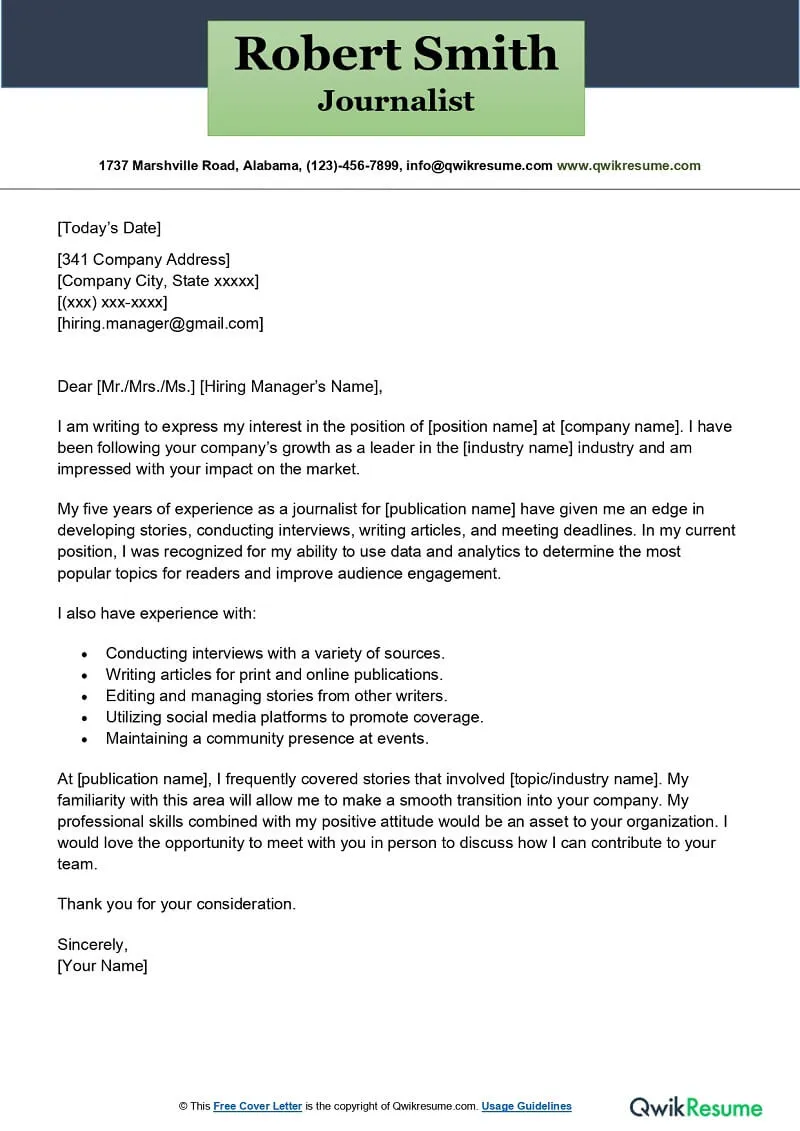
Why Your Journalist Cover Letter Matters
In the competitive world of journalism, a well-crafted cover letter is your first chance to make a lasting impression on potential employers. It serves as a crucial introduction, providing an opportunity to showcase your skills, passion, and suitability for the role. Unlike a resume, which offers a factual account of your experiences, the cover letter allows you to demonstrate your personality, writing style, and genuine interest in the specific position and publication. A compelling cover letter can significantly increase your chances of landing an interview and ultimately securing your dream journalist job. Editors often review cover letters before even glancing at resumes, making your cover letter a make-or-break document.
Crafting a Compelling Journalist Cover Letter
Crafting a compelling cover letter requires careful attention to detail and a strategic approach. Begin by thoroughly researching the publication or organization to which you are applying. Understand their style, target audience, and the types of stories they cover. This research will enable you to tailor your cover letter to their specific needs and demonstrate your genuine interest. Your cover letter should be concise, well-written, and free of any grammatical errors or typos. It should also highlight your most relevant skills and experiences, and make a clear case for why you are the ideal candidate for the job. A generic, mass-produced cover letter is unlikely to impress; personalization is key.
Highlighting Relevant Skills for a Journalist Job

Journalism demands a diverse skill set, and your cover letter is the perfect place to highlight those that align with the job requirements. Strong writing skills are paramount, so showcase your ability to write clear, concise, and engaging copy. Mention any experience with different journalistic styles, such as investigative reporting, feature writing, or breaking news. Also, highlight your research skills, your ability to interview sources, and your capacity to meet deadlines. If the job requires specific technical skills, such as experience with content management systems (CMS) or social media platforms, be sure to include those as well. Demonstrate that you possess the skills necessary to excel in the role.
Showcasing Your Writing Prowess in Your Cover Letter
Your cover letter is a writing sample in itself, so use it to demonstrate your writing abilities. Vary your sentence structure, choose strong verbs, and use compelling language to capture the reader’s attention. Avoid clichés and jargon, and instead strive for originality and clarity. If you have published articles or blog posts, consider including links to them in your cover letter. If you are writing to a specific editor, you can also reference a recent article that you enjoyed to show you read their publication. Even better, write a short paragraph discussing why the piece resonated with you and how your skills could contribute to similar work. This shows initiative and attention to detail.
Tailoring Your Cover Letter to the Specific Job
A one-size-fits-all cover letter is unlikely to impress. Tailor your letter to each specific job application by carefully reviewing the job description and identifying the key skills and experiences that the employer is seeking. Customize your letter to address those specific requirements and highlight how your qualifications align with the role. Mention the publication by name, if appropriate, and demonstrate that you understand their mission and values. By demonstrating that you have taken the time to understand their needs, you can significantly increase your chances of getting hired. Make sure that the tone of the letter matches the tone of the publication.
Proofreading and Editing Your Cover Letter

Typos, grammatical errors, and awkward phrasing can undermine your credibility and diminish your chances of success. Proofread your cover letter meticulously before submitting it. Read it aloud to catch any errors that you might miss while reading silently. Ask a friend, family member, or career advisor to review your letter and provide feedback. Ensure that your cover letter is error-free and reflects the professionalism that employers are seeking. The final product should look clean and professional and have zero issues. Never underestimate the importance of a polished final product.
What to Include in Your Journalist Cover Letter
Your cover letter should include the following elements: a clear statement of the position you are applying for; a brief overview of your relevant skills and experience; an explanation of why you are interested in the specific publication or organization; examples of your work (e.g., links to published articles); a concise and compelling closing statement that reiterates your enthusiasm and includes a call to action (e.g., requesting an interview). Be sure to make your letter readable with proper formatting and font selection. Use paragraphs effectively to break up the text and guide the reader through your key points.
Contact Information and the Opening Paragraph
Start your cover letter with your contact information, including your name, phone number, email address, and any relevant links (e.g., your online portfolio or LinkedIn profile). In the opening paragraph, state the position you are applying for and briefly explain how you learned about the opportunity. Capture the reader’s attention by expressing your enthusiasm for the role and the publication. Use a strong opening sentence that immediately grabs the reader’s attention and sets the tone for the rest of the letter. This initial impression is crucial, as it sets the stage for a positive reading experience.
Expressing Your Passion for Journalism

Journalism is a field driven by passion, so let your enthusiasm shine through. Explain why you are drawn to the profession and what motivates you to pursue a career in journalism. Share your interest in the specific publication or organization and demonstrate your understanding of their mission and values. Mention any particular areas of journalism that you are passionate about, such as investigative reporting, environmental issues, or local news. Show the employer that you are not just looking for a job, but that you are genuinely committed to the field and eager to contribute to their team. This is your opportunity to show the editor why you love this craft.
Showcasing Your Experience and Achievements
Highlight your relevant experience and achievements. Provide specific examples of your accomplishments, quantifying them whenever possible. For example, instead of saying “I wrote articles,” say “I wrote over 50 articles that reached an average of 10,000 readers each.” If you have a track record of success, provide evidence of your skills through published articles, awards, or positive feedback from editors or colleagues. Focus on experiences that directly relate to the requirements of the job and demonstrate your ability to perform the duties effectively. This is your chance to provide details of your greatest hits.
Mentioning Your Relevant Skills
Journalism requires a diverse range of skills, so be sure to showcase your most relevant abilities. Mention your writing skills, including your ability to write clear, concise, and engaging copy. Highlight your research skills, your ability to interview sources, and your capacity to meet deadlines. If the job requires specific technical skills, such as experience with content management systems (CMS) or social media platforms, be sure to include those as well. Demonstrate that you possess the skills necessary to excel in the role, making sure that these match the job posting requirements.
Concluding Your Cover Letter Effectively

Conclude your cover letter with a strong statement that reiterates your enthusiasm for the position and includes a call to action. Thank the reader for their time and consideration. Express your interest in an interview and provide your contact information. Avoid generic closing phrases, such as “Sincerely.” Instead, use a professional and enthusiastic closing that reflects your personality and the tone of the letter. Make sure to always include a call to action to encourage the reader to take the next step, whether it’s scheduling an interview or reviewing your portfolio. A well-crafted conclusion can leave a lasting positive impression and increase your chances of landing the job.
Formatting Your Journalist Cover Letter
Formatting can significantly impact the readability and overall presentation of your cover letter. Choose a professional font, such as Times New Roman, Arial, or Calibri, and use a font size that is easy to read (typically 11 or 12 points). Use standard margins and single-spacing, with a blank line between paragraphs. Use clear headings and subheadings to organize your information and make it easy for the reader to scan. Be consistent with your formatting throughout the letter. The goal is to create a visually appealing document that is easy to navigate and understand.
Formatting for Readability
Ensure your cover letter is easy to read by using clear and concise language, short paragraphs, and bullet points to break up the text. Avoid using complex sentences or jargon that might confuse the reader. Break up large blocks of text with white space. Use formatting options, such as bolding, italics, and underlining, sparingly to emphasize key points. The goal is to create a cover letter that is visually appealing, easy to scan, and engaging to read. Prioritize clarity and conciseness to make a strong impact.
Choosing the Right Tone

The tone of your cover letter should be professional, yet engaging. Adapt your tone to match the tone of the publication or organization to which you are applying. If the publication is known for its formal style, your cover letter should be equally formal. If the publication has a more informal or conversational tone, you can adopt a slightly more relaxed style. Be authentic and let your personality shine through, but always maintain a professional demeanor. Avoid using overly casual language or slang, and always proofread your letter carefully to ensure that the tone is appropriate for the target audience.
Examples of Strong Journalist Cover Letters
Review examples of strong journalist cover letters to get ideas and inspiration. Search online for cover letter samples from successful journalists and analyze their structure, content, and tone. Pay attention to how they highlight their skills, experience, and passion for journalism. Use these examples as a guide, but be sure to customize your own cover letter to reflect your unique skills, experience, and personality. Remember, your cover letter should be a reflection of you and your potential contributions to the publication or organization. Make your application stand out from the rest!