
What is a Job Interest Cover Letter?
A job interest cover letter is a crucial document that accompanies your resume when applying for a job. It serves as your introduction to a potential employer, providing context and showcasing your enthusiasm for the specific position and the company. Unlike a resume, which is a factual summary of your skills and experience, the cover letter allows you to express your personality, motivations, and why you are the ideal candidate. It’s your opportunity to make a strong first impression and persuade the hiring manager to read your resume more carefully.
Why is a Cover Letter Important?
In today’s competitive job market, a well-crafted cover letter can significantly increase your chances of landing an interview. Many employers consider a cover letter essential, using it to gauge your communication skills, writing ability, and attention to detail. It demonstrates your genuine interest in the role and the company, setting you apart from candidates who may only submit a resume. A cover letter allows you to elaborate on your qualifications, connect your experiences to the job requirements, and highlight how you can contribute to the company’s success. Without a cover letter, you might miss the chance to make a compelling case for why you should be hired.
Key Elements of a Compelling Cover Letter

A compelling cover letter is not just a formality; it’s a persuasive document that grabs the reader’s attention from the start. It should clearly and concisely convey your interest in the job, your relevant skills and experience, and your understanding of the company. Key elements include a professional header with contact information, a personalized salutation, a captivating opening paragraph, a focused body that highlights your qualifications, and a strong closing paragraph that calls for action. Your cover letter should also be free of errors, well-formatted, and tailored to each specific job application. The goal is to make the employer want to learn more about you.
Header and Contact Information
Your cover letter should begin with a professional header that includes your full name, address, phone number, and email address. Ensure that your email address is professional and appropriate for a job application. Below your contact information, include the date and the hiring manager’s name and title, if you know them. If you are unable to find the name of the hiring manager, you can use a general salutation. This section is crucial because it provides the employer with the necessary information to contact you and shows that you are organized and professional. Always double-check for accuracy.
Professional Salutation
The salutation sets the tone for your cover letter and demonstrates your attention to detail. Whenever possible, address the hiring manager by name. This shows that you have taken the time to research the company and the specific role. Use a formal salutation, such as “Dear Mr. / Ms. [Last Name].” If you are unsure of the hiring manager’s name, use a general salutation like “Dear Hiring Manager” or “Dear [Department Name] Team.” Avoid informal greetings like “Hello” or “Hi” because they are less professional. Ensure that you spell the recipient’s name correctly and use the appropriate title.
Opening Paragraph Captivating the Reader

The opening paragraph is your first chance to grab the reader’s attention. It should be concise, engaging, and clearly state your interest in the specific job. Mention the position you are applying for and where you found the job posting. You can also briefly highlight your key qualifications or a specific accomplishment that makes you stand out. Avoid generic opening lines; instead, personalize your approach by mentioning something specific about the company or the role that excites you. This will make the reader want to continue reading your cover letter.
Expressing Your Interest and Enthusiasm
Throughout your cover letter, clearly express your interest and enthusiasm for the job and the company. Use positive language and avoid sounding generic. Explain why you are drawn to this particular role and what aspects of the job appeal to you. Mentioning specific projects, company values, or industry trends demonstrates that you’ve done your research and are genuinely excited about the opportunity. Your enthusiasm will help the hiring manager see you as a motivated and engaged candidate.
Highlighting Relevant Skills and Experience
The body of your cover letter should focus on highlighting your relevant skills and experience. Review the job description carefully and identify the key requirements. Provide specific examples from your work history, education, or volunteer experiences that demonstrate how you meet those requirements. Use keywords from the job description to show that you understand what the employer is looking for. Tailor your examples to the specific role and focus on achievements rather than simply listing your responsibilities. This section should effectively bridge the gap between your qualifications and the job’s demands.
Connecting Your Skills to the Job Requirements

It’s not enough to simply list your skills; you must connect them to the job requirements. Explain how your skills and experiences align with the specific needs of the role. Use action verbs to describe your accomplishments, and provide specific examples of how you’ve used your skills to achieve positive results. This demonstrates your understanding of the role and your ability to perform the required tasks. By connecting your qualifications to the job requirements, you show the employer that you are a strong fit for the position.
Quantifying Your Achievements with Numbers
Whenever possible, quantify your achievements with numbers and data. This makes your accomplishments more concrete and impressive. Instead of saying, “Improved customer service,” state, “Improved customer satisfaction scores by 15% within six months.” Use percentages, dollar amounts, and other metrics to demonstrate the impact of your work. Quantifying your achievements provides evidence of your skills and makes your cover letter more persuasive. It gives the employer a clear sense of your value and potential contributions.
Demonstrating Knowledge of the Company
Showing that you have researched the company is crucial. Briefly mention what you admire about the company’s mission, values, or recent achievements. This demonstrates that you are genuinely interested in working there and have taken the time to learn about the organization. Align your personal goals with the company’s goals to show you’d be a good fit, and explain what aspects of the company culture appeal to you. Demonstrating knowledge of the company will make your cover letter stand out from generic applications.
Expressing Your Career Goals
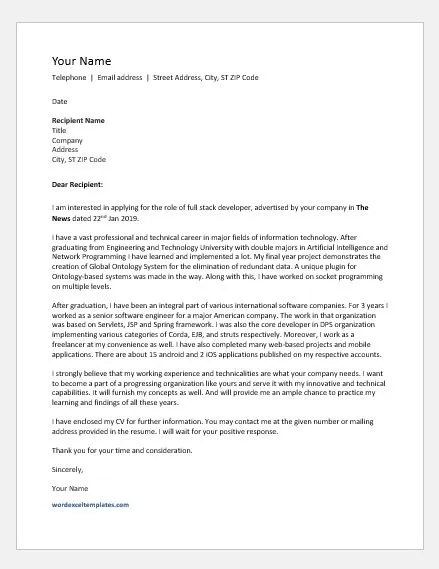
In your cover letter, briefly touch upon your career goals and how this job aligns with them. Explain how the position fits into your long-term career aspirations and what you hope to achieve in the role. This shows that you are not just looking for a job but are invested in your professional growth. Ensure your career goals align with the company’s values and the position’s responsibilities. Showing that you’re looking to grow within the company will give the hiring manager a reason to consider your application seriously.
Closing Paragraph Call to Action
The closing paragraph should reiterate your interest in the job and express your eagerness to hear back from the employer. Thank the hiring manager for their time and consideration. Include a call to action, such as, “I am eager to discuss how my skills and experience can benefit your team. I look forward to hearing from you soon.” This demonstrates your proactive approach. End with a professional closing, such as “Sincerely” or “Best regards,” followed by your name. Always proofread the entire cover letter before submitting it.
Proper Formatting and Proofreading
Proper formatting and proofreading are essential for creating a professional cover letter. Use a standard font like Arial or Times New Roman, with a font size between 10 and 12 points. Use single spacing within paragraphs and double spacing between paragraphs. Maintain consistent margins. Proofread your cover letter multiple times for any grammatical errors, spelling mistakes, and typos. Ask a friend or colleague to review it as well. A well-formatted and error-free cover letter reflects attention to detail and professionalism.
Reviewing and Tailoring Your Cover Letter

Always review and tailor your cover letter for each job application. Avoid using a generic cover letter for all applications. Customize the content to match the specific requirements of the job description and the company’s values. Highlight the skills and experiences that are most relevant to the role. Mentioning the company’s name and demonstrating your understanding of the position shows that you have taken the time to tailor your application. This will significantly increase your chances of getting noticed by the hiring manager.
Cover Letter Templates and Examples
There are numerous cover letter templates and examples available online that can help you get started. Use these templates as a guide, but always customize them to fit your specific qualifications and the job requirements. Consider using different formats depending on the industry and the type of role you’re applying for. Look for examples that are relevant to your field and experience level. While templates can provide a good structure, ensure your cover letter reflects your unique personality and skills.
Avoiding Common Mistakes
There are several common mistakes to avoid when writing a cover letter. Avoid using generic or vague language, and instead, provide specific examples of your achievements and skills. Avoid typos, grammatical errors, and poor formatting. Do not simply restate your resume; use the cover letter to provide additional context and showcase your enthusiasm. Avoid being overly casual or informal in your language. Always proofread your cover letter carefully before submitting it. Making a few edits can significantly improve the impact of your letter, and boost your application.
The Importance of Customization

Customization is key to a successful cover letter. Generic, one-size-fits-all cover letters are easily recognizable and often get rejected. Take the time to research the company and the specific role. Customize your cover letter to match the job description and highlight the skills and experiences most relevant to the position. Demonstrate your knowledge of the company by mentioning specific projects, values, or recent achievements. This level of personalization shows that you are genuinely interested in the job and willing to go the extra mile.
Tips for Different Industries
Different industries may have specific expectations for cover letters. Research the norms of your industry and tailor your cover letter accordingly. For example, if you are applying for a creative role, you might consider using a more visually appealing format or showcasing your creativity in your writing style. For technical roles, focus on your technical skills and experience. Always prioritize clarity and conciseness. The goal is to present yourself as the best candidate for the role, even with an industry shift.
Submitting Your Cover Letter
When submitting your cover letter, carefully follow the instructions provided in the job posting. If the employer specifies a format or method of submission, adhere to it precisely. If the instructions do not mention a specific file type, use a PDF format to ensure that your formatting remains consistent across different devices. Attach both your cover letter and resume to your application, and name the files appropriately. Double-check to ensure that you have attached the correct files before submitting your application. By following these steps, you will significantly improve your chances of getting noticed.