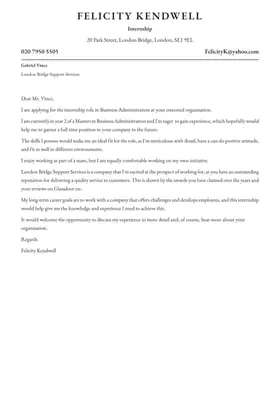
Why a Strong Cover Letter Matters
In the competitive world of internships, a well-crafted cover letter can be your secret weapon. It is far more than just a formality; it is your first opportunity to make a positive impression and distinguish yourself from other applicants. Unlike a resume, which simply lists your experiences and qualifications, a cover letter allows you to tell a story. It lets you showcase your personality, express your genuine interest in the specific role and the company, and highlight the specific skills and experiences that make you the ideal candidate. Without a compelling cover letter, your application might be overlooked, regardless of how impressive your resume may be. A strong cover letter shows you have taken the time to understand the position and are genuinely enthusiastic about the opportunity.
Highlighting Your Skills and Experience
Your cover letter is the perfect place to connect your skills and experiences to the specific requirements of the internship. Begin by carefully reviewing the job description, identifying the key skills and qualifications the employer is seeking. Next, reflect on your own experiences, whether from coursework, extracurricular activities, part-time jobs, or volunteer work. Think about how these experiences have equipped you with the skills mentioned in the job description. For example, if the internship requires strong communication skills, you might mention a project where you effectively presented to a group or a role where you mediated conflicts. If the internship emphasizes technical abilities, highlight relevant coursework, projects, or certifications. Be sure to quantify your achievements whenever possible. Instead of saying ‘Improved customer satisfaction,’ state ‘Increased customer satisfaction by 15% through improved communication strategies.’
Researching the Company and Tailoring Your Letter

One of the most effective ways to impress a potential employer is to demonstrate that you have taken the time to research their company. Before you begin writing your cover letter, visit the company’s website, read their ‘About Us’ section, explore their social media profiles, and, if possible, read news articles or press releases about them. This research will give you valuable insights into the company’s mission, values, culture, and recent projects or achievements. Armed with this information, you can tailor your cover letter to resonate with the company’s specific needs and priorities. Mention specific projects, initiatives, or aspects of the company that genuinely interest you. Show that you understand their industry, their challenges, and their goals. This personalized approach demonstrates your genuine interest and makes your application stand out from generic, mass-produced cover letters. It shows that you are not just looking for any internship, but specifically, this internship with this company.
Formatting Your Cover Letter
The format of your cover letter is just as important as its content. A well-formatted letter is easy to read, professional, and makes a positive first impression. Begin by using a professional font, such as Times New Roman, Arial, or Calibri, in a standard size like 11 or 12 points. Use clear and concise language throughout the letter, and keep paragraphs relatively short and easy to digest. The ideal length for a cover letter is one page. Include a proper heading with your contact information (name, address, phone number, and email address), the date, and the employer’s contact information. Use a professional salutation, such as ‘Dear Mr./Ms./Mx. [Last Name]’. Maintain consistent formatting throughout the letter, including font style, margins, and spacing. Pay careful attention to grammar, spelling, and punctuation. A polished and well-formatted cover letter showcases your attention to detail and professionalism.
Essential Cover Letter Elements
Every effective cover letter should include several key elements. Start with a compelling opening that immediately grabs the reader’s attention and states the position you are applying for. In the body paragraphs, highlight your relevant skills and experiences, connecting them to the job requirements. Demonstrate your understanding of the company and express your enthusiasm for the opportunity. Explain why you are interested in the internship and what you hope to gain from the experience. The body of the letter should be concise and focused, providing specific examples to support your claims. Finally, end with a strong closing that reiterates your interest, thanks the reader for their time and consideration, and includes a call to action, such as expressing your availability for an interview. Include your contact information once more at the end of the letter for easy reference.
Crafting a Compelling Opening

The opening paragraph is your first and often only chance to make a strong impression. Avoid generic phrases such as ‘I am writing to apply for the internship…’ Instead, aim for an opening that immediately grabs the reader’s attention. You can start by mentioning how you learned about the internship, perhaps through a specific contact or a company event. Briefly state the position you are applying for and then immediately explain why you are excited about this particular opportunity and the company. If you have a compelling accomplishment or a relevant skill, consider starting with that to demonstrate your value upfront. You might also consider mentioning a mutual connection, if applicable. The goal is to create an opening that is both professional and personable, showcasing your enthusiasm and immediately establishing your relevance for the position.
Showcasing Relevant Skills and Experience
The body of your cover letter should be dedicated to showcasing the skills and experiences that make you an ideal candidate. The goal is to demonstrate that you not only possess the necessary skills but that you have used them effectively in the past. Focus on the key requirements outlined in the job description and connect your relevant experiences to those requirements. Use specific examples to illustrate your skills. Instead of simply stating that you have strong communication skills, provide an example of a situation where you successfully communicated with a team, a client, or a customer. Quantify your achievements whenever possible. Instead of saying ‘Managed social media accounts,’ specify ‘Managed social media accounts, increasing follower engagement by 20%.’ This approach provides concrete evidence of your abilities and makes your claims more believable. Tailor your examples to the specific internship and company; demonstrating a clear understanding of their needs and what you can bring to the table.
Demonstrating Enthusiasm and Fit
Employers want to hire interns who are genuinely excited about the opportunity and who seem like a good fit for their company culture. Your cover letter is your chance to demonstrate your enthusiasm. Express your specific interest in the internship and explain why you are drawn to the company. Research the company’s mission, values, and recent projects and show how they align with your own interests and career goals. Mention what excites you about the specific role, and what you hope to learn and achieve during the internship. Be specific and authentic. Avoid generic statements. Instead, describe a particular aspect of the company or the role that resonates with you. Show that you have taken the time to understand the company and that you are not just looking for any internship. This genuine enthusiasm will make your application stand out and demonstrate that you are more than just a qualified applicant; you are someone who is genuinely interested in contributing to their team.
Closing Your Cover Letter Effectively

The closing paragraph of your cover letter is your final opportunity to leave a lasting impression. Begin by reiterating your interest in the internship and thanking the reader for their time and consideration. Reiterate your enthusiasm for the opportunity and briefly mention how you believe you can contribute to the company. Include a call to action. Express your willingness to provide more information or to discuss your qualifications in an interview. Make sure to provide your contact information, including your phone number and email address, one last time. Use a professional closing, such as ‘Sincerely’ or ‘Best regards’, followed by your typed name. Proofread the entire letter carefully to ensure it is free of errors and reflects your professionalism and attention to detail. A strong, well-crafted closing leaves the reader with a positive impression and increases your chances of landing an interview.
Cover Letter Examples for Different Internship Types
Different types of internships will require slightly different approaches in your cover letter. Tailoring your letter to the specific industry and role is important. Some examples are provided in the following sections.
Example 1 Tech Internship
Dear [Hiring Manager Name],
I am writing to express my keen interest in the Software Engineering Intern position at [Company Name], as advertised on [Platform]. As a highly motivated Computer Science student at [University Name], with a strong foundation in [Specific Technologies], I am eager to apply my skills and contribute to your innovative projects. During my coursework, I have gained extensive experience in [Mention specific skills and projects], including [Project Details]. My experience has instilled in me strong problem-solving capabilities and the ability to work collaboratively in a team. I am particularly drawn to [Company Name]’s work in [Specific Area] and believe my skills align well with your mission to [Mention Company mission if known]. I am eager to learn more and contribute to your team. Thank you for your time and consideration. I have attached my resume for your review.
Sincerely, [Your Name]
Example 2 Marketing Internship

Dear [Hiring Manager Name],
I am writing to express my enthusiastic interest in the Marketing Intern position at [Company Name], as advertised on [Platform]. As a highly motivated Marketing student at [University Name], I have developed a strong understanding of marketing principles and strategies. My academic achievements include developing and executing successful marketing campaigns, including [Campaign Details]. My experience has equipped me with the skills to thrive in a dynamic environment, with a focus on digital marketing, social media management and content creation. I am particularly excited about [Company Name]’s marketing strategy and would love the opportunity to contribute my skills. I am particularly drawn to [Company Name]’s approach to [Specific Marketing Area]. Thank you for your time and consideration. I have attached my resume for your review.
Sincerely, [Your Name]
Example 3 Engineering Internship
Dear [Hiring Manager Name],
I am writing to express my strong interest in the Engineering Intern position at [Company Name], as advertised on [Platform]. As a highly motivated Engineering student at [University Name], I am passionate about hands-on work and practical applications. My coursework has provided me with a solid foundation in [Specific Engineering skills], including [Project Details]. I am eager to apply my technical skills, my problem-solving capabilities, and my collaborative attitude to projects at [Company Name]. My experiences have enabled me to effectively apply technical skills to solve real-world problems. I am particularly inspired by [Company Name]’s engineering approach to [Specific Engineering Area]. Thank you for your time and consideration. I have attached my resume for your review.
Sincerely, [Your Name]
Proofreading and Editing Your Cover Letter
Once you have finished writing your cover letter, proofreading and editing it meticulously is essential. Errors in grammar, spelling, or punctuation can undermine your credibility and create a negative impression. Begin by reading your cover letter aloud. This helps you identify awkward phrasing and grammatical errors that you might miss when reading silently. Use a grammar and spell checker, but do not rely on it entirely. These tools can sometimes miss subtle errors. Ask a friend, family member, or career advisor to review your cover letter. A fresh pair of eyes can often catch mistakes that you have overlooked. Pay close attention to formatting and consistency. Ensure that your font, margins, and spacing are consistent throughout the letter. Review the letter to ensure the tone is appropriate, professional, and enthusiastic. A polished and error-free cover letter demonstrates your attention to detail and your commitment to presenting yourself in the best possible light. This reflects your professionalism and significantly increases your chances of making a positive impression.
Key Mistakes to Avoid

Several common mistakes can weaken a cover letter and reduce your chances of getting hired. Avoid using generic, impersonal language, such as ‘To whom it may concern’ or phrases that could apply to any job. Do not simply restate your resume. Instead, elaborate on your skills and experiences, providing specific examples to demonstrate your value. Avoid making the letter too long. Keep it concise, focused, and easy to read, ideally within one page. Avoid including irrelevant information or information that is not directly related to the internship. Proofread your letter carefully and avoid any typos, grammatical errors, or spelling mistakes. Do not include any negative information about past employers or experiences. Avoid using jargon or overly technical language. Be professional, enthusiastic, and sincere, showing that you understand the company and its needs and that you are genuinely interested in the position and the chance to contribute to the company.
Getting Feedback on Your Cover Letter
Seeking feedback on your cover letter is a crucial step in the job application process. A second opinion can help you identify areas for improvement and ensure that your letter is as effective as possible. Start by asking friends, family members, or career advisors to review your cover letter. Provide them with a copy of the job description so they can evaluate whether your letter aligns with the requirements of the position. Ask them to focus on clarity, organization, grammar, and overall effectiveness. Consider visiting your university’s career services center. They can provide expert advice on cover letter writing and help you tailor your letter to specific job opportunities. Take advantage of online resources and templates. However, always customize your letter to reflect your unique skills and experiences and the specific requirements of the internship. By actively seeking and incorporating feedback, you can refine your cover letter, increase your chances of getting noticed, and land the internship of your dreams.