Understanding the Purpose of a Business Development Cover Letter
A business development cover letter serves as your first introduction to a potential employer, going beyond the basic details of your resume to showcase your personality, passion, and specific suitability for the role. Unlike a generic resume, a cover letter gives you the opportunity to tell a story, connecting your skills and experience to the company’s needs and demonstrating why you’re the ideal candidate. It’s your chance to make a compelling case, highlighting your understanding of the business development field and your ability to contribute to the company’s growth. Effectively written cover letters can significantly increase your chances of landing an interview, making them an essential part of any job application in business development.
Why a Cover Letter is Crucial for Business Development
In the competitive field of business development, a cover letter is not optional; it’s a necessity. It provides context to your resume, allowing you to explain career choices, bridge employment gaps, and highlight the unique value you bring to the table. Business development roles often require a keen understanding of strategy, relationship-building, and market analysis, all of which can be effectively communicated in a well-crafted cover letter. It demonstrates your communication skills, a critical attribute in business development, and shows your proactive approach to securing the position. A strong cover letter allows you to differentiate yourself from other applicants, showcasing your personality and passion for the specific opportunity.
Highlighting Relevant Skills and Experience

When writing a business development cover letter, it’s crucial to spotlight skills and experiences that align with the job requirements. Begin by carefully reviewing the job description and identifying the key skills and qualifications the employer is seeking. These may include strategic planning, market analysis, lead generation, relationship management, and negotiation. Provide specific examples of how you have successfully utilized these skills in previous roles. Quantify your achievements whenever possible, using numbers to illustrate your impact. For example, mention the percentage increase in sales you generated, the number of new partnerships you established, or the cost savings you achieved. Tailor your examples to the specific role, emphasizing the relevance of your skills to the company’s needs.
Key Elements of a Compelling Business Development Cover Letter
A compelling business development cover letter needs to be structured strategically to capture the hiring manager’s attention. Begin with a strong opening that immediately states your interest in the position and the company, briefly mentioning how your skills align with their needs. In the body of your letter, demonstrate your understanding of the company’s mission and the challenges they face. Focus on showcasing your accomplishments and relevant skills using specific examples. Explain how your past experiences have prepared you for the role and the value you can bring to the company. Throughout the letter, maintain a professional tone, and always proofread meticulously for any grammatical errors or typos. Conclude with a call to action, expressing your enthusiasm for the opportunity and your availability for an interview.
The Proper Structure of Your Cover Letter
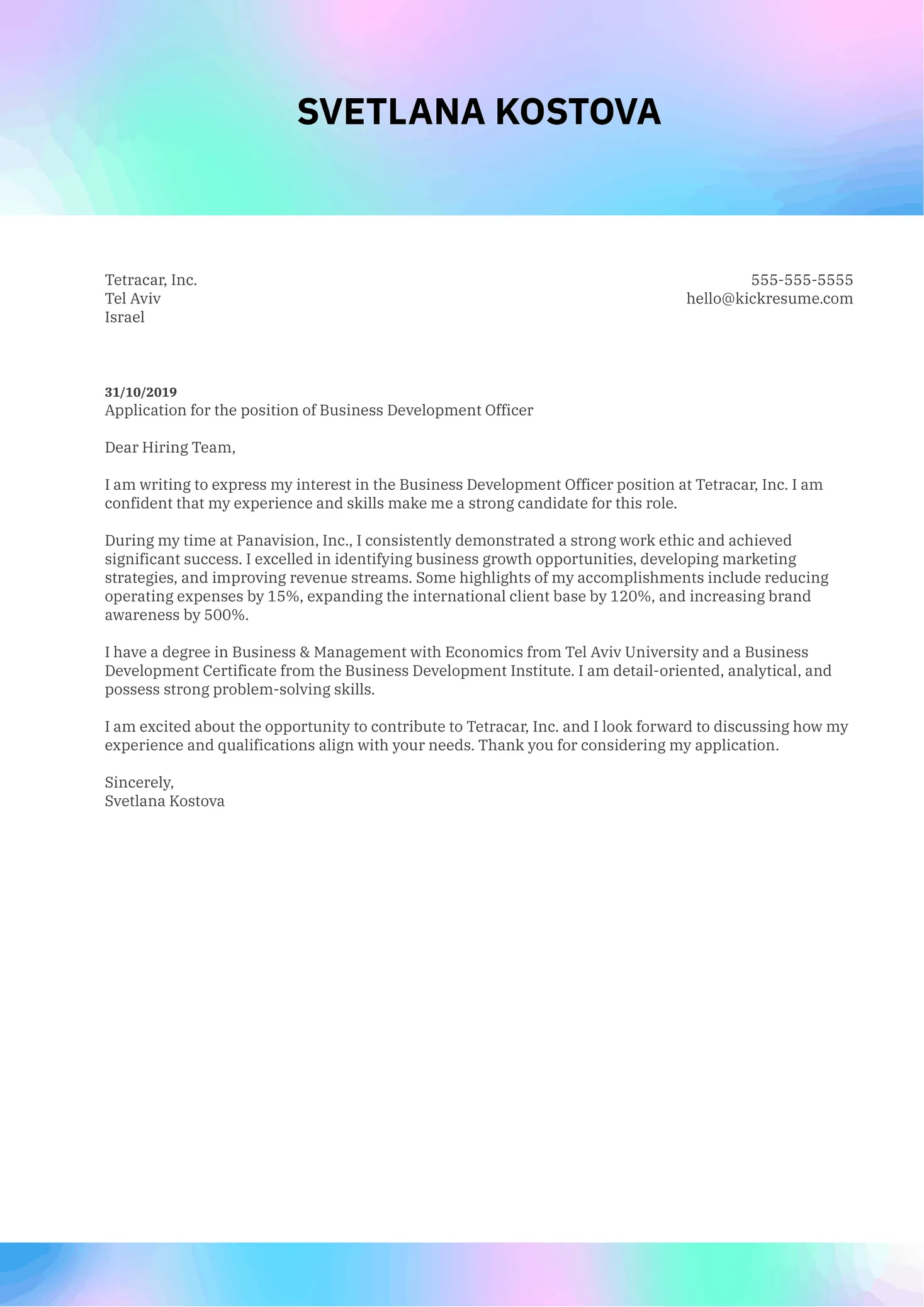
The structure of your business development cover letter should be well-organized and easy to read. Start with a header that includes your contact information, the date, and the recipient’s contact information. Next, include a formal salutation, such as “Dear Mr./Ms. [Last Name]”, if possible; if not, use a professional alternative such as “Dear Hiring Manager”. The opening paragraph should immediately state your interest in the position and the company. The body of your letter should consist of 2–3 paragraphs, highlighting your skills, experiences, and achievements. The closing paragraph should reiterate your interest, include a call to action, and thank the reader for their time and consideration. Finally, close with a professional sign-off, such as “Sincerely” or “Best regards”, followed by your typed name.
Formatting and Presentation Tips

Effective formatting and presentation are essential for a polished business development cover letter. Use a professional, easy-to-read font like Times New Roman, Arial, or Calibri in a standard size (11 or 12 points). Keep your letter concise and to the point, aiming for one page in length. Use clear and concise language, avoiding jargon and overly complex sentences. Break up large blocks of text with paragraphs and bullet points to enhance readability. Use appropriate margins (1 inch on all sides) and spacing (single-spaced within paragraphs, double-spaced between paragraphs). Before submitting your cover letter, proofread it carefully for any grammatical errors or typos, and consider having a friend or colleague review it as well. Ensure your cover letter is saved in a professional format, such as a PDF file, to maintain the formatting across different devices.
Showcasing Your Achievements and Quantifiable Results
Quantifying your achievements is a key strategy for making your business development cover letter stand out. Instead of just listing your responsibilities, provide concrete examples of your accomplishments, using numbers and metrics to illustrate your impact. For instance, instead of saying “Increased sales”, specify “Increased sales by 25% within one year through strategic partnership development.” If you have experience generating leads, state the number of leads you generated or the conversion rate achieved. Mention the size of deals you closed or the revenue you helped generate. Including these specific, measurable results demonstrates your ability to deliver tangible results and provides concrete evidence of your value to potential employers. By quantifying your achievements, you showcase your competence and make your cover letter more impactful.
Examples of Strong Action Verbs to Use
Using strong action verbs in your business development cover letter can make your achievements more impactful and engaging. Action verbs describe what you did, making your experience more dynamic and showcasing your capabilities. Some effective action verbs for business development include “Spearheaded,” “Developed,” “Negotiated,” “Implemented,” “Launched,” “Managed,” “Cultivated,” “Generated,” “Expanded,” “Increased,” “Streamlined,” and “Collaborated.” For example, instead of writing “Responsible for lead generation,” write “Generated over 100 qualified leads per month through targeted marketing campaigns.” This active language creates a more compelling narrative, helping the hiring manager understand the value you brought to your previous roles and what you can bring to their company.
Quantifying Your Impact with Numbers

Numbers are your best friend when writing a business development cover letter. They provide concrete evidence of your accomplishments and quantify your impact. Whenever possible, back up your claims with data and specific figures. For example, instead of saying you “improved customer relations,” write “Improved customer satisfaction scores by 15% through the implementation of a new customer service protocol.” If you have experience with business development, mention the revenue you helped generate, the number of new partnerships you secured, or the percentage increase in market share. Use these metrics to highlight your performance, demonstrating your ability to drive results. Presenting your achievements quantitatively makes your cover letter more credible and convincing.
Tailoring Your Cover Letter to the Specific Job
Customizing your business development cover letter to each specific job is crucial for making a strong impression. Generic cover letters are easily spotted and are often overlooked. Instead, carefully review the job description and identify the key requirements and qualifications the employer is seeking. Then, tailor your cover letter to highlight the specific skills and experiences that align with those needs. Use the same keywords and phrases from the job description, demonstrating that you understand the role and the company’s priorities. Show how your past experiences have prepared you for the role and the value you can bring to the company. By tailoring your cover letter, you show that you’re truly interested in the position and have the skills and experience to succeed.
Researching the Company and the Role
Before writing your cover letter, thoroughly research the company and the specific role. Visit their website, read industry news, and review their social media presence. Understand the company’s mission, values, and recent initiatives. Investigate the challenges they face and the opportunities they are pursuing. This research will help you tailor your cover letter and demonstrate a genuine interest in the company. When describing your skills and experience, show how they align with the company’s needs and how you can contribute to their goals. By demonstrating this level of knowledge, you show your dedication and increase your chances of getting noticed. Understanding the specific role involves analyzing the job description and clarifying the key responsibilities and qualifications.
Demonstrating Your Understanding of Their Needs

Demonstrating your understanding of the company’s needs is essential for making your business development cover letter stand out. Instead of simply listing your skills, use your research to identify the company’s challenges and goals. Explain how your experience and skills can help them overcome those challenges and achieve their objectives. For example, if the company is looking to expand into a new market, highlight your experience in market analysis or your ability to build strategic partnerships. Showcase your ability to solve problems and create value. By aligning your qualifications with the company’s needs, you demonstrate your understanding of their priorities and your ability to contribute to their success. This shows that you have a strategic mindset and are proactive in finding solutions.
Adding a Compelling Call to Action
A compelling call to action is a vital component of a successful business development cover letter. It encourages the hiring manager to take the next step by expressing your interest in an interview and your availability. Rather than ending your letter passively, include a clear statement that expresses your enthusiasm for the opportunity. Indicate your availability for an interview and provide your contact information again. This is your final chance to leave a positive impression and demonstrate your eagerness to learn more about the role. For example, you could write: “I am eager to discuss how my skills and experience can contribute to [Company Name]’s growth. I am available for an interview at your earliest convenience and can be reached at [Phone Number] or [Email Address].”
Expressing Enthusiasm and Interest
Expressing genuine enthusiasm and interest in the opportunity is key to making a memorable impression. Your cover letter should reflect your passion for the role and the company. Avoid generic statements; instead, demonstrate your excitement by mentioning specific aspects of the company or the role that appeal to you. Mention something specific that sparked your interest in the role, whether it’s their innovative approach, their market position, or their company culture. Your enthusiasm needs to be evident from the opening paragraph, setting a positive tone for the rest of the letter. This enthusiasm helps to demonstrate your drive and potential to the hiring manager, making them more likely to consider you for the position. Tailor your language to express your enthusiasm sincerely and professionally.
Concluding with a Strong Closing Statement

Your closing statement is your final opportunity to leave a lasting impression. Reiterate your interest in the position and thank the hiring manager for their time and consideration. Keep your closing concise and professional. Avoid sounding overly eager or desperate. Instead, express your confidence in your skills and your eagerness to contribute to the company’s success. Consider including a specific statement about what you hope to achieve in the role or how you can help the company. Conclude with a standard closing like “Sincerely” or “Best regards”, followed by your name and contact information. A strong closing statement summarizes your value proposition and leaves the reader with a positive impression of your application.