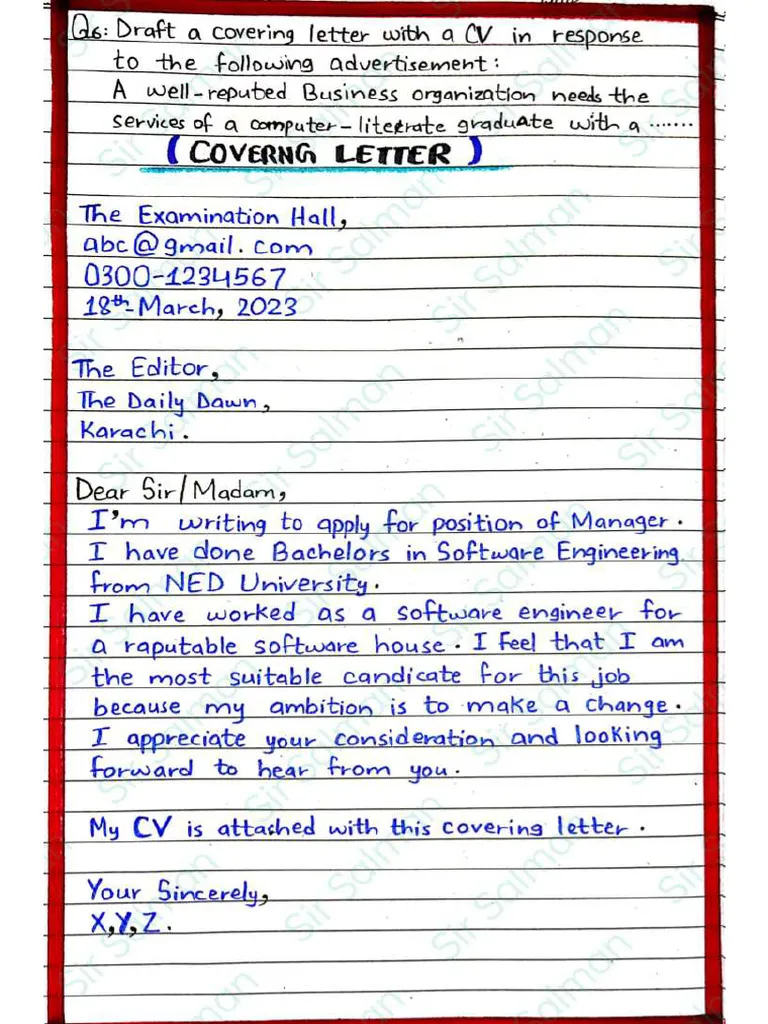
What is a Cover Letter CV?
A Cover Letter CV is a crucial document accompanying your resume (Curriculum Vitae) when applying for a job. It serves as your first introduction to a potential employer, providing a concise overview of your skills, experience, and qualifications. Unlike a resume, which is a factual summary, a cover letter allows you to showcase your personality, enthusiasm, and how your specific abilities align with the job requirements. The cover letter’s primary function is to pique the employer’s interest, encourage them to read your resume, and ultimately, invite you for an interview. Therefore, a well-written cover letter is an essential component of any successful job application strategy. When crafting a compelling cover letter, focus on demonstrating how your skills and experiences align with the specific job description and the company’s values.
The Importance of a Cover Letter CV
The importance of a cover letter CV cannot be overstated in the competitive job market. It significantly enhances your chances of getting noticed by recruiters and hiring managers. A cover letter gives you the opportunity to personalize your application, highlighting the specific reasons you are a good fit for the role and the company. It showcases your written communication skills, organizational abilities, and attention to detail—essential qualities employers look for. Moreover, it provides context to your resume, allowing you to explain gaps in your employment history, career changes, or any other relevant information that might not be immediately apparent from your resume alone. In today’s job market, a well-crafted cover letter can set you apart from other candidates and increase your chances of landing an interview. When it comes to cover letters, the key is to demonstrate how your skills and experiences can benefit the employer.
Top 5 Secrets to Writing a Cover Letter CV

Crafting an effective cover letter CV can be simplified by following certain key strategies. Here are the top five secrets to creating a standout cover letter that will impress potential employers and get you an interview. These secrets cover everything from tailoring your content to perfecting your presentation, each step designed to elevate your application and set you apart from the competition. By applying these strategies, you’ll significantly increase your chances of not only getting noticed but also of securing the job you desire. Remember that your cover letter is your chance to make a memorable first impression, so make every word count and every detail count.
Secret 1 Tailoring Your Cover Letter CV
The first secret to a successful cover letter CV is tailoring. Generic, one-size-fits-all cover letters are easily identifiable and often discarded. Instead, personalize each cover letter to match the specific job and company you’re applying for. This means thoroughly researching the organization, understanding its values, and identifying the key requirements of the position. Within the cover letter, explicitly reference the job description, highlighting how your skills and experiences directly align with the employer’s needs. Tailoring demonstrates that you’ve taken the time to understand the role and are genuinely interested in the opportunity. It proves that you are not just sending out a mass application but have invested effort in showing your suitability for the specific role. By tailoring your letter, you show a proactive approach, which is often a sign of a good candidate.
Highlighting Relevant Skills and Experience
When tailoring your cover letter, it’s crucial to highlight the skills and experience most relevant to the job you’re applying for. Review the job description meticulously and identify the key skills and qualifications the employer is seeking. Then, select specific examples from your past experiences that demonstrate you possess those skills. Focus on achievements and results, and quantify them whenever possible. For example, instead of saying, ‘Managed social media accounts,’ state, ‘Increased social media engagement by 30% in six months.’ Use action verbs to describe your accomplishments and make it clear how your previous roles have prepared you for the new position. Tailoring your cover letter by focusing on skills and experience helps you stand out.
Secret 2 Focusing on Achievements

Another critical secret for writing an effective cover letter CV is to focus on your achievements. Employers are more interested in what you’ve accomplished than just listing your job responsibilities. Instead of simply stating your duties, provide concrete examples of how you’ve made a positive impact in previous roles. This could include increasing sales, improving efficiency, leading successful projects, or receiving positive feedback from colleagues or clients. When describing your achievements, use the STAR method (Situation, Task, Action, Result) to provide context and clearly demonstrate your accomplishments. By quantifying your achievements, you not only make your cover letter more compelling but also offer tangible proof of your capabilities. Focus on achievements to give your application a strong edge.
Quantifying Your Accomplishments
Quantifying your accomplishments is essential to making your cover letter CV more persuasive. Whenever possible, use numbers, percentages, and specific data to illustrate your achievements. For instance, instead of saying, ‘Improved customer satisfaction,’ say, ‘Increased customer satisfaction scores by 20% through implementing a new customer service strategy.’ Quantifiable results provide concrete evidence of your skills and abilities and make your accomplishments more memorable. By using metrics, you add credibility and demonstrate the tangible value you brought to previous employers. Moreover, quantifying your achievements allows the hiring manager to quickly understand the scope and impact of your contributions, setting you apart from other applicants. Highlighting achievements through quantification is a powerful tool for capturing the reader’s attention.
Secret 3 Using the Right Tone and Language
The tone and language of your cover letter CV are essential for making a positive impression. Your cover letter should be professional, enthusiastic, and reflect your personality. While it’s essential to maintain a formal tone, avoid sounding robotic or overly corporate. Use a clear, concise writing style, and ensure your language is easy to understand. Tailor your language to match the company’s culture and the industry’s standards. For example, a cover letter for a creative role may allow for a more creative writing style than one for a legal or financial position. Using the right tone shows you understand the company’s expectations and provides insights into how you would fit in.
Avoiding Clichés and Jargon

In your cover letter CV, steer clear of clichés and jargon. Overused phrases and industry-specific terms can make your letter sound generic and may not resonate with the reader. Instead, use original language and specific examples to highlight your skills and achievements. Replace common phrases like ’team player’ or ‘hard worker’ with more descriptive phrases that demonstrate your abilities and accomplishments. Similarly, avoid technical jargon that the reader might not understand. Focus on clarity and precision, using straightforward language that clearly conveys your message and resonates with the hiring manager. Avoiding clichés and jargon will help you make a positive impression.
Secret 4 Structuring Your Cover Letter CV
The structure of your cover letter CV is just as important as its content. A well-structured letter is easy to read and helps the employer quickly grasp your key qualifications. The standard structure for a cover letter includes a header, a greeting, an introduction, body paragraphs, and a closing. Ensure your header contains your contact information and the date. In the greeting, address the hiring manager by name if possible. The introduction should state your purpose and why you’re interested in the role. The body paragraphs should focus on your skills and achievements. Finally, the closing should express your interest and include a call to action, such as requesting an interview. Using the correct structure keeps your cover letter organized and effective.
Header and Contact Information
Your cover letter’s header should include your contact information. This includes your name, address, phone number, and email address. Also, include the date, and the recipient’s name, title, and company address (if you have this information). Make sure your contact information is accurate and up-to-date. This ensures that the hiring manager can easily reach you if they decide to move forward with your application. The header should be professional and easy to read, usually aligned to the left or right side of the page. Double-check your email address to ensure it is professional and appropriate for a job application. The formatting of your header is a simple but very important step.
Greeting and Introduction

Start your cover letter CV with a professional greeting, such as ‘Dear [Hiring Manager Name]’. If you don’t know the hiring manager’s name, use ‘Dear Hiring Manager’ or ‘Dear [Department Name] Team.’ The introduction is your first chance to grab the reader’s attention. In the introduction, state the position you’re applying for and how you found the job. Briefly mention why you’re interested in the role and the company. You might also include a compelling statement that highlights your key skills or achievements. Keep the introduction concise and focused, setting the tone for the rest of your letter. A strong greeting and introduction will create a positive impression.
Body Paragraphs (Achievements and Skills)
The body paragraphs of your cover letter CV are where you elaborate on your skills, experience, and accomplishments. Focus on the most relevant aspects of your background that align with the job description. Use specific examples to demonstrate your abilities, and quantify your achievements whenever possible. Structure each paragraph to highlight a key skill or accomplishment, providing details and context using the STAR method (Situation, Task, Action, Result). This approach allows you to show, not just tell, the employer how you’ve made an impact in previous roles. Each paragraph should be carefully constructed to showcase your value to the employer and encourage them to read your resume. The body paragraphs are where your qualifications come to life.
Closing and Call to Action
Your closing should express your interest in the position and thank the hiring manager for their time and consideration. Reiterate your enthusiasm for the role and the company. Include a clear call to action, such as ‘I am eager to discuss my qualifications further in an interview’ or ‘I look forward to hearing from you soon.’ This proactive approach signals your interest and makes it easy for the employer to take the next step. Keep the closing concise and professional, leaving a lasting positive impression. Also, make sure to include your contact information once again, so the person can reach out to you quickly. A well-crafted closing and a clear call to action enhance your chances of moving to the next stage of the hiring process.
Secret 5 Proofreading and Editing

The final secret to a successful cover letter CV is thorough proofreading and editing. Before submitting your cover letter, carefully review it for any errors in grammar, spelling, punctuation, and formatting. Even minor mistakes can undermine your credibility and make a negative impression. Proofreading is a crucial step. Read your letter aloud to catch any awkward phrasing or repetitive sentences. Check for consistency in font, spacing, and overall design. It’s often helpful to have another person review your cover letter for a fresh perspective. A polished and error-free cover letter demonstrates your attention to detail and professionalism. Always remember that a well-edited cover letter increases your chances of getting selected.
Checking for Grammatical Errors and Typos
Before submitting your cover letter CV, thoroughly check for grammatical errors and typos. These mistakes can significantly detract from your professionalism and make you appear careless. Proofread your cover letter multiple times, using different methods. Read it slowly, paying close attention to each word and sentence. Use a grammar checker to identify potential errors. Check the spelling of proper nouns, company names, and the hiring manager’s name. Look for common mistakes like incorrect punctuation, subject-verb disagreements, and misused words. Even the smallest error can make a bad impression. By meticulously checking for grammatical errors and typos, you ensure that your cover letter reflects your attention to detail and commitment to quality.
Ensuring a Professional Appearance
In addition to checking for errors, ensure that your cover letter has a professional appearance. The formatting of your cover letter impacts how it is perceived by the reader. Choose a clear, easy-to-read font, such as Arial or Times New Roman, and use a font size between 10 and 12 points. Keep your text well-spaced, with consistent margins and paragraph breaks. Avoid using excessive colors, bolding, or italics, which can be distracting. The overall appearance should be clean, organized, and visually appealing. A professional appearance shows that you take your application seriously and will reflect on you. Creating a good appearance is an important step.
Formatting Your Cover Letter CV

Proper formatting is crucial for ensuring your cover letter is easy to read and presents your information clearly and professionally. Formatting includes choosing the right font, setting appropriate margins, and spacing the text effectively. Proper formatting reflects your attention to detail and makes a strong first impression. Good formatting will help the reader easily understand and focus on your key qualifications. Use formatting consistently throughout your cover letter to maintain a neat and polished appearance.
Choosing the Right Font and Font Size
Choosing the right font and font size is a fundamental aspect of formatting your cover letter CV. Select a professional and easy-to-read font, such as Arial, Times New Roman, Calibri, or Helvetica. These fonts are widely accepted and ensure that your letter is legible on various devices. Use a font size between 10 and 12 points to ensure the text is clear without being too small or too large. Maintain consistency in font choice throughout the document, including the header, body paragraphs, and closing. Avoid using overly stylized or unusual fonts, which can make your letter appear unprofessional. The choice of font contributes to the overall visual appeal and readability of your cover letter.
Tips for Formatting
To format your cover letter CV effectively, consider these tips. Use 1-inch margins on all sides of the page to provide adequate white space and make the text easier to read. Single-space your paragraphs and double-space between paragraphs to visually separate each section. Use a clear and consistent heading style for different sections of your letter. Use bold or italics sparingly to highlight key information, such as your name or the job title. Ensure that your formatting is consistent across all pages of your cover letter. Make sure the document is visually appealing. These formatting tips will help you create a professional and well-structured cover letter that enhances your application.
Final Thoughts on Cover Letter CVs
A well-crafted cover letter CV is an essential tool for any job seeker. By following these top 5 secrets, you can significantly improve your chances of getting noticed by employers and securing an interview. Tailor your letter to each job, focus on your achievements, use the right tone and language, structure it effectively, and proofread it carefully. Remember that your cover letter is your opportunity to make a strong first impression and demonstrate your value to the company. Taking the time to write a compelling cover letter CV will be a worthwhile investment in your job search. By following the advice and guidelines, you are one step closer to getting your dream job.