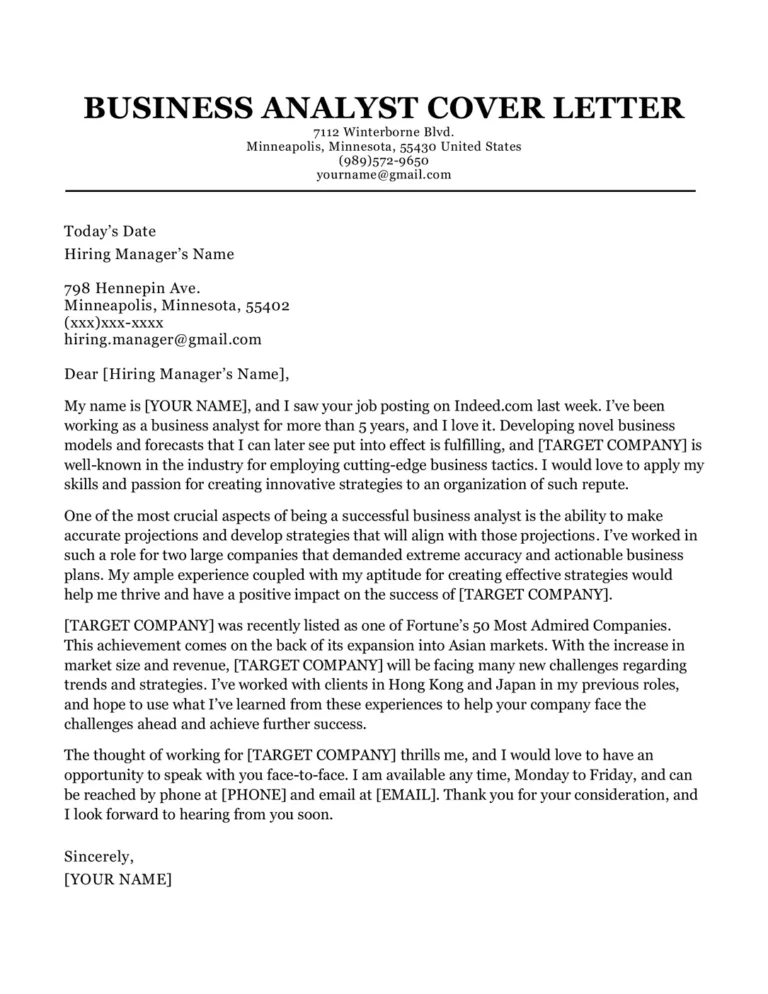
Why a Cover Letter Matters for Business Analysts
In the competitive world of business analysis, a well-crafted cover letter is often the key that unlocks the door to your dream job. It’s your first opportunity to make a strong impression and demonstrate your enthusiasm for the role. Unlike a resume, which provides a snapshot of your experience, a cover letter allows you to tell a story, showcasing your personality, communication skills, and how your unique skills align with the specific requirements of the position. Recruiters and hiring managers use cover letters to assess your communication skills and evaluate your fit within the company culture. A compelling cover letter can significantly increase your chances of getting noticed and securing an interview, especially in a field where clear and concise communication is paramount. Ignoring this crucial step could mean missing out on opportunities.
Highlight Your Skills and Experience
Your cover letter is the perfect platform to spotlight the skills and experience that make you a standout business analyst. Start by identifying the key requirements listed in the job description. Carefully select the skills and experiences from your background that best align with these requirements. Examples include requirements gathering, process modeling, data analysis, stakeholder management, and project management. When describing your experience, provide specific examples of how you’ve successfully utilized these skills in previous roles. Instead of just listing your responsibilities, focus on the results you achieved. What projects did you lead? What challenges did you overcome? What positive outcomes did your work generate? This is where you demonstrate your value and differentiate yourself from other applicants.
Quantify Your Achievements

Numbers speak louder than words, especially when it comes to demonstrating your impact as a business analyst. Whenever possible, quantify your achievements with specific metrics and data. For example, instead of saying you ‘improved efficiency,’ state that you ‘reduced processing time by 15% through process optimization.’ If you implemented a new system, mention the percentage increase in user adoption or the amount of cost savings achieved. Quantifiable results provide tangible evidence of your abilities and make your accomplishments more compelling. This approach not only showcases your analytical skills but also demonstrates your understanding of how your work contributes to the overall success of the organization. Using metrics adds credibility to your claims and shows that you are results-oriented.
Tailor Your Cover Letter to the Job
Generic cover letters are easily identified and often discarded. To make your application stand out, customize each cover letter to match the specific job and company you’re applying to. Research the company, its mission, and its values. Understand the challenges they face and the goals they’re trying to achieve. Show your understanding of the role and the company’s needs. Then, in your cover letter, explain how your skills and experience can directly address those needs. Mention specific projects or initiatives that align with the company’s goals. This demonstrates that you’ve taken the time to understand their business and are genuinely interested in the opportunity. Tailoring your letter shows initiative and demonstrates that you are serious about the position.
Format Your Cover Letter Correctly
The format of your cover letter is as important as its content. A well-formatted letter is easy to read and reflects your professionalism. Use a standard business letter format with a clear and readable font like Arial or Times New Roman (size 11 or 12). Include your contact information at the top, followed by the date and the hiring manager’s name and title. Keep the letter concise, typically one page in length. Use clear headings and paragraphs to break up the text and make it scannable. Maintain consistent margins and spacing throughout the document. Proofread the formatting carefully to ensure there are no inconsistencies. A professional format shows that you pay attention to detail and respect the reader’s time.
Proofread and Edit Your Cover Letter

Typos and grammatical errors can undermine your credibility and leave a negative impression. Before submitting your cover letter, proofread it carefully to catch any mistakes. Use a spell checker and grammar checker, but don’t rely on them entirely. Read the letter aloud to identify awkward phrasing or unclear sentences. Ask a friend or colleague to review your cover letter for a second opinion. They may spot errors or suggest improvements that you’ve missed. Ensure that the tone is professional and enthusiastic. A well-proofread and edited cover letter shows attention to detail, strong communication skills, and a commitment to excellence.
Cover Letter Structure for Business Analysts
Header and Contact Information
Begin your cover letter with your full name, address, phone number, and email address. Include the date and the hiring manager’s name, title, and company address. If you don’t know the hiring manager’s name, research the company’s website or use a general salutation like ‘Dear Hiring Manager’. This section sets the tone for the rest of the letter and provides the necessary contact information for the recruiter or hiring manager.
Opening Paragraph

Start with a strong opening that immediately grabs the reader’s attention. State the specific position you’re applying for and how you found the opportunity. Express your enthusiasm for the role and the company. You could briefly mention something that attracted you to the position, the company, or the industry. Make it clear why you are interested in this specific job. This sets the stage and makes the recruiter want to read more about your skills and experience.
Body Paragraphs
The body paragraphs are the meat of your cover letter. This is where you highlight your skills, experience, and achievements. Use specific examples to demonstrate how your skills and experience align with the job requirements. Focus on the results you’ve achieved in previous roles, using quantifiable data whenever possible. Relate your experience back to the company and what they are looking for. Show your understanding of the company’s needs and how you can contribute to their success. Tailor the content for the specific job you’re applying for by referencing the job description.
Closing Paragraph
In your closing paragraph, reiterate your interest in the position and the company. Summarize your key qualifications and emphasize your enthusiasm. Thank the hiring manager for their time and consideration. Include a call to action, such as stating that you look forward to hearing from them or that you are available for an interview at their earliest convenience. Maintain a professional and confident tone.
Cover Letter Examples for Business Analyst Positions

Example Cover Letter for a Junior Business Analyst
Dear [Hiring Manager Name],
I am writing to express my keen interest in the Junior Business Analyst position at [Company Name], as advertised on [Platform]. As a recent graduate with a degree in [Relevant Field] and a strong foundation in business analysis principles, I am eager to apply my skills to contribute to your team’s success. During my internship at [Previous Company], I assisted senior analysts with requirements gathering, process mapping, and data analysis for a major project that resulted in a 10% increase in process efficiency. My proficiency in [Software/Tools] combined with my strong analytical and communication skills make me a good fit for this role. I am enthusiastic about the opportunity to learn and grow in the field of business analysis at [Company Name].
Sincerely, [Your Name]
Example Cover Letter for a Senior Business Analyst
Dear [Hiring Manager Name],
I am writing to express my interest in the Senior Business Analyst position at [Company Name]. With over [Number] years of experience in business analysis, I have a proven track record of driving successful projects and delivering significant business value. In my previous role at [Previous Company], I led a team of analysts in the implementation of a new CRM system, resulting in a 15% increase in sales productivity. I have a comprehensive understanding of business process optimization, stakeholder management, and data analysis, and I am proficient in [Software/Tools]. I am particularly impressed by [Company Name]’s commitment to [Company Value or Project], and I am confident that my expertise can contribute to your strategic goals. My experience includes leading complex projects and mentoring junior analysts.
Sincerely, [Your Name]
Key Takeaways for a Winning Cover Letter

In conclusion, a compelling cover letter is essential for any business analyst seeking to advance their career. By highlighting your skills and experience, quantifying your achievements, tailoring the letter to the specific job, formatting it correctly, and proofreading meticulously, you can significantly increase your chances of securing an interview. Remember to showcase your communication skills, analytical abilities, and how your expertise aligns with the company’s goals. A well-crafted cover letter is more than just a formality; it’s an opportunity to make a lasting impression and demonstrate your potential to contribute to the company’s success. Use your cover letter to express your enthusiasm, showcase your achievements, and get that all-important interview.