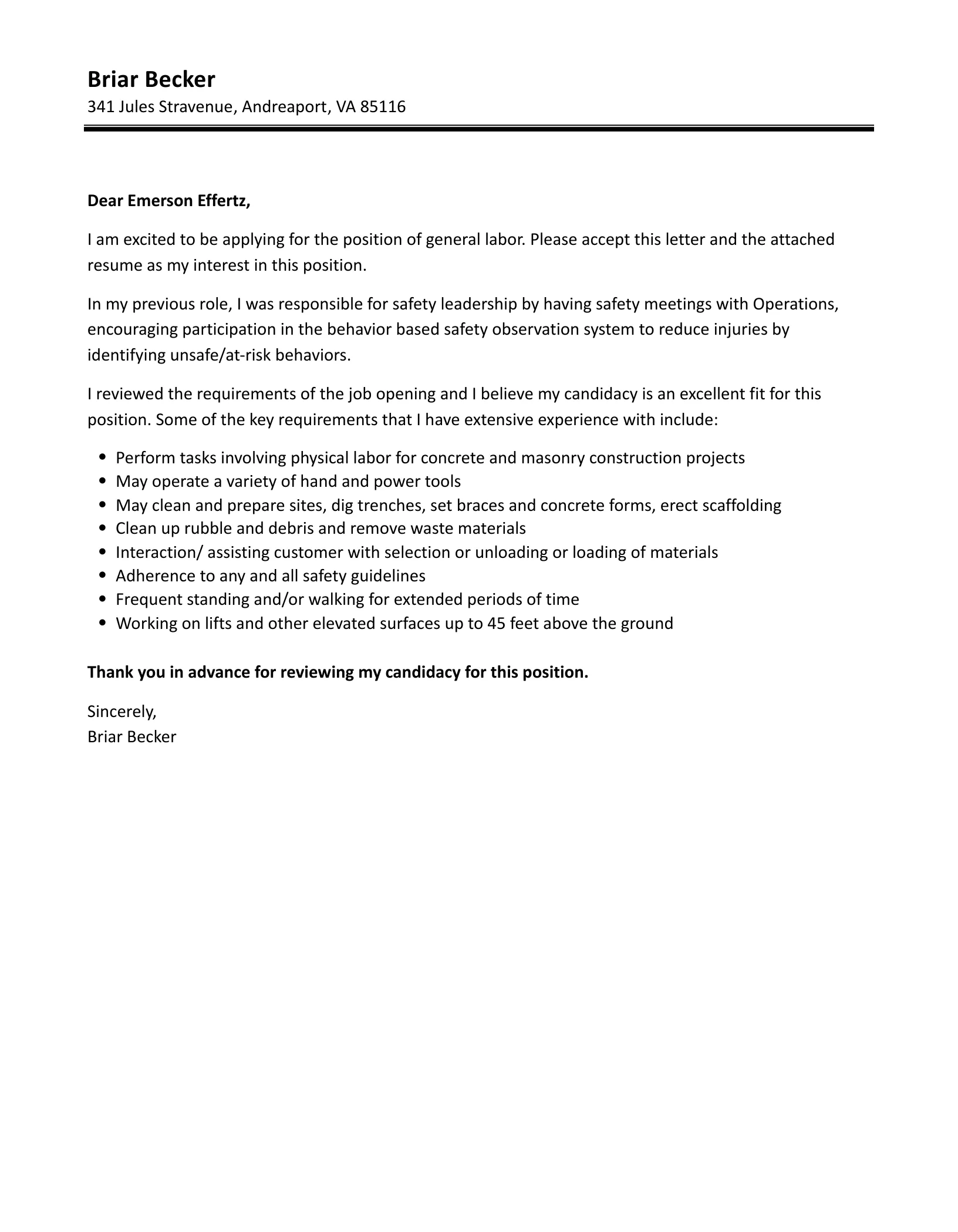
Crafting a Compelling General Labor Cover Letter
A well-written general labor cover letter is your first impression on a potential employer. It’s your opportunity to showcase your skills, experience, and personality, setting you apart from other applicants. This guide will walk you through the essential steps of creating a cover letter that grabs attention and increases your chances of landing a general labor position. The goal is to not just submit a document but to create a compelling narrative that highlights your suitability for the role. A strong cover letter complements your resume, providing context and demonstrating your enthusiasm for the opportunity. By following these guidelines, you can transform a generic application into a personalized statement that resonates with the hiring manager and gets you closer to your desired job.
Understanding the Purpose of a Cover Letter
The primary purpose of a cover letter is to introduce yourself to the employer and express your interest in the advertised position. It allows you to elaborate on the information presented in your resume, providing a narrative that connects your skills and experiences to the job requirements. Unlike a resume, which is a factual document, a cover letter allows you to highlight your personality, work ethic, and enthusiasm for the role. It’s also an excellent opportunity to explain any gaps in your employment history or to address any concerns the employer might have. A well-crafted cover letter can significantly increase your chances of securing an interview by showcasing your suitability and passion for the general labor position.
Highlighting Relevant Skills and Experience

General labor positions often require a diverse set of skills. Your cover letter should emphasize the skills and experiences most relevant to the specific job you’re applying for. Review the job description carefully and identify the key requirements the employer is seeking. Then, use your cover letter to demonstrate how your skills and experiences align with those requirements. Provide specific examples of how you have utilized these skills in the past. If you lack direct experience, focus on transferable skills and how you’ve demonstrated them in other contexts, such as volunteer work, academic projects, or previous part-time jobs. Quantify your achievements whenever possible to provide concrete evidence of your abilities.
Essential Skills for General Labor Positions
General labor roles demand a variety of skills, including physical stamina, the ability to follow instructions, and a willingness to learn. Include any certifications or training you’ve obtained, such as safety certifications (OSHA), forklift operation, or first aid/CPR. Highlight your experience with tools and equipment, detailing your familiarity with hand tools, power tools, and machinery. Emphasize your ability to read blueprints, perform basic mathematical calculations, or understand technical instructions. Be sure to mention any experience with construction, landscaping, or warehouse work, even if it was limited. These examples and specific skill mentions will make your cover letter more persuasive and increase your chances of standing out.
Showcasing Physical Abilities
Physical strength, endurance, and the ability to perform repetitive tasks are essential for general labor roles. In your cover letter, clearly state your physical capabilities. Mention your ability to lift heavy objects, stand for long periods, and work in various weather conditions. If you have experience in physically demanding jobs, describe those experiences, providing details about the tasks you performed and the challenges you overcame. Avoid vague statements, and instead, use specific examples that illustrate your physical abilities, such as the weight you can lift, the distances you can walk, or the types of tasks you are accustomed to performing. Consider adding details about your fitness level or any relevant training you’ve received.
Demonstrating Teamwork and Reliability

General labor positions often require teamwork and a strong work ethic. Highlight your ability to work effectively as part of a team, emphasizing any experience you have collaborating with others to achieve a common goal. Describe situations where you successfully resolved conflicts, communicated effectively, and supported your team members. Mention your punctuality, dependability, and commitment to following instructions. Providing examples of your reliability, such as consistently meeting deadlines or volunteering for extra tasks, will help showcase your positive work ethic. Employers value these qualities in general labor candidates, so make sure your cover letter clearly illustrates these aspects of your professional character.
Structuring Your General Labor Cover Letter
A well-structured cover letter is easy to read and highlights your key qualifications. Begin by formatting your cover letter professionally, using a standard font like Arial or Times New Roman, and ensuring consistent formatting throughout. Follow a standard business letter format, including your contact information, the date, the employer’s contact information, a professional greeting, body paragraphs, a closing, and your signature. A clear and organized structure helps the hiring manager quickly grasp the essence of your qualifications and encourages them to read the entire document. Proper formatting demonstrates attention to detail and professionalism, making your cover letter more impactful.
Header and Contact Information
At the top of your cover letter, include your full name, address, phone number, and email address. It is important to ensure that the contact information is accurate and up-to-date so that the potential employer can contact you easily. Underneath your contact information, include the date and the employer’s contact information, if available. If you know the name of the hiring manager, include it in your greeting. If not, use a general greeting like “Dear Hiring Manager.” Using proper header information is crucial for a professional presentation.
Professional Greeting and Introduction

Start your cover letter with a professional greeting, such as “Dear Mr./Ms./Mx. [Last Name],” if you know the hiring manager’s name. If not, use a general greeting like “Dear Hiring Manager.” In the introduction, state the position you are applying for and briefly explain how you learned about the opportunity. Express your enthusiasm for the role and the company. The introduction should be concise, setting the tone for the rest of the cover letter. Make sure to capture the reader’s attention and encourage them to continue reading your application.
Body Paragraphs – Showcasing Your Value
The body of your cover letter is where you demonstrate your qualifications and explain why you are a good fit for the position. Use one or two paragraphs to highlight your relevant skills, experience, and achievements. Provide specific examples that illustrate how you have used these skills in the past. Quantify your achievements whenever possible to provide concrete evidence of your abilities. Tailor your cover letter to the job description by addressing the specific requirements and responsibilities outlined in the job posting. Mentioning the company name and referencing its values or mission in this section will show that you’ve done your research.
Tailoring Your Cover Letter to the Job Description
Each cover letter should be tailored to the specific job you are applying for. This means carefully reviewing the job description and identifying the key requirements and responsibilities. Highlight the skills and experiences that align with these requirements. Use the same keywords and phrases that are used in the job description to demonstrate that you understand the role and what the employer is looking for. Avoid sending a generic cover letter; instead, show the employer that you’ve taken the time to understand their needs and that you are the right fit for the position.
Keywords and Phrases to Include

Incorporate relevant keywords and phrases from the job description throughout your cover letter. This helps the hiring manager quickly identify your qualifications and ensures your cover letter is noticed. Common keywords include “physical labor,” “teamwork,” “safety procedures,” “construction,” and specific equipment names. Use these terms naturally within your sentences, focusing on how you’ve demonstrated these skills and experiences in the past. Review the job description for any specific terminology or phrases the employer uses to describe the role and responsibilities. Integrating these keywords and phrases is a strategic way to ensure that your application aligns perfectly with the employer’s expectations.
Addressing Specific Requirements
Some job descriptions will include specific requirements, such as certifications, licenses, or experience with particular tools or equipment. Directly address these requirements in your cover letter. Mention any certifications or licenses you possess and how they relate to the job. If you have experience with specific tools or equipment, provide details about your familiarity and proficiency. If you lack a specific requirement, explain how you are working to obtain it or how your transferable skills and experiences make you a strong candidate. Addressing these specific requirements will demonstrate your understanding of the role and your commitment to the job.
Proofreading and Formatting Your Cover Letter
Before submitting your cover letter, proofread it carefully to eliminate any errors in grammar, spelling, and punctuation. Errors can create a negative impression and detract from your qualifications. Use a spell checker and grammar checker, but also read your cover letter aloud to catch any mistakes that might be missed. Have a friend or family member review your cover letter for clarity and accuracy. Ensure your cover letter is easy to read by using a clean font, consistent formatting, and appropriate spacing. A polished cover letter demonstrates attention to detail and professionalism, increasing your chances of making a positive impression.
Ensuring Clarity and Conciseness

Keep your cover letter clear, concise, and easy to understand. Avoid using overly complex language or jargon that might confuse the hiring manager. Use short, clear sentences and paragraphs. Focus on the most important information, and avoid unnecessary details. Make every word count, and use action verbs to create a dynamic and engaging narrative. Your cover letter should be brief, ideally one page in length. Brevity helps ensure that your key qualifications are highlighted and that the hiring manager can easily grasp the value you bring to the role.
Using Proper Grammar and Spelling
Errors in grammar and spelling can undermine your credibility and make your cover letter appear unprofessional. Carefully review your cover letter for any mistakes. Use a spell checker and grammar checker, but also read your cover letter aloud to catch any errors that might be missed. Pay close attention to punctuation, sentence structure, and word choice. Ensure that your cover letter flows smoothly and makes sense. A polished cover letter will demonstrate your attention to detail and enhance your chances of securing an interview. Always review your finished cover letter one last time before submitting it for accuracy.
Examples of Strong Action Verbs
Using strong action verbs can make your cover letter more dynamic and engaging. Action verbs create a sense of movement and demonstrate your accomplishments. Here are some examples of strong action verbs to include in your cover letter, such as: “Assisted,” “Constructed,” “Maintained,” “Operated,” “Repaired,” “Managed,” “Implemented,” and “Completed.” These verbs help you show the employer what you have done and make your accomplishments more tangible. Choose verbs that accurately reflect your skills and experiences, and use them throughout your cover letter to create a compelling narrative.
Closing Your Cover Letter and Following Up

In the closing paragraph, reiterate your interest in the position and express your enthusiasm for the opportunity. Thank the hiring manager for their time and consideration. Provide your contact information and state that you are available for an interview. It is also appropriate to mention that you look forward to hearing from them soon. After submitting your cover letter and resume, follow up with the employer within a week or two to reiterate your interest and inquire about the status of your application. This shows your continued interest and initiative, making you more memorable to the hiring manager.