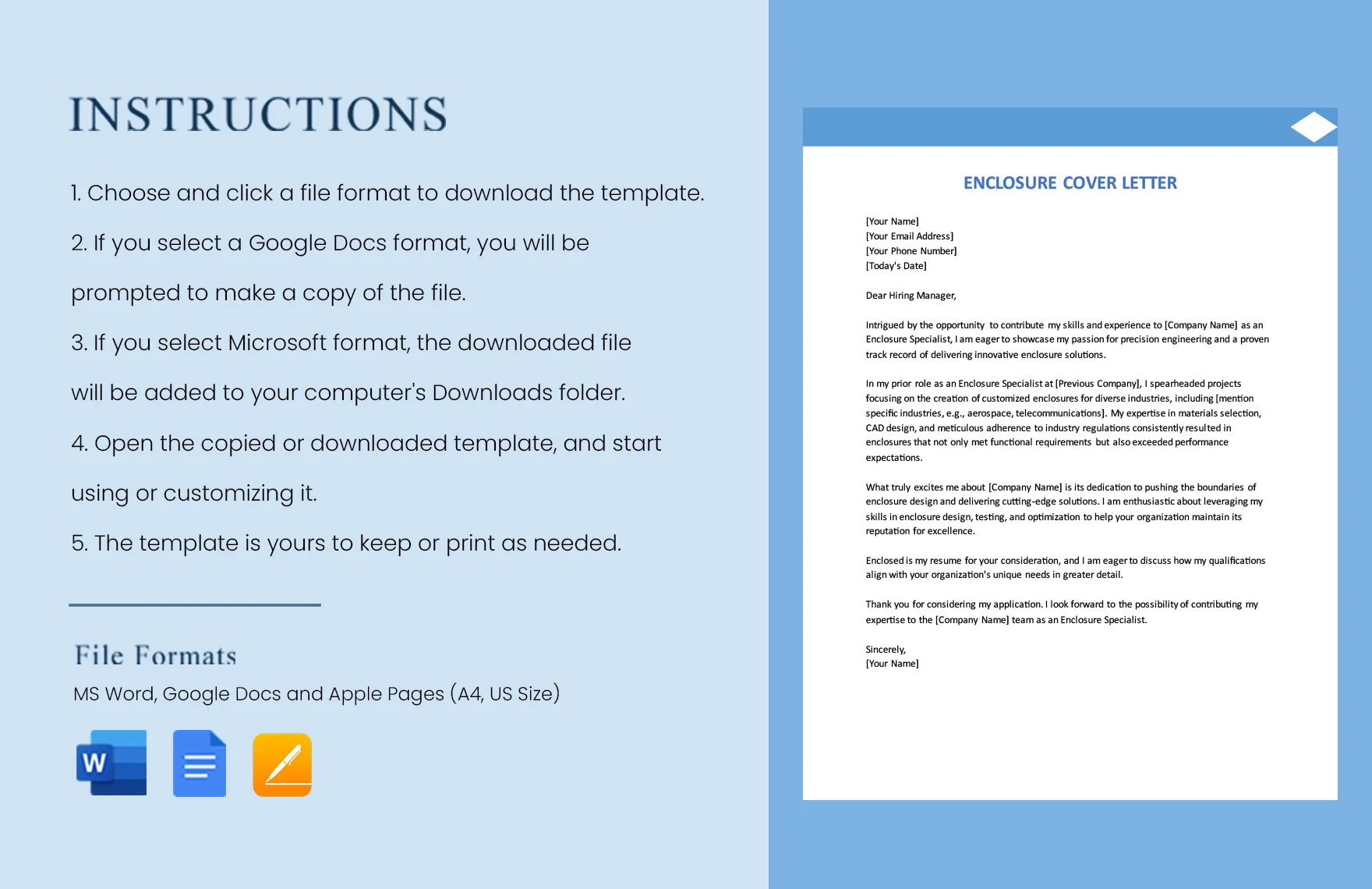
What are Enclosures in Cover Letters
Enclosures in a cover letter refer to any additional documents or materials that you are submitting along with your application. These items are meant to provide the hiring manager with a more comprehensive view of your qualifications, skills, and experience. They are an essential part of a job application and are meant to supplement the information presented in your cover letter and resume. Proper use of enclosures can significantly boost your chances of getting noticed. It is crucial to understand what constitutes an enclosure, how to format them, and how to properly reference them within your cover letter.
Enclosures often include items like your resume, references, or writing samples. Their purpose is to provide supporting evidence of the claims you make in your cover letter and resume. By including relevant enclosures, you demonstrate your attention to detail and commitment to the application process. When used strategically, enclosures can differentiate you from other applicants and showcase your suitability for the role. Moreover, they allow you to present additional information that might not fit within the confines of a standard cover letter or resume, providing a fuller picture of your professional background and capabilities.
Types of Enclosures You Can Include
The types of enclosures you include will depend on the specific job you’re applying for and the requirements of the employer. However, some common examples include your resume, a portfolio, writing samples, letters of recommendation, certifications, and transcripts. It’s important to carefully review the job description to determine what documents the employer expects or requests. Providing the requested enclosures shows that you pay attention to detail and are willing to go the extra mile to meet the application criteria. Always tailor your enclosures to match the job’s requirements, ensuring that each document supports your application.
Resume

Your resume is almost always included as an enclosure. It’s a detailed summary of your work experience, skills, education, and accomplishments. Make sure your resume is up-to-date, well-formatted, and tailored to the specific job you’re applying for. Highlighting relevant skills and experiences that align with the job description is crucial. Ensure your contact information is accurate and easy to find. Your resume serves as a key document that gives the employer an overview of your qualifications. Use a clear, professional font and layout to make it easy to read and scan.
Portfolio
A portfolio is essential if you’re applying for a creative or design-related role. It showcases your best work and gives the employer tangible examples of your skills. This could include writing samples, design projects, code snippets, or any other work that demonstrates your abilities. Ensure your portfolio is well-organized, easy to navigate, and features your most impressive projects. Provide context for each piece, explaining your role and the project’s objectives. A strong portfolio can be a powerful tool to impress potential employers and illustrate your capabilities. Consider hosting your portfolio online and including the link in your cover letter and resume.
Writing the Cover Letter Enclosure Section
The enclosure section of your cover letter is a concise statement informing the reader what documents you are including with your application. Typically, it appears at the end of your letter, just before your signature. Keep this section brief and professional. The primary goal is to clearly identify what you’ve attached for their review. By including this section, you are explicitly directing the hiring manager’s attention to the supplementary materials. The placement is important; make sure it is easily noticeable, so the reader doesn’t miss this vital information. Always check for any specific instructions or requirements from the employer regarding enclosures and include any specific instructions.
Placement and Formatting

The standard placement for the enclosure section is below the closing and your signature. Formatting varies slightly, but the aim is to be clear and easy to read. The phrase ‘Enclosure:’ or ‘Enclosures:’ followed by a list of the attached documents is common. For example, you might write ‘Enclosures Resume, Portfolio, and References.’ Ensure your enclosure section is easily distinguishable from the body of your letter. Keeping the formatting consistent throughout your cover letter is important. Use a clear and legible font, and avoid overly complex layouts. Proper formatting makes it easier for the recipient to quickly identify the documents.
Examples of Cover Letter Enclosure Statements
Here are a few examples of how to format your enclosure statement:
Example 1 Enclosure Resume Example 2 Enclosures Resume, Writing Sample, and Letters of Recommendation Example 3 Attachment Resume and Portfolio (Link Provided)
The wording should be straightforward and tailored to the documents you’ve included. Make sure to list all enclosures accurately. When providing a link to an online portfolio or resume, be certain that the link is active and takes the recipient directly to the intended content. When in doubt, it’s usually better to list more details than less.
“Enclosure” or “Attachments”
Both ‘Enclosure’ and ‘Attachments’ are acceptable terms for this section. ‘Enclosure’ is more traditional, while ‘Attachments’ is more modern. The term you choose is largely a matter of personal preference and professional standards. The main goal is to clearly communicate that additional documents are included with your application. If the job posting uses a specific term, such as ‘Attachments,’ it’s a good idea to use the same term to show attention to detail and professionalism. However, in the absence of any explicit guidance, either option is fine. Be consistent with the term you select.
Do’s and Don’ts for Cover Letter Enclosures

Properly managing enclosures can significantly affect your job application. There are certain practices that should be followed, and others that should be avoided. It is important to adhere to the employer’s guidelines. By carefully considering these dos and don’ts, you can make a strong impression and increase your chances of getting an interview. When in doubt, be professional, concise, and always tailor your approach to the specific job and employer.
Do Include
Do include all documents requested by the employer. Always proofread your enclosures for any errors. Format documents professionally, using clear fonts and layouts. Make sure your enclosures are relevant to the job you are applying for. Tailor your enclosures to match the job requirements. Use a consistent naming convention for your files. Ensure your contact information is up-to-date on all enclosures. Consider the file format when sending enclosures, and prioritize PDF format.
Don’t Include
Don’t include documents that are not requested unless they are highly relevant and add significant value. Avoid sending large files that might be difficult for the recipient to open. Don’t send files with unprofessional or confusing file names. Avoid making it difficult for the reader to find the relevant information within your enclosures. Don’t assume the reader will know which documents are included without explicitly stating them. Do not include any sensitive or confidential information unless absolutely necessary and properly secured.
Benefits of Using Cover Letter Enclosures

Using enclosures offers several benefits that can give you a competitive edge. They allow you to provide additional evidence to support your claims, helping to validate your skills and experience. Enclosures give a complete view of your qualifications and give the employer more reasons to consider you. They enable you to provide a variety of information, such as portfolios, writing samples, and recommendations. Well-crafted enclosures display your attention to detail and professionalism. By taking the time to include appropriate and well-prepared enclosures, you can improve your chances of getting noticed and securing an interview. Always tailor the enclosures to meet the specific job requirements.
In conclusion, enclosures in cover letters are an essential component of a job application. They provide additional information that strengthens your qualifications, supporting the claims made in your cover letter and resume. By following the guidelines on the correct use of enclosures, you increase your chances of being selected for an interview. Remember to carefully review the job description, include the requested documents, and maintain a professional and organized approach. Taking these steps will help you stand out from the competition and highlight your suitability for the role.