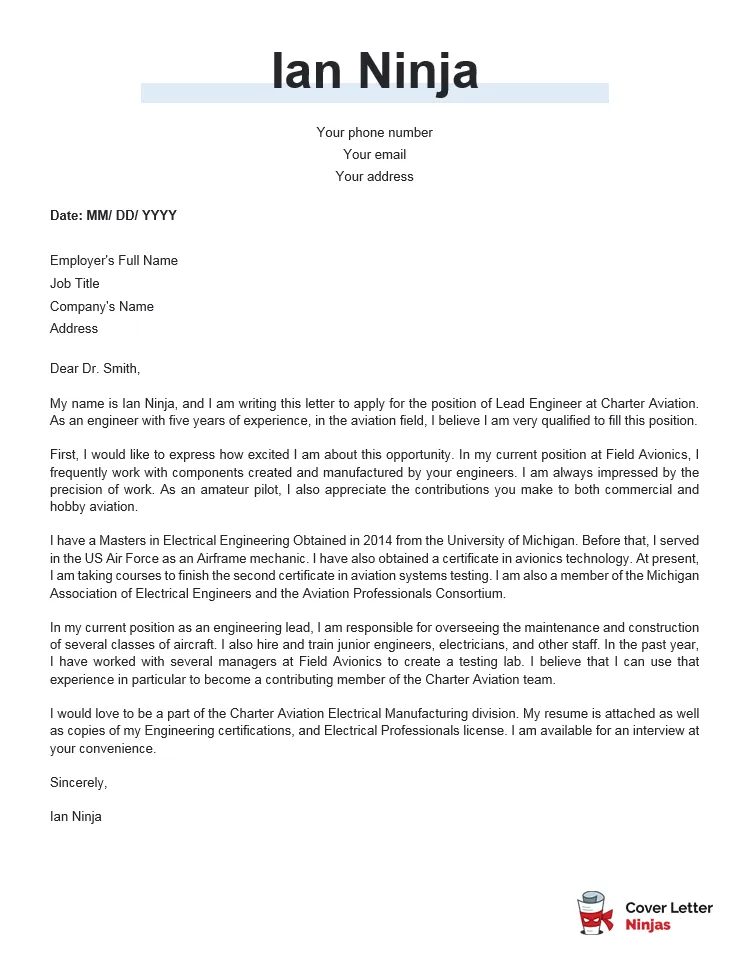
The Importance of an Impressive Electrical Engineer Cover Letter
In the competitive field of electrical engineering, a well-crafted cover letter is more than just a formality; it’s your first opportunity to make a strong impression. It serves as a crucial introduction, allowing you to showcase your skills, experience, and personality in a way that your resume alone cannot. A compelling cover letter for electrical engineering highlights your unique value proposition, demonstrating to potential employers why you are the ideal candidate. It’s your chance to tell a story, connect with the hiring manager, and stand out from the crowd. A great cover letter can significantly increase your chances of landing an interview and ultimately securing your dream job.
Highlighting Your Electrical Engineering Skills
Your cover letter should act as a spotlight, illuminating the key skills that align with the job requirements. Electrical engineering is a diverse field, and you should tailor your letter to the specific role you’re applying for. This involves carefully reviewing the job description and identifying the skills and qualifications the employer is seeking. Focus on the most relevant aspects of your experience and demonstrate how your abilities meet their needs. By emphasizing your relevant skills, you instantly signal to the employer that you possess the necessary expertise to excel in the position.
Technical Skills to Showcase

Electrical engineers require a diverse set of technical skills. Be sure to highlight your proficiency in areas such as circuit design, power systems, control systems, electronics, and signal processing. If the role requires specific technical knowledge, make sure to mention it. Provide concrete examples of how you have applied these skills in past projects, describing the results achieved and challenges overcome. For example, if the job demands experience in designing power distribution systems, detail your experience, the types of projects, and any improvements you implemented.
Software and Tools Proficiency
In addition to core technical skills, employers look for experience with relevant software and tools. List the software and tools you are proficient in, such as CAD software (e.g., AutoCAD, OrCAD), simulation software (e.g., SPICE, MATLAB, Simulink), and programming languages (e.g., C++, Python). Specify your level of proficiency for each tool and give examples of how you’ve used them in previous projects. If you have experience with industry-specific tools, such as those used for testing, measurement, or analysis, highlight those as well. Demonstrating your familiarity with these tools shows that you are ready to contribute from day one.
Project Experience and Accomplishments
Your project experience is a powerful way to demonstrate your practical application of electrical engineering principles. Describe your involvement in relevant projects, emphasizing your role, responsibilities, and the outcomes you achieved. Focus on projects that align with the job description’s requirements. Include details about the scope of the project, the technologies used, and the specific contributions you made. This section should showcase how your skills have translated into tangible results, highlighting your ability to solve problems and deliver successful projects. Make sure to quantify your achievements whenever possible, using metrics and data to support your claims.
Quantifying Your Achievements

Whenever possible, quantify your achievements to provide concrete evidence of your contributions. Use numbers and metrics to demonstrate the impact of your work. Instead of stating, ‘Improved system efficiency,’ write, ‘Improved system efficiency by 15%, resulting in a 10% reduction in energy consumption.’ Quantifying your accomplishments adds credibility to your claims and demonstrates your ability to deliver results. Include metrics such as cost savings, increased efficiency, project completion time, or any other relevant data that highlights your achievements in previous projects. This provides a clear and compelling picture of your capabilities.
Tailoring Your Cover Letter
A generic cover letter is easily spotted and often discarded. Customize each cover letter to align with the specific job requirements and the company’s values. Show that you have thoroughly researched the position and understand what the employer is looking for. Refer to the job description, and highlight the skills, experiences, and qualifications that match the required criteria. Demonstrate your enthusiasm for the specific role, the company’s mission, and how your skills will contribute to their goals. This level of personalization demonstrates your genuine interest and increases your chances of securing an interview.
Matching Skills to Job Requirements
The best cover letters clearly match your skills to the job’s requirements. Analyze the job description thoroughly and identify the key skills and qualifications the employer is seeking. Then, in your cover letter, explicitly state how your skills and experience meet those requirements. For instance, if the job description asks for experience with power distribution systems, dedicate a section to showcasing your work in that area, detailing projects, the results achieved, and any relevant certifications or training. Use keywords from the job description to make your application more easily searchable by applicant tracking systems (ATS).
Researching the Company

Demonstrate your interest by researching the company. Visit their website, read recent news articles, and explore their social media presence. Understand their mission, values, and recent projects. Incorporate your knowledge of the company into your cover letter, highlighting how your skills and experiences align with their objectives. For example, you could mention a specific project the company is working on and explain how your expertise could contribute. This shows you have taken the time to understand the company and are genuinely interested in joining their team. Addressing the hiring manager by name also adds a personal touch, demonstrating that you have put in the effort.
Formatting and Design Best Practices
The formatting and design of your cover letter can significantly impact how it is received. A well-formatted letter is easy to read, professional, and visually appealing. Ensure your cover letter is free from grammatical errors and typos, and pay attention to the overall layout. A clean and organized design reflects your professionalism and attention to detail. Choose a layout that is easy to navigate, with clear headings, concise paragraphs, and adequate white space. Your goal is to present your qualifications in a clear, engaging, and professional manner.
Font and Layout Suggestions
Select a professional font such as Times New Roman, Arial, or Calibri for your cover letter. These fonts are widely readable and convey a sense of professionalism. Use a font size between 10 and 12 points to ensure readability. The layout of your cover letter should be clean and well-organized. Use clear headings and subheadings to structure your content and make it easy for the reader to scan. Include adequate white space between paragraphs and sections to avoid a cluttered appearance. Maintain a consistent layout throughout the document to enhance its overall professionalism. Make sure it is well-aligned and uses a standard margin.
Proofreading and Editing for Perfection

Proofreading and editing are crucial steps in the cover letter writing process. Errors and typos can detract from your professionalism and make you appear careless. Before submitting your cover letter, carefully proofread it for any grammatical errors, spelling mistakes, or punctuation errors. Consider using spell-check and grammar-check tools, but don’t rely on them entirely. It’s also a good idea to have someone else review your cover letter. A fresh pair of eyes can often catch errors that you might have missed. Pay close attention to the tone and clarity of your writing, and ensure your cover letter presents you in the best possible light. Proofreading helps to ensure your cover letter is polished and error-free.
Key Elements of a Strong Electrical Engineer Cover Letter
A strong cover letter includes specific elements to effectively communicate your qualifications and make a compelling case for why you should be hired. These elements include your contact information, a professional opening, well-structured body paragraphs, and a compelling closing statement. By incorporating these key components, you can create a cover letter that captures the attention of the hiring manager and increases your chances of securing an interview.
Your Contact Information
At the top of your cover letter, include your contact information. This should include your name, address, phone number, and professional email address. Ensure your email address is professional. Consider including a link to your LinkedIn profile or online portfolio. Make it easy for the hiring manager to reach you, and ensure that your contact information is accurate and up-to-date.
Professional and Concise Opening

Your opening paragraph is your first opportunity to grab the reader’s attention. Start with a professional and concise opening. Address the hiring manager by name if possible, and clearly state the position you’re applying for. Briefly explain why you’re interested in the role and the company. Demonstrate your enthusiasm and your understanding of the company’s needs. Avoid generic openings. Aim for a strong, engaging opening that immediately captures the reader’s interest.
Body Paragraphs: Showcasing Your Value
The body paragraphs are where you showcase your skills, experience, and accomplishments. Use these paragraphs to highlight the most relevant aspects of your qualifications. Tailor your content to match the job description and provide specific examples of how you have applied your skills. Focus on your achievements and quantify them whenever possible. Be concise and to the point, and use clear, concise language. Each paragraph should focus on a specific skill or experience, demonstrating your value to the employer. This should be where you show your skills and experiences aligned to the job description.
A Compelling Closing Statement
Conclude your cover letter with a strong closing statement. Reiterate your interest in the position and the company. Express your enthusiasm for the opportunity and how your skills and experience can contribute to their success. Thank the hiring manager for their time and consideration, and include a call to action, such as requesting an interview. Ensure the tone is professional, and leave a positive and lasting impression. Your closing statement is your final chance to convince the employer that you are the best candidate for the job.