Cover Letter Template No Experience What to Include
Navigating the job market without prior professional experience can feel daunting, but a well-crafted cover letter can be your secret weapon. This guide provides a comprehensive approach to crafting a cover letter that effectively showcases your potential, even when you lack traditional work experience. The primary goal of your cover letter is to demonstrate to the hiring manager that you possess the skills, enthusiasm, and potential to excel in the role, irrespective of your past. Your cover letter should highlight why you are a good fit for the role, even without prior experience in a similar field. It should also convey your passion, drive, and eagerness to learn and contribute to the company’s success. This first section will focus on the essential components to include in a cover letter when you have little or no work experience, and how to adapt those components to your advantage.
Highlighting Transferable Skills
Transferable skills are the cornerstone of your cover letter when you’re light on experience. These are skills you’ve developed in various aspects of your life – academic projects, volunteer work, extracurricular activities, or personal hobbies – that can be applied to a professional setting. Some examples include communication, teamwork, problem-solving, time management, and leadership. Identify and showcase these skills. For instance, if you led a project in a student organization, highlight the leadership skills you demonstrated. If you worked on a team project, describe how you collaborated and communicated effectively. The key is to connect your skills to the job requirements. Review the job description carefully and identify the skills the employer is seeking. Then, provide concrete examples from your background that illustrate how you’ve used these skills successfully. Quantify your achievements whenever possible to make your skills more impactful. For example, instead of saying, “Improved communication skills,” say “Improved team communication, resulting in a 15% increase in project efficiency.”
Identifying Your Accomplishments

Even without paid work experience, you have accomplishments. Think about projects, coursework, volunteer roles, or personal initiatives where you achieved something significant. These accomplishments demonstrate your abilities and work ethic. When describing your accomplishments, use the STAR method: Situation, Task, Action, Result. Provide context (situation), explain the task you undertook, describe the actions you took, and highlight the results of your efforts. For example, if you organized a fundraising event, describe the situation (needing funds), the task (organizing the event), your actions (planning, marketing, managing volunteers), and the result (the amount of money raised or the positive impact on the community). Focus on outcomes and how your contributions made a difference. This approach will help you showcase your competence and ability to achieve results even in the absence of traditional work experience. Remember that achievements can also include solving problems, improving processes, or exceeding expectations in any setting. The goal is to demonstrate your ability to deliver value.
Tailoring Your Cover Letter
A generic cover letter is easily spotted and often discarded. Tailoring your cover letter to each job application is crucial. This involves customizing your letter to align with the specific requirements and expectations outlined in the job description. Start by carefully reviewing the job posting and identifying the key skills and qualifications the employer is looking for. Then, adapt your cover letter to highlight the experiences and skills that are most relevant to the role. Use the same language the employer uses in the job description to show that you understand their needs. Research the company and demonstrate your knowledge of their mission, values, and recent achievements. This shows your genuine interest and that you’ve put in the effort to learn more about the organization. Personalize your letter by mentioning the hiring manager’s name (if available) and tailoring your language and tone to suit the company culture. The more you tailor your letter, the more likely it is to stand out and resonate with the hiring manager.
Researching the Company and Role
Demonstrating that you have taken the time to research the company and the role is critical. This shows your genuine interest and your proactive approach. Before you start writing, visit the company’s website, read their mission statement, and browse their social media profiles to learn about their values, products, services, and recent news. Look for information about the company culture, as this will help you tailor your tone and style to match their environment. Understand the role you’re applying for by carefully reviewing the job description. Identify the key responsibilities, required skills, and desired qualifications. Think about how your experiences and skills align with these requirements and find ways to address them in your cover letter. If possible, research the hiring manager or other key individuals within the company. Understanding their background can provide insight into their priorities and allow you to personalize your letter further. Highlighting your knowledge of the company and the role will show the hiring manager that you are truly invested in the opportunity.
Showcasing Your Enthusiasm

Enthusiasm is contagious, and in the absence of experience, it can be your strongest asset. Let your passion for the role and the company shine through in your cover letter. Express your genuine interest in the position and the industry. Explain why you are excited about the opportunity and what motivates you to apply. Your enthusiasm should be evident in your tone, language, and the specific examples you provide. Avoid generic statements and instead, provide concrete reasons for your interest. For example, if you are passionate about the company’s mission, explain how you connect with it and why you want to contribute to it. If you are excited about the opportunity to learn new skills, mention the specific areas you are interested in and how you plan to develop them. Remember, the hiring manager is looking for someone who is motivated and eager to learn. Expressing your enthusiasm will help you to stand out from other candidates and show that you are invested in the success of the company.
Format and Structure of Cover Letter
A well-structured cover letter is easy to read and makes a positive impression. Follow a standard format to ensure clarity and professionalism. Begin with your contact information, the date, and the hiring manager’s name and title (if known). Use a professional business letter format with appropriate spacing and clear paragraphs. The body of your cover letter typically consists of three to four paragraphs. In the first paragraph, state the position you’re applying for and where you found the job posting. The second paragraph is where you highlight your relevant skills and experiences, emphasizing transferable skills. The third paragraph should showcase your enthusiasm for the role and the company. In the final paragraph, express your interest in an interview and thank the hiring manager for their time and consideration. Keep your letter concise and focused, ideally within one page. Use a professional font like Times New Roman, Arial, or Calibri, and ensure your letter is free of grammatical errors and typos. A well-formatted cover letter demonstrates your attention to detail and professionalism.
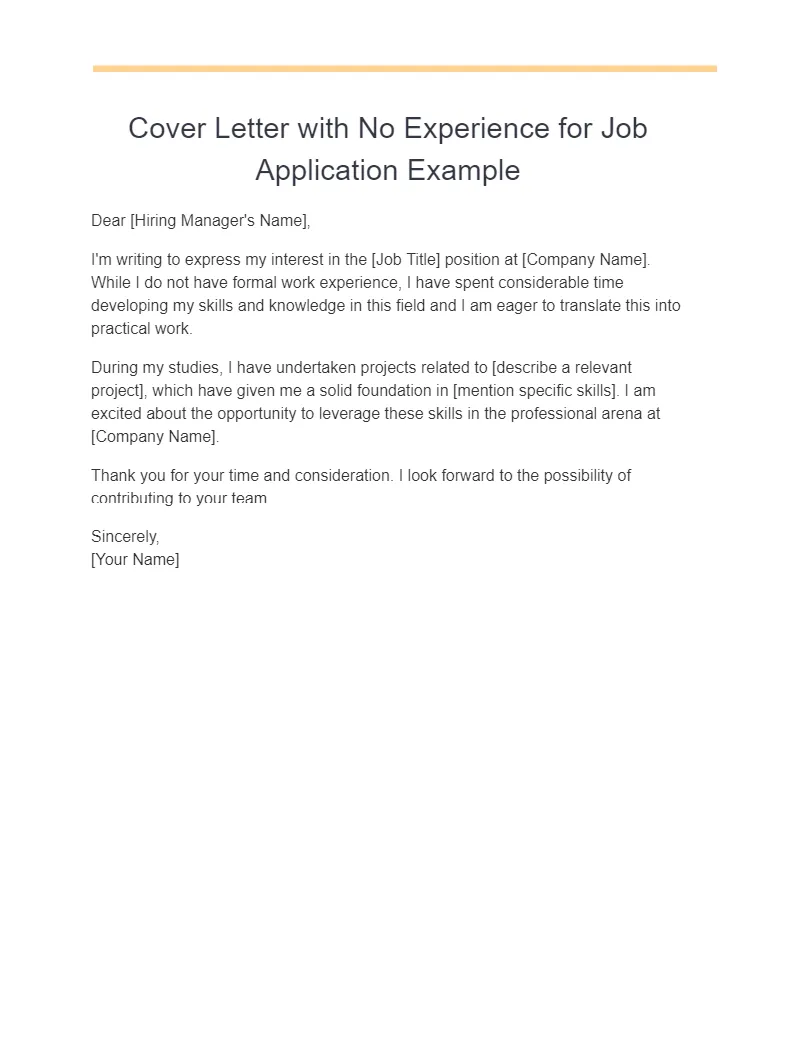
Cover Letter Template Example
To provide a clear example, a template is: [Your Name] [Your Address] [Your Phone Number] [Your Email]
[Date]
[Hiring Manager Name (if known)] [Hiring Manager Title] [Company Name] [Company Address]
Dear [Mr./Ms./Mx. Last Name],
I am writing to express my keen interest in the [Job Title] position at [Company Name], as advertised on [Platform]. While my background may not include extensive professional experience in [specific field], I am confident that my skills and enthusiasm make me a strong candidate.
In my previous role as [Your role] at [Organization name], I have developed [skill 1], [skill 2], and [skill 3], all of which are directly relevant to the responsibilities outlined in the job description. For example, [Provide brief example]. I am eager to apply these skills to contribute to [Company Name]’s success.
[Company Name]’s commitment to [Company value or mission] greatly resonates with me, and I am particularly drawn to [Specific aspect of the role or company]. I am excited about the opportunity to learn and grow within your organization.
Thank you for your time and consideration. I have attached my resume for your review and welcome the opportunity to discuss my qualifications further in an interview.
Sincerely, [Your Signature] [Your Typed Name] This example should be tailored to each application.
Proofreading and Polishing Your Cover Letter

Before submitting your cover letter, meticulous proofreading is non-negotiable. Errors and typos detract from your professionalism and can undermine your credibility. Read your cover letter multiple times, paying close attention to grammar, spelling, punctuation, and formatting. Use a spell-checker and grammar-checker, but don’t rely on them entirely. These tools may not catch all errors, particularly those related to context or word choice. Have a friend, family member, or career advisor review your letter for feedback. A fresh pair of eyes can catch errors you might have missed. Ensure your cover letter flows logically and is easy to read. Use clear and concise language, and avoid jargon or overly complex sentences. Remember, your cover letter is a reflection of your attention to detail and your commitment to excellence. Proofreading ensures your cover letter makes a positive and professional impression.
Highlighting Volunteer Work, Internships & Projects
If you have volunteer experience, internships, or personal projects, these are excellent additions to your cover letter. Describe your responsibilities and accomplishments in these roles, even if they were unpaid. Highlight the skills you developed and the results you achieved. For volunteer work, explain the mission of the organization and your contributions. Quantify your accomplishments whenever possible. For example, instead of saying, “Assisted with event planning,” say, “Planned and executed a fundraising event that raised $5,000 for the organization.” For internships, describe your role, the tasks you completed, and the skills you gained. If you completed a personal project, explain the project’s goals, your approach, and the outcomes. Show how these experiences demonstrate your initiative, skills, and ability to contribute to the workforce. These experiences show your initiative and that you are willing to learn and contribute to a team. The more you highlight your volunteer work, internships, and projects, the more you will show that you can work in a team environment.
Emphasizing Your Soft Skills
Soft skills are essential for success in any role and often transferable across industries. In the absence of extensive work experience, emphasize your soft skills in your cover letter. Highlight skills like communication, teamwork, problem-solving, adaptability, time management, and leadership. Provide specific examples of how you have demonstrated these skills in your past experiences. For example, if you’re highlighting your communication skills, describe a situation where you effectively communicated with a team or presented information to a group. If you’re emphasizing teamwork, explain how you collaborated with others to achieve a common goal. Use action verbs to showcase your skills, such as “communicated,” “collaborated,” “solved,” “managed,” and “led.” The STAR method can be particularly useful when describing your soft skills. By illustrating your soft skills with specific examples, you demonstrate your ability to contribute to the workplace and increase your chances of getting noticed.
Call to Action and Follow-up

Conclude your cover letter with a strong call to action and information about your follow-up plan. Clearly express your interest in an interview and reiterate your enthusiasm for the role and the company. Thank the hiring manager for their time and consideration. Include a statement indicating your willingness to provide additional information or answer any questions they may have. State that you have attached your resume for their review. After submitting your cover letter and resume, follow up with the hiring manager or the company to reiterate your interest. Send a brief email or make a phone call within a week of submitting your application. Thank them for their time and reiterate your enthusiasm for the opportunity. This follow-up demonstrates your initiative and your genuine interest in the role, which can significantly increase your chances of getting hired. A strong call to action and follow-up plan will improve your chances of getting the job.