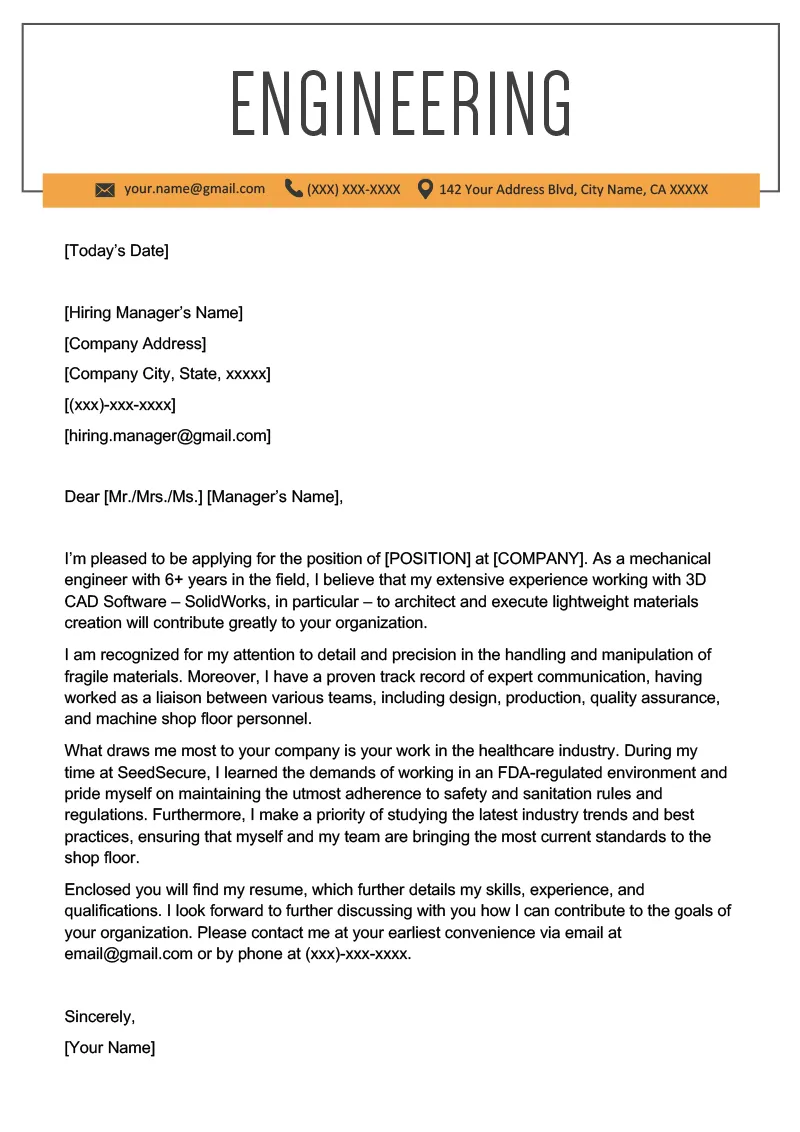
Why a Strong Cover Letter Matters in Engineering
In the competitive field of engineering, a well-crafted cover letter is not just a formality it is your first opportunity to make a lasting impression on a potential employer. Think of it as your personal introduction a chance to showcase your unique qualifications and personality beyond the confines of your resume. A strong cover letter can set you apart from other applicants, especially when you’re applying for engineering positions, where technical skills are paramount. It provides context to your resume, allowing you to explain the “why” behind your experiences and highlighting how your skills and experiences align with the specific job requirements. A compelling cover letter demonstrates your communication skills and genuine interest in the position and the company, increasing your chances of securing an interview and ultimately landing your dream engineering role.
Furthermore, a cover letter allows you to address any potential gaps or concerns in your application. For example, if you’re transitioning from a different engineering discipline or have a significant gap in employment, your cover letter can provide a clear explanation and reframe it as a positive. It’s also a great place to highlight your soft skills, such as teamwork, problem-solving, and communication, which are critical in engineering roles. These skills are often not as explicitly detailed on a resume but are highly valued by employers. By investing time and effort in crafting a detailed cover letter, you can significantly boost your chances of catching the hiring manager’s attention and showcasing yourself as a well-rounded, qualified candidate who is eager to contribute to the company’s success.
Highlighting Your Technical Skills
Your cover letter is the ideal place to highlight the technical skills most relevant to the engineering position you are applying for. It’s not enough to simply list these skills; you need to provide context and demonstrate how you have used them in previous projects or roles. Start by reviewing the job description carefully and identifying the key technical skills the employer is seeking. Then, in your cover letter, explicitly mention these skills and provide brief examples of how you’ve applied them to solve problems or achieve results. This can include programming languages, software proficiency, specific design tools, or engineering methodologies. For instance, if the job requires proficiency in CAD software, you could describe a project where you used CAD to design a complex mechanical system, highlighting your ability to create detailed models and ensure precision.
When describing your technical skills, use action verbs to create a compelling narrative. Instead of saying “familiar with MATLAB,” write “Utilized MATLAB to simulate and analyze thermal properties.” This approach demonstrates your hands-on experience and ability to apply your skills to practical situations. Furthermore, quantify your achievements whenever possible. Instead of saying “improved efficiency,” state “Improved system efficiency by 15% through optimized code.” By providing concrete examples and quantifiable results, you can effectively showcase the value you bring to the table. This focused approach proves to the employer that you possess the specific expertise required for the job and the ability to make a meaningful contribution to their team. The more relevant and detailed your explanation, the more likely you’ll stand out from the crowd.
Quantifying Your Achievements

In the engineering field, quantifying your achievements is crucial for demonstrating your impact and value to potential employers. While listing your skills and experiences is important, providing concrete, measurable results allows you to showcase your accomplishments in a tangible way. Whenever possible, use numbers, percentages, and specific data points to illustrate the positive outcomes you have achieved in previous roles or projects. For example, instead of saying “Improved product design,” state “Reduced product development time by 20% through the implementation of a new design methodology.” This not only highlights your technical expertise but also emphasizes your ability to drive efficiency and deliver results.
When quantifying your achievements, focus on metrics that are relevant to the engineering position you are applying for. Consider the key performance indicators (KPIs) that the employer likely values, such as cost savings, performance improvements, efficiency gains, or project completion rates. If you’ve worked on projects where you’ve implemented innovative solutions, be sure to quantify the impact of those solutions. This might include a reduction in material costs, an increase in system reliability, or an improvement in product performance. By presenting your accomplishments in a data-driven manner, you provide solid evidence of your capabilities and demonstrate your potential to contribute to the company’s success. It shows a clear understanding of the impact you can make and your dedication to delivering positive results in the workplace.
Showcasing Your Engineering Projects
Engineering projects provide a prime opportunity to demonstrate your skills, knowledge, and passion for the field. Your cover letter is the perfect place to highlight the most relevant and impressive projects you have undertaken, whether they were part of your academic studies, internships, or previous employment. Choose projects that align with the requirements of the job description and allow you to showcase the technical skills, problem-solving abilities, and innovative thinking that the employer is seeking. Provide a brief overview of each project, including the objectives, your role, the challenges you faced, and the solutions you implemented. Don’t just list the project; explain what you did, how you did it, and the results you achieved.
When describing your engineering projects, focus on the practical application of your skills and the impact of your work. Did you design a new system, improve an existing process, or solve a complex problem? Quantify your achievements whenever possible. Did your project lead to cost savings, efficiency improvements, or enhanced performance? Use specific metrics to illustrate your contributions. For example, you might state, “In my senior design project, I designed a novel water filtration system that improved water purification rates by 25% while reducing energy consumption by 15%.” This provides the hiring manager with a clear understanding of your capabilities and your potential value to their organization. Highlighting your projects is not just about listing what you have done; it’s about demonstrating your ability to deliver tangible results and make a positive impact.
Tailoring Your Letter to the Job Description
One of the most crucial cover letter secrets for engineering jobs is tailoring your letter to the specific job description. Generic cover letters that apply to all positions are unlikely to impress hiring managers. Instead, thoroughly review the job description and identify the key requirements, skills, and qualifications that the employer is seeking. Use this information to customize your cover letter, highlighting the specific experiences and skills that align with the job’s needs. This demonstrates that you’ve taken the time to understand the position and that you are genuinely interested in the opportunity.
When tailoring your cover letter, pay close attention to the language used in the job description. Use similar keywords and phrases to demonstrate that you understand the role and the company’s priorities. This helps the hiring manager quickly see that you possess the skills and experience they are looking for. Address the specific responsibilities and challenges mentioned in the job description and explain how your skills and experiences make you the ideal candidate to address them. Show, don’t just tell, how you meet the requirements. For example, if the job requires proficiency in a particular software, provide an example of a project where you utilized that software to achieve specific results. By personalizing your cover letter, you significantly increase your chances of getting noticed and securing an interview for the position. This thoughtful approach shows that you are seriously considering the role and that you are a good fit for the company’s culture.
Understanding the Company’s Values

Before you write your cover letter, take some time to research the company’s values, mission, and culture. Understanding these aspects of the organization will enable you to tailor your cover letter to align with their core principles. Visit the company’s website and explore their “About Us” or “Careers” sections to gain insights into their values, objectives, and employee expectations. Look for information about their team environment, commitment to innovation, or dedication to sustainable practices. Incorporate these values into your cover letter to demonstrate that you share similar beliefs and that you would be a good cultural fit.
When describing your experiences and skills, relate them to the company’s values. For example, if the company values teamwork, emphasize your experience collaborating with colleagues on projects. If they prioritize innovation, highlight your ability to think creatively and develop innovative solutions. Use the company’s language and tone to create a connection and show that you understand their priorities. Demonstrating this understanding can significantly increase your chances of making a positive impression on the hiring manager. Showing that you’ve done your homework and understand what the company stands for positions you as an applicant who not only has the required skills but also fits well into their work environment. This can be a decisive factor in the hiring process.
Keywords and Phrases in Your Cover Letter
In today’s competitive job market, strategically incorporating relevant keywords and phrases into your cover letter is essential. Applicant Tracking Systems (ATS) are often used to screen applications, and these systems search for specific keywords to identify qualified candidates. To ensure your cover letter passes this initial screening, carefully review the job description and identify the keywords and phrases that describe the required skills, experiences, and qualifications. Include these keywords naturally throughout your cover letter, particularly in the opening paragraph, skills section, and project descriptions.
Avoid keyword stuffing, which can make your cover letter appear unnatural and diminish its impact. Instead, weave the keywords into the narrative to highlight your experience and qualifications. For example, instead of simply listing “CAD, MATLAB, Python,” integrate these skills into your descriptions of projects and accomplishments. For instance, you might write, “Utilized CAD software to design intricate components, leading to a 15% reduction in material waste.” Additionally, use industry-specific terminology and phrases to demonstrate your understanding of engineering principles and practices. This will not only help your cover letter get past the ATS but also show the hiring manager that you have a deep understanding of the engineering field and its best practices. A well-placed keyword can significantly improve your chances of getting noticed, but it must be part of a clear, concise, and engaging story.
Formatting for Clarity and Impact
The visual presentation of your cover letter plays a crucial role in making a positive first impression. Formatting for clarity and impact can significantly enhance readability and grab the hiring manager’s attention. Choose a professional and easy-to-read font, such as Times New Roman, Arial, or Calibri, and maintain a consistent font size throughout your letter. Use clear headings and subheadings to break up the text and make it easier for the reader to navigate the content. Employ bullet points or numbered lists to highlight your achievements, skills, and project details, making the information concise and easy to digest.
Keep your cover letter concise and focused. Aim for one page, and avoid lengthy paragraphs or dense blocks of text. Use ample white space to improve readability and make the letter visually appealing. Ensure proper margins and alignment to create a clean and professional look. Proofread your cover letter carefully to eliminate any grammatical errors, typos, or inconsistencies. A well-formatted cover letter demonstrates attention to detail and professionalism, making a positive statement about your organizational skills and communication abilities. Remember, the visual presentation is part of the overall impression you make and can influence the hiring manager’s perception of your abilities. A polished and well-organized cover letter is a reflection of your capabilities and professionalism.
Proofreading and Editing Your Cover Letter

Proofreading and editing your cover letter is the final crucial step in ensuring a polished and professional application. Before submitting your letter, carefully review it for any grammatical errors, spelling mistakes, or punctuation errors. These errors can detract from your credibility and make you appear less detail-oriented. Use a grammar and spell-checking tool, but don’t rely on it entirely; these tools often miss subtle errors. Read your cover letter aloud, as this can help you identify awkward phrasing and other errors that you might miss when reading silently. Consider asking a friend, family member, or career advisor to review your cover letter for a fresh perspective.
Pay close attention to the clarity and conciseness of your writing. Ensure that your message is clear, easy to understand, and effectively communicates your qualifications and interest in the position. Eliminate any unnecessary jargon or overly complex sentences. Make sure your tone is professional, enthusiastic, and aligned with the company’s culture. Edit your cover letter to make it concise and focused, avoiding any irrelevant details. A well-proofread and edited cover letter demonstrates that you are detail-oriented, committed to quality, and take pride in your work. This attention to detail can make a significant difference in how hiring managers perceive you, increasing your chances of securing an interview and ultimately landing the engineering job you desire. Always be sure to tailor the document and re-proof it after each edit.
Conclusion
Crafting a compelling cover letter is essential for anyone seeking an engineering position. By following these cover letter secrets, including highlighting your technical skills, quantifying your achievements, and tailoring your letter to the job description, you can significantly increase your chances of landing an interview and ultimately securing your dream engineering role. Remember to showcase your achievements, use relevant keywords, and always proofread your work. By investing time and effort in creating a strong cover letter, you can make a lasting impression and stand out from the competition. Good luck with your engineering job applications!