Understanding the Safety Manager Role
Before you begin crafting your cover letter, it’s crucial to understand the responsibilities of a safety manager. This understanding will help you tailor your letter to showcase your relevant experience and skills. A safety manager is responsible for ensuring a safe and healthy work environment, preventing accidents, and complying with safety regulations. They play a vital role in protecting employees and minimizing workplace hazards. A successful safety manager possesses a deep understanding of safety protocols, risk assessment, and regulatory compliance. They are proactive, detail-oriented, and possess excellent communication skills to effectively implement safety programs and train employees. Emphasizing these aspects in your cover letter will demonstrate your suitability for the role. Showing you understand the position and its importance is a crucial step in getting hired.
Key Responsibilities of a Safety Manager
A safety manager’s responsibilities are diverse and require a multifaceted skill set. These professionals conduct regular inspections to identify potential hazards, develop and implement safety programs, and investigate accidents. They also provide safety training to employees, ensuring everyone understands safety protocols and best practices. Furthermore, safety managers are responsible for staying up-to-date with safety regulations and ensuring compliance with all relevant laws. They often work closely with management to create a culture of safety within the organization. It’s also their job to analyze incident data to identify trends and areas for improvement. Showcasing your experience with these responsibilities in your cover letter will significantly boost your chances of getting hired.
Essential Skills for Safety Managers

To excel as a safety manager, several key skills are essential. These include a strong understanding of safety regulations and standards, excellent communication and interpersonal skills, and the ability to analyze data and identify trends. Safety managers must also be able to develop and deliver effective training programs and possess strong problem-solving and decision-making abilities. Furthermore, the ability to work effectively with diverse teams, manage conflict, and remain calm under pressure is vital. Demonstrate these skills through specific examples in your cover letter. For example, mention your experience with risk assessments, incident investigations, and safety program implementation. Highlight any certifications, such as OSHA certifications, and your experience with safety management software, as these skills are highly valued by employers. Proving you have the skills and experience will help you stand out from the crowd.
Crafting a Compelling Cover Letter
Your cover letter is your first opportunity to make a positive impression on a potential employer. It should be well-written, concise, and tailored to the specific job you are applying for. Start by researching the company and the specific requirements of the safety manager position. Address your letter to the hiring manager by name, if possible. Make sure to clearly state the position you are applying for in the first paragraph. Highlight your key qualifications and experiences, focusing on how your skills and experience align with the job requirements. Maintain a professional tone and be sure to proofread your letter carefully for any errors. Your cover letter is a chance to go beyond your resume, demonstrating your personality, enthusiasm, and suitability for the role. Show you are passionate about the work and the company and express your desire to contribute to the organization’s safety culture.
Formatting Your Cover Letter
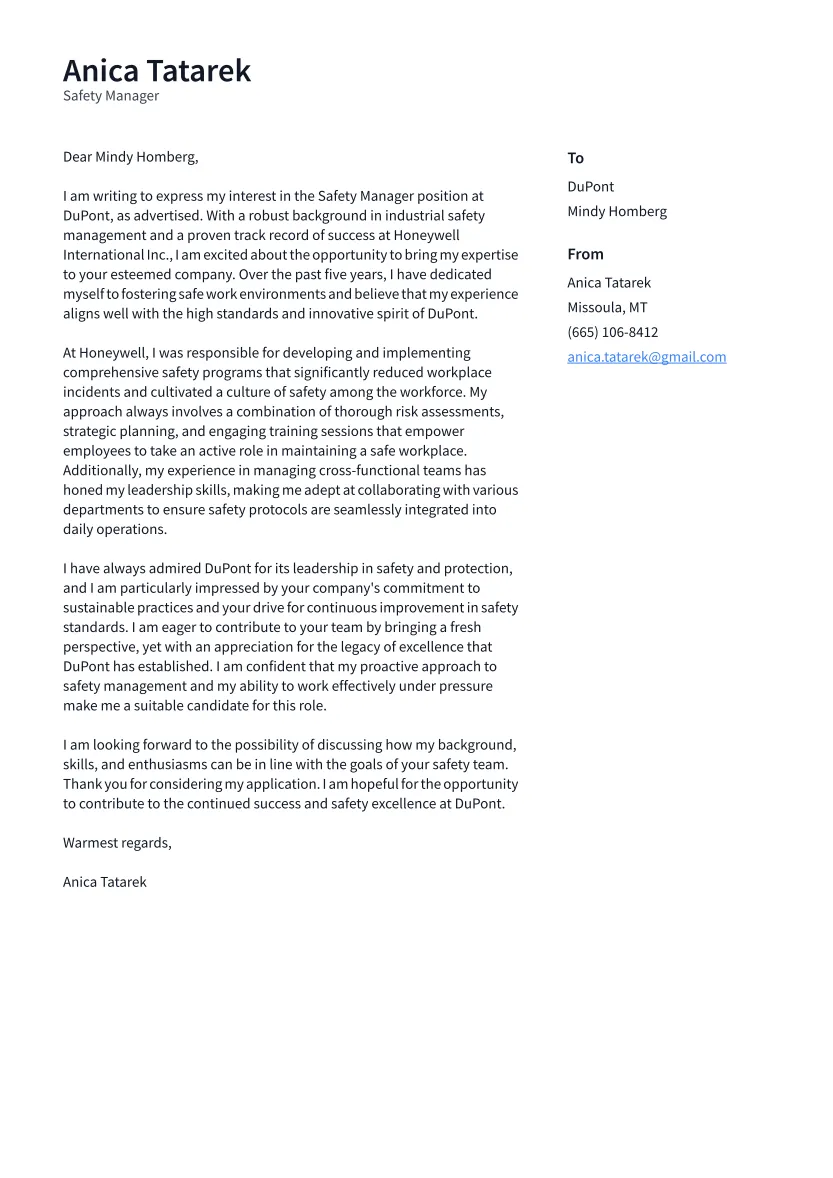
Proper formatting is essential for making your cover letter easy to read and visually appealing. Use a professional font, such as Times New Roman or Arial, and maintain a consistent font size throughout the document. Keep your letter concise, ideally within one page. Use clear headings and subheadings to organize your content and make it easy for the reader to scan. Use bullet points to highlight your key achievements and skills. Avoid using jargon or overly complex language. Ensure your letter has adequate margins and spacing, and proofread it carefully to eliminate any typos or grammatical errors. A well-formatted cover letter demonstrates your attention to detail and professionalism, making a positive impression on the hiring manager. Ensure your formatting is consistent with standard business letter formats, and consider using a template to ensure a polished appearance.
Header and Contact Information

Your header should include your full name, address, phone number, and email address. Ensure this information is accurate and up-to-date. Place this information at the top of the letter, either left-aligned or centered. Below your contact information, include the date, and then the hiring manager’s name, title, and company address. If you don’t know the hiring manager’s name, research the company website or LinkedIn to find out. Addressing the letter to a specific person adds a personal touch. Double-check all contact information to ensure the hiring manager can easily reach you. This is a crucial element; if they can’t reach you, you won’t get the interview.
Greeting and Introduction
Start your cover letter with a professional greeting, such as “Dear Mr./Ms. [Last Name]” or “Dear Hiring Manager.” In your introduction, clearly state the position you are applying for and where you saw the job posting. Briefly mention why you are interested in the role and the company. Make a strong first impression by highlighting your most relevant qualifications and experiences. Show your enthusiasm and express your eagerness to contribute to the company’s safety goals. Keep the introduction concise and to the point, setting the tone for the rest of the letter. Your opening paragraph should immediately grab the reader’s attention and make them want to learn more about you.
Highlighting Relevant Experience
In the body of your cover letter, provide specific examples of your experience and how it relates to the job requirements. Focus on the key responsibilities and skills mentioned in the job description. Describe your accomplishments in previous roles, quantifying your achievements whenever possible. Use action verbs to describe your responsibilities and accomplishments, such as “managed,” “implemented,” “developed,” and “trained.” Explain how you have successfully implemented safety programs, reduced workplace accidents, and ensured regulatory compliance. Demonstrate your understanding of safety management principles and your ability to apply them effectively. Focus on the most relevant aspects of your experience to capture the hiring manager’s attention. Your goal is to show you can do the job and have the experience needed to be successful.
Quantifying Achievements

Wherever possible, quantify your achievements to demonstrate your impact. Instead of saying you “improved safety,” state that you “reduced workplace accidents by 30% in one year” or “saved the company $10,000 annually through effective safety programs.” Use numbers and statistics to support your claims. For example, mention the number of employees you’ve trained, the number of safety inspections you’ve conducted, or the percentage of compliance you’ve achieved. Quantifying your accomplishments makes your cover letter more compelling and demonstrates your ability to deliver results. Provide concrete evidence of your success in previous roles. Showing you can use data to improve safety helps employers understand your worth to their organization.
Demonstrating Skills and Certifications
Clearly outline your relevant skills and certifications in your cover letter. Highlight any specific safety certifications you hold, such as CSP (Certified Safety Professional), CHST (Certified Health and Safety Technician), or OSHA certifications. Mention your expertise in safety management systems, risk assessment, incident investigation, and safety training. If the job description mentions specific software or equipment, include your experience with those tools. Demonstrate your ability to apply safety principles, interpret regulations, and develop and implement safety programs. Show how your skills align with the specific requirements of the job. Listing your skills and certifications is a direct way to show the hiring manager that you possess the necessary qualifications. Demonstrate you can do the work from day one.
Mentioning Specific Accomplishments
Provide specific examples of your accomplishments in previous safety management roles. Describe a time you successfully implemented a new safety program that reduced accidents, improved employee morale, or saved the company money. Share an instance where you successfully investigated an accident and identified the root cause. Describe your experience with safety audits and inspections, including how you identified and corrected safety hazards. Detail any awards or recognition you have received for your safety efforts. Mentioning specific accomplishments proves that you are an effective and results-oriented safety manager. These examples bring your qualifications to life and allow the hiring manager to visualize your contributions to their organization.
Expressing Enthusiasm and Professionalism

Throughout your cover letter, express your enthusiasm for the position and the company. Demonstrate your passion for safety and your commitment to creating a safe and healthy work environment. Show your understanding of the company’s values and mission, and explain how your skills and experience align with their goals. Maintain a professional tone and avoid using overly casual language. Proofread your letter carefully to eliminate any typos or grammatical errors. Your cover letter should reflect your professionalism and attention to detail. Enthusiasm and professionalism will make you stand out as a strong candidate and show you are eager to be part of the company’s team and culture.
Closing the Cover Letter
In your closing paragraph, reiterate your interest in the position and express your gratitude for the opportunity to be considered. Thank the hiring manager for their time and consideration. Reiterate your key qualifications and skills, and express your confidence in your ability to contribute to the company’s success. Keep the closing brief and professional, summarizing your main points and reinforcing your interest in the job. End your letter with a professional closing, such as “Sincerely” or “Best regards,” followed by your typed name.
Call to Action
Include a clear call to action in your closing paragraph, such as expressing your availability for an interview. State that you are eager to discuss your qualifications further and explain how you can contribute to the company’s safety goals. Provide your contact information again, making it easy for the hiring manager to reach you. Make it easy for the hiring manager to take the next step. This could involve requesting an interview, offering to provide references, or expressing your excitement about the opportunity. A clear call to action indicates your eagerness to move forward in the hiring process and helps the hiring manager know the next step.
Proofreading and Editing

Proofreading and editing your cover letter is a crucial step in ensuring it makes a positive impression. Carefully review your letter for any errors in grammar, spelling, and punctuation. Ensure your sentences are clear, concise, and easy to understand. Have someone else review your letter to catch any mistakes you may have missed. Proofreading is not just about eliminating errors, it’s also about ensuring your letter flows smoothly and conveys your message effectively. Take the time to edit your cover letter to perfection. A polished and error-free cover letter demonstrates your attention to detail and professionalism. A well-written and error-free cover letter reflects positively on your skills and increases your chances of getting an interview.