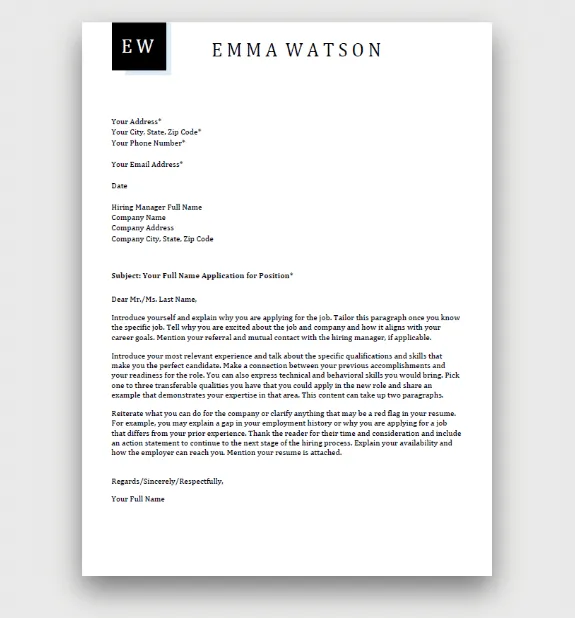
What is a Cover Letter
A cover letter is a crucial document that accompanies your resume when applying for a job. It serves as your introduction to the hiring manager, providing context to your application and highlighting your suitability for the position. Unlike a resume, which offers a factual overview of your experience and skills, a cover letter allows you to express your personality, enthusiasm, and unique qualifications. It’s your chance to make a compelling case for why you are the ideal candidate, demonstrating how your skills and experiences align with the job requirements and the company’s needs. Essentially, it is a tailored sales pitch that goes beyond the basic information in your resume, giving you the opportunity to make a memorable first impression and significantly increase your chances of getting an interview.
Why is a Cover Letter Important
In today’s competitive job market, a well-crafted cover letter is more important than ever. It provides a platform to differentiate yourself from other applicants and showcase your genuine interest in the role and the company. A cover letter allows you to tell a story, connecting your skills and experiences to the specific requirements of the job. It demonstrates your understanding of the company’s mission, values, and culture, and explains how you can contribute to their success. Moreover, a cover letter shows that you have taken the time to research the company and the position, indicating your proactive approach and commitment. Failing to submit a cover letter, or submitting a generic one, can be a missed opportunity and may lead to your application being overlooked. By including a personalized cover letter, you present yourself as a serious candidate who is truly interested in the opportunity.
Key Components of a Cover Letter

A strong cover letter comprises several key components, each playing a vital role in presenting a cohesive and persuasive case. The header includes your contact information, the date, and the recipient’s details. The salutation sets the tone, addressing the hiring manager or the relevant contact person professionally. The opening paragraph grabs the reader’s attention and states the purpose of the letter and the position you’re applying for. The body paragraphs provide detailed examples of your skills and experiences, aligning them with the job requirements and demonstrating your achievements. The closing paragraph reiterates your interest, summarizes your qualifications, and includes a call to action, such as requesting an interview. Finally, a professional closing and your signature complete the letter, leaving a lasting impression on the hiring manager. Each part of the cover letter should be carefully crafted to communicate your value and make a strong impression.
Header Information and Contact Details
The header of your cover letter is the first thing the hiring manager sees, making a strong impression. It should include your full name, address, phone number, and professional email address. Ensure your email address is professional and suitable for business communication. Below your contact information, include the date, followed by the hiring manager’s name (if known), their title, and the company’s name and address. If you cannot find the name of the hiring manager, you can use a general title such as ‘Hiring Manager.’ Proper formatting and accurate details create a professional image, showing that you pay attention to detail. Using a consistent font and alignment throughout your cover letter enhances its readability and presentation. A well-formatted header sets the foundation for the rest of the cover letter, making a favorable first impression.
The Salutation How to Address the Hiring Manager
The salutation is your chance to make a positive initial connection with the hiring manager. Ideally, you should address the hiring manager by name, such as ‘Dear Mr./Ms./Mx. [Last Name].’ Researching the hiring manager’s name on the company website or LinkedIn is crucial. If you cannot find a specific name, use a general salutation like ‘Dear Hiring Manager’ or ‘Dear [Department Name] Team.’ Avoid using overly casual greetings such as ‘Hi’ or ‘Hello.’ Be sure to double-check the spelling and correct title of the hiring manager. If you are unsure of the correct gender pronoun, a gender-neutral title such as ‘Mx.’ is a respectful option. A professional and personalized salutation demonstrates your attention to detail, respect, and genuine interest in the position and the company. This initial step sets a professional tone for the rest of your cover letter, making it easier for the hiring manager to connect with you.
Opening Paragraph Grab Their Attention

Your opening paragraph must immediately capture the hiring manager’s interest. Start by stating the position you’re applying for and where you found the job posting. Then, succinctly highlight your most relevant qualifications and experiences that align with the job requirements. Avoid generic statements or phrases; instead, try to make a statement that shows your personality and commitment. You can also mention something specific that drew your interest to the company, such as their mission, a recent achievement, or a company value. This initial paragraph should set the tone for the rest of the cover letter and entice the reader to continue. Use action verbs and focus on what you can offer, showcasing your enthusiasm and how your skills will benefit the company. The aim is to create a compelling first impression that encourages the hiring manager to read the entire letter.
Body Paragraphs Highlighting Skills and Experience
The body paragraphs are the core of your cover letter. Use these sections to provide detailed examples of your skills, experiences, and achievements, showing how you meet the job’s requirements. Tailor each paragraph to the specific job description, emphasizing the key qualifications the employer is seeking. Back up your claims with concrete examples and quantifiable results whenever possible; use the STAR method (Situation, Task, Action, Result) to structure your examples. Explain the situations you faced, the tasks you undertook, the actions you took, and the positive results you achieved. Show, don’t just tell, the hiring manager what you’ve accomplished. Demonstrate your problem-solving abilities, teamwork, and communication skills by providing specific examples from previous roles. Each paragraph should be well-structured, concise, and focused on delivering value to the reader, thus making a strong impression on the hiring manager.
Tailoring the Cover Letter to the Job
One of the most critical aspects of a successful cover letter is tailoring it to each specific job application. Generic cover letters are easily spotted and often discarded. Start by carefully reviewing the job description to understand the key requirements, skills, and experiences the employer seeks. Use the same keywords and phrases from the job description in your cover letter to demonstrate your understanding of the role. Highlight the experiences and skills that most closely align with the job requirements, providing specific examples from your previous roles. Research the company to learn about their mission, values, and culture, and incorporate this knowledge to show your genuine interest. Customize your cover letter by addressing the specific needs of the hiring company, demonstrating how your unique capabilities and experiences make you the best fit. This level of personalization shows that you are invested in the opportunity and serious about the position.
Quantifying Achievements to Show Impact

To make your cover letter more compelling, always quantify your achievements. Instead of stating that you ‘improved sales,’ provide specific metrics such as ‘increased sales by 15% in six months.’ Use numbers, percentages, and concrete data to demonstrate the impact of your actions and the value you brought to previous roles. Quantifying your achievements allows the hiring manager to easily understand your contribution and visualize your capabilities. For example, if you led a project, mention the number of team members you managed, the budget you handled, or the deadlines you met. When describing your experience, use data to show your past performance. This makes your claims more credible and persuasive. Including hard data makes your cover letter stand out from the competition and helps make a strong case for your potential contributions.
The Closing Paragraph Call to Action
Your closing paragraph should reiterate your interest in the position and summarize your key qualifications. Thank the hiring manager for their time and consideration. Include a call to action, such as expressing your availability for an interview. State that you look forward to hearing from them soon. Avoid generic closings like ‘Sincerely’ or ‘Thank you.’ Instead, opt for a more professional and enthusiastic closing, such as ‘I am eager to discuss my qualifications further’ or ‘I am excited about the opportunity and welcome the chance to speak with you.’ Include your contact information again, just in case it is missed in the header. End your cover letter with a professional closing (e.g., ‘Sincerely,’ ‘Best regards’) followed by your typed name and if you are submitting a digital copy, the ability to have your signature.
Proofreading and Editing
Before submitting your cover letter, meticulous proofreading and editing are crucial. Errors in grammar, spelling, and punctuation can undermine your credibility and make a negative impression. Carefully review your cover letter multiple times, checking for any typos or grammatical errors. Read it aloud to catch any awkward phrasing or sentence structure. Use spell-checking and grammar-checking tools, but do not rely on them completely. Ask a friend, family member, or career counselor to review your cover letter. A fresh pair of eyes can often spot errors that you might have missed. Ensure your cover letter is well-organized, with a clear and logical flow. Remove any unnecessary jargon and ensure your message is clear and concise. A well-written and error-free cover letter reflects professionalism and attention to detail, significantly increasing your chances of success.
Cover Letter Formatting Tips

Formatting your cover letter correctly is important for its readability. Use a professional and easy-to-read font such as Times New Roman, Arial, or Calibri, with a font size between 10 and 12 points. Maintain consistent formatting throughout the document, including consistent spacing, margins, and alignment. Left-justify your text and use single-spacing within paragraphs and double-spacing between paragraphs. Avoid using overly decorative fonts or formatting that might distract from the content. Be consistent with your font size and use bolding sparingly to highlight key points. Proofread the format to make sure everything looks professional. A well-formatted cover letter is visually appealing, making it easier for the hiring manager to read and understand your message. Follow formatting tips for a clean and professional presentation.
Font and Style
The font and style you choose for your cover letter impact its readability and overall professional appearance. Select a font that is clean, easy to read, and universally compatible. Common and effective fonts include Times New Roman, Arial, Calibri, and Helvetica. Keep the font size consistent, generally between 10 and 12 points, to ensure the text is legible. Use a standard font style such as regular or roman. Avoid using decorative or overly stylized fonts that can distract the reader. Choose a professional tone for your writing, maintaining a formal yet approachable style. Pay attention to paragraph spacing, line spacing, and margins to create a well-balanced layout. Proper font and style choices reflect attention to detail and professionalism, ensuring your cover letter makes a positive impression on the hiring manager.
File Format and Submission
When submitting your cover letter, pay close attention to the file format and submission instructions. Always save your cover letter as a PDF file, unless the application instructions specify a different format, such as a DOC or DOCX file. PDF files preserve the formatting, ensuring your cover letter looks the same on any computer or device. Use a clear and descriptive file name for your cover letter, such as ‘YourName_CoverLetter_JobTitle.’ Review the job application instructions carefully to understand the required submission method. Some applications may require you to upload your cover letter directly, while others may ask you to send it via email. If submitting by email, include a concise and professional subject line, such as ‘Application for [Job Title] - [Your Name].’ Always send a clean document. Following these guidelines makes your application process smooth and helps to showcase your professionalism.