
Crafting a compelling cover letter is crucial for software developers, especially those with two years of experience. This document serves as your first impression, a chance to showcase your skills, and highlight your achievements. A well-written cover letter can significantly increase your chances of landing an interview. This guide provides five essential tips to help you create a standout cover letter that grabs the attention of recruiters and hiring managers, setting you apart from the competition. Remember, the goal is to not only present your qualifications but also to demonstrate your passion for software development and your understanding of the role.
Highlighting Your Experience
With two years of experience, you have a valuable foundation to build upon. Your cover letter should effectively communicate the breadth and depth of your skills. Focus on projects that demonstrate your abilities and align with the job description. It’s not just about listing your past roles; it’s about illustrating how your experience makes you a strong candidate for the specific position. Prioritize experiences that are most relevant, and always tailor your descriptions to mirror the requirements outlined by the employer. Showcase your understanding of the software development lifecycle and how you contributed to previous projects. Quantify your contributions to demonstrate the impact of your work.
Quantify Your Achievements
Instead of simply stating your responsibilities, use numbers and metrics to quantify your achievements. This provides concrete evidence of your impact and demonstrates the value you brought to your previous roles. For instance, instead of writing, ‘Improved application performance,’ write ‘Improved application performance by 20% by optimizing database queries.’ Use data points to showcase your accomplishments, such as the number of projects completed, lines of code written, or features implemented. Providing these measurable results makes your cover letter more persuasive and shows potential employers the tangible benefits you can bring.
Use Action Verbs
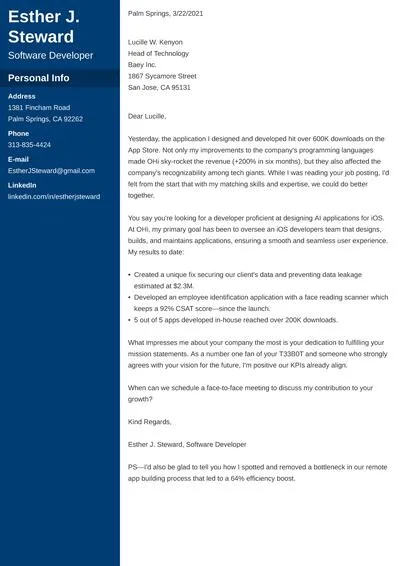
Start your sentences with strong action verbs to highlight your accomplishments and skills. Verbs like ‘developed,’ ‘implemented,’ ‘designed,’ ‘optimized,’ ‘managed,’ and ‘collaborated’ instantly convey your proactive approach and hands-on experience. Using action verbs makes your cover letter more dynamic and engaging, keeping the reader’s attention. These words help you succinctly describe your achievements and the key contributions you made in your previous roles. They showcase your ability to initiate and complete tasks, making you a more attractive candidate.
Showcase Technical Skills
Clearly list your technical skills and the programming languages, tools, and frameworks you’re proficient in. Ensure your cover letter matches the job description, highlighting the skills that are most relevant to the position. If the job posting mentions specific technologies, include them in your cover letter. This targeted approach demonstrates that you have the necessary qualifications and are a good fit for the role. Mention the projects where you used these skills to showcase your practical experience and expertise. Be specific and avoid vague statements, providing concrete examples to support your claims.
Demonstrate Problem-Solving Abilities
Software development is all about solving problems. In your cover letter, provide examples of how you identified and solved technical challenges. Describe the problem, the steps you took to address it, and the outcome. This shows your ability to think critically and find effective solutions. You can detail how you debugged complex issues, improved system efficiency, or overcame technical hurdles during your previous projects. Highlighting your problem-solving skills makes you a valuable asset to any development team.
Structuring Your Cover Letter

The structure of your cover letter is just as important as its content. A well-organized cover letter is easy to read and understand. It shows that you can communicate effectively. You need to make sure you are following a clear format. This involves an opening paragraph, body paragraphs, and a closing paragraph. Each section should serve a distinct purpose. Consider it as telling a brief story. This allows you to present your qualifications and experiences in a way that is easy to understand.
Opening Paragraph that Captures Attention
Start your cover letter with a compelling opening paragraph that immediately grabs the reader’s attention. Instead of a generic greeting, consider mentioning something specific that caught your eye about the company or the role. You can express your enthusiasm for the position and briefly state why you are a strong candidate. This shows the hiring manager that you’ve researched the company and are genuinely interested in the opportunity. The goal is to create an initial impression and encourage the reader to continue reading the rest of your letter.
Body Paragraphs that Sell You
Use the body paragraphs to expand on your skills, experience, and achievements. Each paragraph should focus on a specific aspect of your qualifications, supporting your claims with concrete examples. Structure your paragraphs logically, using the STAR method (Situation, Task, Action, Result) to describe your experience. This method helps you provide context, explain your role, describe the actions you took, and quantify the results you achieved. This structure will make your arguments more credible and impactful.
Closing Paragraph with a Call to Action

End your cover letter with a strong call to action. This indicates your interest in the position and makes it easy for the hiring manager to take the next step. Thank the reader for their time and consideration, and reiterate your enthusiasm for the opportunity. Include a sentence expressing your availability for an interview. Also, consider providing your contact information again for the sake of clarity and convenience. This proactive approach helps demonstrate your commitment to the role and increases your chances of getting an interview.
Formatting and Presentation
The formatting and presentation of your cover letter are critical. This reflects your attention to detail and professionalism. Use a clean and easy-to-read font, such as Arial or Times New Roman. Ensure there is consistent spacing and formatting throughout the document. Proofread your cover letter multiple times to eliminate any spelling or grammatical errors. Pay close attention to the overall layout and make sure your cover letter is visually appealing. A well-formatted document enhances readability, allowing the recruiter to focus on the content rather than being distracted by formatting issues.
Keep it Concise and Professional
Keep your cover letter concise and professional. Recruiters often have limited time to review applications, so it’s important to make your points clearly and efficiently. Aim for a one-page cover letter, focusing on your most relevant qualifications. Use clear and concise language, avoiding jargon or overly complex sentences. Ensure your tone is professional and enthusiastic, demonstrating your genuine interest in the opportunity. Proper etiquette is necessary. Keep it to the point.
Proofread Meticulously

Proofread your cover letter meticulously for any errors in grammar, spelling, and punctuation. Mistakes can damage your credibility and indicate a lack of attention to detail. Before submitting your cover letter, review it multiple times. Ideally, ask a friend or colleague to proofread it as well, as a fresh pair of eyes can often catch errors you might have missed. Double-check all contact information and ensure the formatting is consistent throughout the document. Take your time. Make sure you’re delivering your best application.
Tailoring Your Cover Letter
Personalize your cover letter for each job application. Generic cover letters don’t impress hiring managers. Customize your cover letter to match the specific requirements and expectations of the role. It shows that you are invested in that particular opportunity. Customize your cover letter by researching the company and matching your skills to the job description. This personalized approach greatly increases your chances of getting noticed. Remember, show them you care.
Research the Company
Before you start writing your cover letter, research the company to gain a better understanding of its mission, values, and culture. Look at its website, social media profiles, and recent news articles. This information will help you tailor your cover letter and demonstrate your genuine interest. Mention specific projects, initiatives, or values that resonate with you. Understanding the company shows you’ve done your homework and that you are dedicated to the opportunity. Showing this level of effort sets you apart from those who submit generic applications.
Match Skills to Requirements

Carefully review the job description and identify the required skills and qualifications. Then, highlight your relevant skills and experiences in your cover letter, providing specific examples that demonstrate how you meet those requirements. If the job description emphasizes certain technologies, skills, or experiences, make sure to include them. Tailoring your cover letter to match the job requirements shows the recruiter that you are a good fit for the role. It also shows that you have carefully considered the requirements of the role.
Use Keywords from the Job Description
Incorporate keywords from the job description into your cover letter. This helps the hiring manager quickly identify that you have the skills and experience they are looking for. Keywords are often used by applicant tracking systems (ATS) to screen resumes and cover letters. Strategically using keywords increases your chances of getting past the initial screening process. But avoid keyword stuffing; maintain a natural and readable tone. This technique ensures that your application stands out and highlights your qualifications.
By following these tips, you can create a standout cover letter that effectively showcases your skills and experience. Remember to highlight your achievements, demonstrate your problem-solving abilities, and tailor your cover letter to each specific job. With a well-crafted cover letter, you’ll significantly increase your chances of getting noticed by recruiters and landing your dream software developer role.