Why IT Cover Letters are Crucial
In the competitive world of Information Technology, a well-crafted cover letter is more than just a formality; it’s your first opportunity to make a lasting impression. Unlike a resume, which provides a snapshot of your skills and experience, a cover letter allows you to tell a story, showcasing your personality, passion, and the value you can bring to a potential employer. It’s your chance to connect with the hiring manager on a personal level, demonstrating why you’re the perfect fit for the role and the company. This is particularly true in the IT sector, where technical skills alone are often not enough. Employers are looking for candidates who can communicate effectively, solve problems creatively, and align with the company’s culture. A compelling cover letter can set you apart from other qualified applicants, increasing your chances of landing an interview and ultimately, the job. It’s the tool to bridge the gap between your qualifications and the employer’s needs. A strong cover letter shows that you have taken the time to understand the company, the role, and how your specific skills and experience make you an ideal candidate, so don’t underestimate its importance.
Highlighting Skills and Experience in IT Cover Letters
Crafting a cover letter that effectively highlights your IT skills and experience requires a strategic approach. Start by carefully reviewing the job description, identifying the key skills and qualifications the employer is seeking. Then, tailor your cover letter to address those specific requirements. Instead of simply listing your skills, provide concrete examples of how you’ve used those skills to achieve results in previous roles. For example, if the job description emphasizes experience with cloud computing, describe a project where you successfully migrated a company’s infrastructure to the cloud, highlighting the benefits and outcomes of your work. Use action verbs to describe your accomplishments, and quantify your achievements whenever possible. Instead of saying you “managed a team”, state that you “led a team of five engineers, successfully delivering three projects on time and under budget.” This provides tangible evidence of your abilities and demonstrates your value as a candidate. Remember to keep your language clear, concise, and professional, avoiding jargon or technical terms that the hiring manager may not understand. A well-written cover letter will showcase your ability to translate your technical expertise into compelling narratives that resonate with the employer.
Quantifying Achievements for Impact

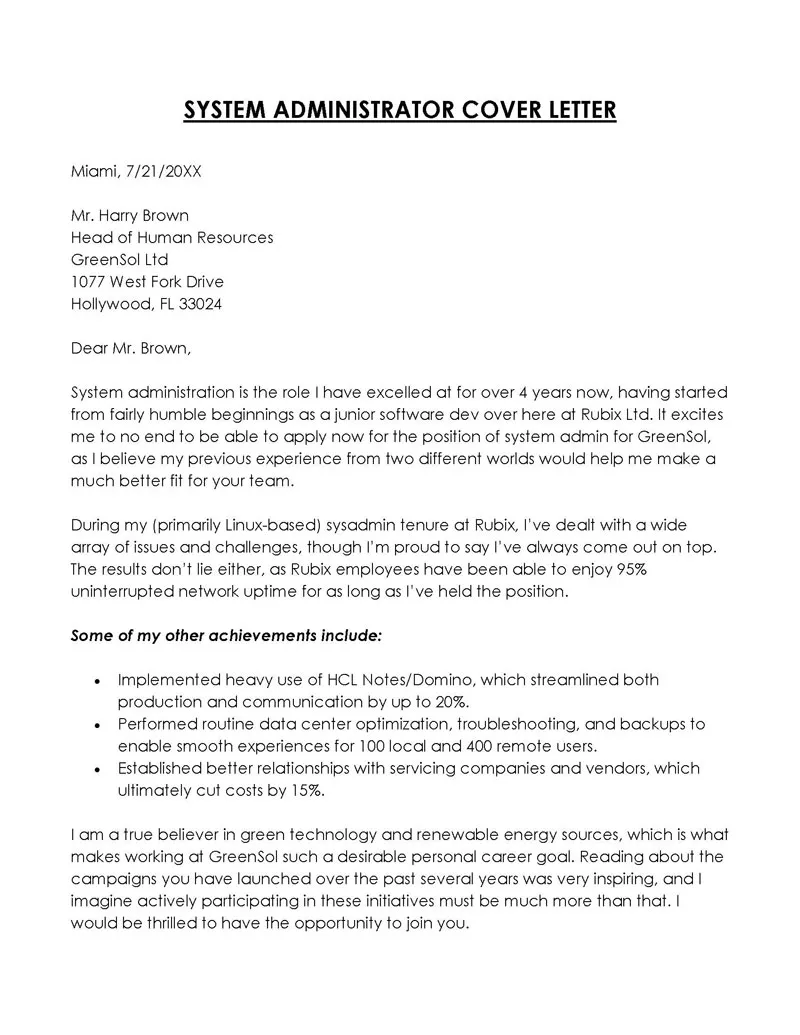
One of the most effective ways to make your IT cover letter stand out is by quantifying your achievements. Instead of making general statements about your skills and experience, use numbers, statistics, and data to demonstrate the impact you’ve made in previous roles. This adds credibility to your claims and provides concrete evidence of your abilities. For instance, rather than saying you improved network performance, state that you “increased network speed by 30% through optimization and upgrades.” If you reduced security breaches, specify the percentage decrease in incidents or the amount of money saved. Quantifying your achievements not only highlights your technical skills but also demonstrates your ability to measure and analyze results, a critical competency in the IT field. Use metrics like the number of projects completed, the size of budgets managed, or the number of users supported to showcase the scope of your experience. This approach helps employers quickly understand the value you bring to the table, making your cover letter more persuasive and memorable. The more specific you are, the more impactful your cover letter becomes, increasing your chances of landing an interview. (Image: cover-letter-achievements.webp)
Example 1 Software Engineer Cover Letter
Here’s an example of a cover letter tailored for a Software Engineer position. This example showcases how to highlight relevant skills and experience, and what to avoid. Remember to customize it with your specific information and tailor it to each job application. It’s important to avoid generic language and show genuine interest in the company and the role.
Skills Section
Highlight your technical proficiencies, such as programming languages (Java, Python, C++), software development methodologies (Agile, Scrum), and relevant frameworks or tools (React, Angular, AWS, etc.). Emphasize the skills most relevant to the job description and use keywords from the job posting. For example, if the role requires experience with cloud computing, make sure to mention your proficiency with cloud platforms like AWS, Azure, or Google Cloud.
Experience Section

Describe your previous software engineering roles, focusing on your responsibilities and accomplishments. Use action verbs to describe your work and quantify your achievements whenever possible. For example, you might state that you “developed and implemented a new feature that increased user engagement by 20%.” Mention specific projects you’ve worked on and the technologies you used. Emphasize your contributions to the project’s success and your ability to work both independently and as part of a team. Tailor your experience to match the requirements outlined in the job description, ensuring you emphasize the most relevant aspects of your background.
Example 2 Network Administrator Cover Letter
This example is designed for a Network Administrator role. Adapt it to your specific experience and the job’s requirements.
Skills Section
Showcase your knowledge of network hardware and software, including routers, switches, firewalls, and network operating systems (e.g., Cisco IOS, Juniper Junos). Highlight your experience with network protocols (TCP/IP, DNS, DHCP), network security, and troubleshooting. Mention any relevant certifications, such as CCNA, CCNP, or CompTIA Network+.
Experience Section

Detail your previous network administration roles, including your responsibilities for network design, implementation, and maintenance. Provide specific examples of your accomplishments, such as improving network performance, enhancing security, or reducing downtime. Quantify your achievements whenever possible; for instance, you might state that you “reduced network latency by 15% through the implementation of QoS policies.” Describe your experience with network monitoring tools and your ability to diagnose and resolve network issues.
Example 3 Cybersecurity Analyst Cover Letter
This example covers a Cybersecurity Analyst position. Adjust it according to the specific job requirements.
Skills Section
Emphasize your skills in security monitoring, incident response, vulnerability assessment, and penetration testing. Highlight your knowledge of security frameworks and standards (e.g., NIST, ISO 27001), as well as your experience with security tools and technologies, such as SIEM, firewalls, and intrusion detection systems (IDS/IPS). Mention relevant certifications like CISSP, CEH, or CompTIA Security+.
Experience Section

Describe your previous cybersecurity roles, focusing on your responsibilities for threat detection, incident response, and security audits. Provide specific examples of your accomplishments, such as preventing security breaches, reducing the time to detect and respond to incidents, or improving security posture. Quantify your achievements whenever possible; for example, you could state that you “reduced the number of successful phishing attempts by 40% through employee training and awareness programs.” Highlight your experience with security tools and technologies, and your ability to work both independently and as part of a security team.
Key Takeaways & Final Tips for IT Cover Letters
To write a great IT cover letter, remember to tailor each letter to the specific job and company. Proofread carefully for grammar and spelling errors. Keep it concise and focused, highlighting your most relevant skills and experiences. Show enthusiasm and a genuine interest in the role and the company. Use action verbs and quantify your achievements to make your cover letter more impactful. Make sure your cover letter is well-formatted and easy to read. By following these tips and using the examples provided, you can create a cover letter that showcases your IT expertise and helps you land your dream job in the IT sector. (Image: it-cover-letter-tips.webp)