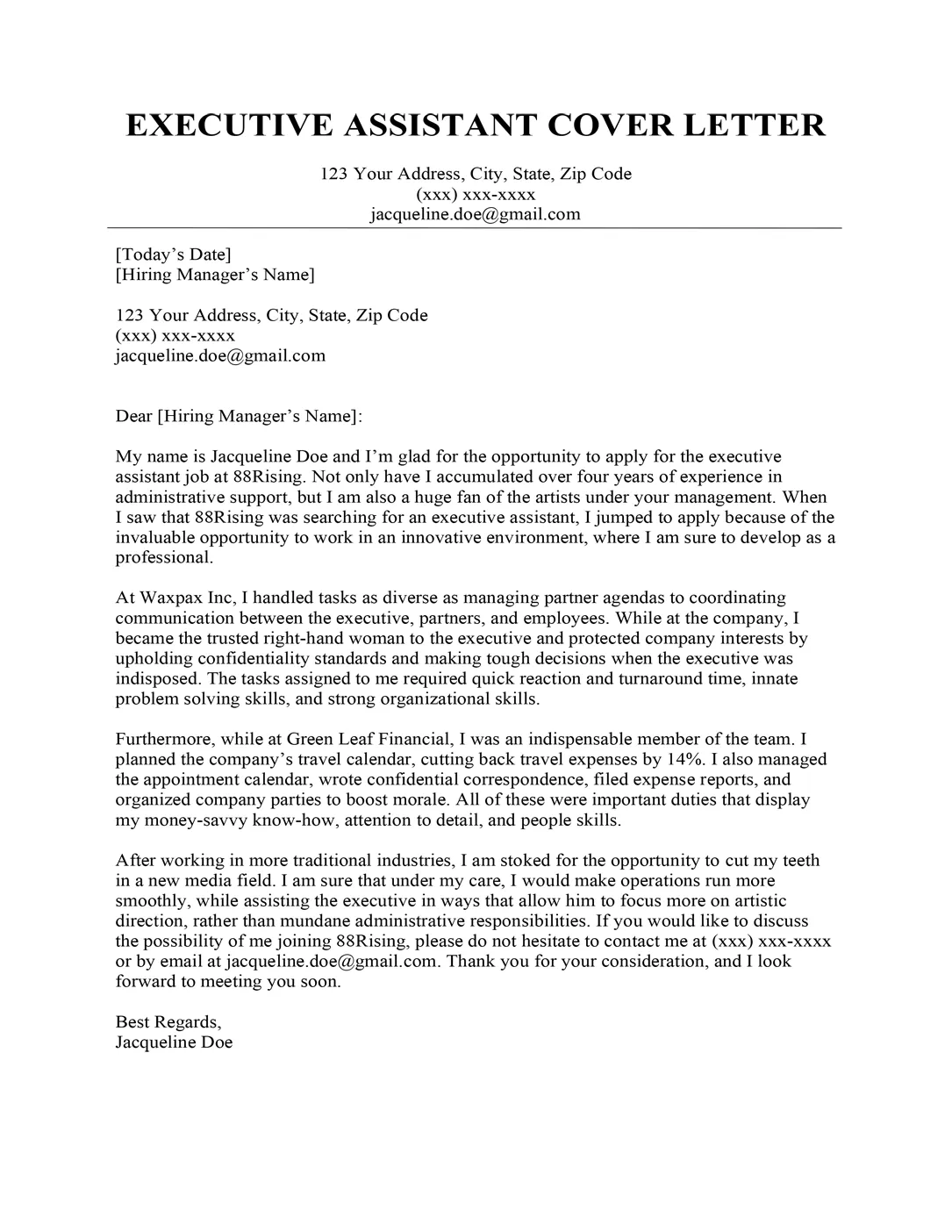
Cover Letter Examples for Executive Assistants
An Executive Assistant plays a pivotal role in the smooth operation of any organization. A well-crafted cover letter is your first opportunity to showcase your skills, experience, and suitability for the position. The cover letter is a crucial document that complements your resume and allows you to highlight your unique qualifications. Let’s delve into five cover letter examples tailored for Executive Assistants, along with insights to help you create a compelling application.
Understanding the Role of an Executive Assistant
Executive Assistants are the linchpins of any successful executive. They provide comprehensive administrative support, manage schedules, handle communications, and often act as a liaison between the executive and other internal or external stakeholders. Understanding the multifaceted nature of this role is the first step in crafting an effective cover letter. The responsibilities are diverse, requiring a blend of organizational prowess, communication skills, and a proactive approach.
Key Responsibilities of an Executive Assistant

The responsibilities of an Executive Assistant are vast. They typically include managing calendars, scheduling meetings, arranging travel, preparing presentations, handling correspondence, and managing information flow. Strong organizational skills, attention to detail, and the ability to prioritize tasks are crucial. Excellent communication skills, both written and verbal, are also paramount, as they often serve as the primary point of contact for the executive.
Essential Skills for Executive Assistants
Beyond specific tasks, certain soft skills are indispensable. These include strong communication and interpersonal skills, organizational abilities, time management, and the ability to handle confidential information with discretion. Proficiency in relevant software, such as Microsoft Office Suite (Word, Excel, PowerPoint, Outlook), is generally expected. Adaptability, problem-solving skills, and the capacity to work independently are also valuable assets. These skills should be demonstrated in your cover letter.
Cover Letter Example 1 The Accomplishments-Focused Approach
This approach highlights your achievements and the impact you’ve made in previous roles. This is about demonstrating tangible results. The cover letter should be filled with examples of your successes, which can be directly related to the requirements of the new Executive Assistant position. It provides concrete evidence of your abilities and value, and makes you stand out. Highlighting accomplishments is a key strategy in cover letters.
Highlighting Achievements in Your Cover Letter

When describing achievements, focus on what you accomplished, not just your responsibilities. Use action verbs to describe your role. For example, instead of writing “Managed the executive’s calendar,” write “Streamlined the executive’s calendar, resulting in a 15% reduction in scheduling conflicts.” Quantifiable results make your achievements more impactful and memorable for the hiring manager, as they offer a clear picture of your success.
Quantifying Your Impact
Quantify your achievements to provide clear evidence of your value. Whenever possible, use numbers to illustrate the impact of your work. For example, “Improved the efficiency of travel arrangements, reducing travel expenses by 10%.” Or “Successfully managed over 500 emails per week, ensuring timely responses and efficient communication.” Provide facts and statistics to showcase your abilities effectively.
Cover Letter Example 2 The Skills-Based Approach
This approach focuses on showcasing your relevant skills and how they align with the job requirements. It’s about demonstrating that you possess the competencies the employer seeks. This is a great approach, especially if you’re transitioning from a different role or have extensive experience. The skills-based cover letter provides a clear indication of your qualifications. Use the job description to identify the key skills the employer seeks.
Showcasing Relevant Skills

In your cover letter, highlight the skills that are most relevant to the job. List your skills, then provide specific examples of how you have used them in the past. For instance, if the job description requires strong organizational skills, you could write, “My organizational skills are highly developed. In my previous role, I implemented a new filing system that improved document retrieval time by 20%.”
Tailoring Skills to the Job Description
Carefully review the job description and identify the key skills the employer is seeking. Then, tailor your cover letter to emphasize those skills. Use the same keywords and phrases used in the job description to show the hiring manager that you understand their needs. This targeted approach increases your chances of being selected for an interview. Align your skills with the job requirements.
Cover Letter Example 3 The Problem-Solving Approach
This approach highlights your problem-solving abilities and your capacity to find effective solutions to challenges. The cover letter focuses on instances where you’ve identified problems, developed and implemented solutions, and the positive results you’ve achieved. This strategy showcases your resourcefulness and ability to think critically under pressure. It’s important to have the ability to overcome daily challenges, and an Executive Assistant must have this quality.
Demonstrating Problem-Solving Abilities

In your cover letter, provide specific examples of problems you’ve solved in past roles. Describe the challenge, the steps you took to address it, and the outcome. For instance, you might write, “Identified a bottleneck in the travel booking process. Implemented a new online booking system, which reduced booking time by 30% and minimized errors.” Show how your initiative and action led to improvements.
Providing Specific Examples
When providing examples, be as specific as possible. Use the STAR method (Situation, Task, Action, Result) to structure your response. Start with the situation you faced, describe the task you needed to complete, explain the actions you took, and detail the results you achieved. This structured approach provides a clear and compelling narrative that demonstrates your problem-solving skills effectively.
Cover Letter Example 4 The Leadership Approach
If you have leadership experience, this approach is a great choice. The cover letter emphasizes your leadership qualities and your ability to guide and influence others. This approach highlights your capability to manage and delegate tasks effectively. This is particularly applicable if you’ve overseen projects, mentored colleagues, or managed a team. Leadership skills are incredibly important for the executive assistant role.
Showcasing Leadership Qualities

Demonstrate your leadership qualities by providing examples of how you’ve led or influenced others. Discuss instances where you took the initiative, guided a team, or mentored colleagues. For instance, you might write, “Led a team of administrative staff in a project to improve internal communication, which resulted in a 25% increase in employee satisfaction.” Showcase your skills and how you have motivated people.
Highlighting Experience with Teams
If you’ve worked with teams, emphasize your ability to collaborate and contribute to team success. Provide examples of how you’ve fostered teamwork, resolved conflicts, and contributed to a positive work environment. For instance, you could highlight how you coordinated team projects or facilitated effective communication among team members. Collaboration is very important in most organizations.
Cover Letter Example 5 The Adaptability Approach
This approach focuses on your ability to adapt to change and handle challenges effectively. The cover letter showcases your flexibility, resilience, and your willingness to embrace new situations. It demonstrates your capacity to thrive in a dynamic environment. Adaptability is a critical quality for an Executive Assistant, who often faces a variety of evolving tasks and challenges daily.
Emphasizing Adaptability and Flexibility

Highlight instances where you’ve successfully adapted to new situations or handled unexpected challenges. Describe your approach to change and how you’ve used flexibility to achieve positive outcomes. For example, you could write, “Quickly adapted to a new software system, mastering its functionalities within a week and training other staff members.” This demonstrates how you adapt in the workplace.
Addressing Changes and Challenges
When discussing challenges, focus on how you overcame them and what you learned from the experience. Show your resilience and your ability to maintain a positive attitude in the face of adversity. For example, you might describe a time when you had to manage a crisis situation, highlighting your problem-solving skills and your ability to remain calm under pressure. Make sure you can demonstrate that you can handle issues when they occur.
Key Takeaways for Executive Assistant Cover Letters
These examples offer diverse approaches. Always tailor your cover letter to the specific job requirements and the company’s culture. Highlight your most relevant skills and experiences, and use quantifiable results whenever possible. Proofread carefully to ensure your letter is free of errors, and showcase your professionalism and attention to detail.
Formatting and Structure Tips
Ensure your cover letter has a professional format. Use a clear, readable font and a standard font size (e.g., Times New Roman, 12-point). Maintain consistent spacing and formatting throughout the document. Address the hiring manager by name if possible. Use a formal tone and keep the letter concise, typically no more than one page.
Proofreading and Editing
Thoroughly proofread and edit your cover letter before submitting it. Check for grammar, spelling, and punctuation errors. Ask a friend or colleague to review your letter for feedback. A well-written, error-free cover letter demonstrates your attention to detail and professionalism, increasing your chances of getting an interview.