Understanding the Importance of a Biology Cover Letter
A well-crafted cover letter is a crucial tool in your job application arsenal, especially in the competitive field of biology. It’s your first impression, a chance to introduce yourself to a potential employer and highlight your relevant skills and experiences. A cover letter provides a platform to elaborate on your resume, offering a narrative that showcases your personality, enthusiasm, and understanding of the role you are applying for. It’s more than just a formality; it’s an opportunity to differentiate yourself from other candidates and make a lasting impact. This guide will walk you through the essential elements of a compelling biology cover letter, providing examples and tips to help you land your dream job.
Why a Cover Letter Matters
In the world of biology, where attention to detail and effective communication are paramount, a cover letter plays a pivotal role. It’s not just about listing your qualifications; it’s about demonstrating how your skills and experiences align with the specific requirements of the job. A cover letter allows you to personalize your application, expressing your genuine interest in the position and the organization. It’s your chance to tell a story – the story of your passion for biology and how you can contribute to their team. Think of it as your personal introduction, setting the stage for your resume and giving the hiring manager a clear picture of who you are and what you bring to the table. A strong cover letter can significantly increase your chances of getting an interview, even if your resume is not perfect.
Highlighting Relevant Skills and Experiences

The best biology cover letters clearly connect your skills and experiences to the job description. Before you start writing, carefully review the job posting and identify the key requirements, both technical and soft skills, that the employer is seeking. Then, structure your cover letter to showcase those skills. Use specific examples from your past experiences – whether from research projects, internships, or coursework – to illustrate your abilities. For instance, if the job requires experience with PCR techniques, provide a brief overview of your experience and, when possible, quantify your achievements, such as the number of samples you processed or the success rate of your experiments. Focus on the skills that are most relevant to the position and provide concrete examples that prove your proficiency.
Key Components of a Biology Cover Letter
Contact Information and Date
At the top of your cover letter, include your contact information: your name, phone number, email address, and optionally, your LinkedIn profile URL. Following this, add the date of the letter. This section ensures that the hiring manager can easily reach you and provides a professional header to your document. Make sure your contact information is up-to-date and that your email address is professional. This section is generally left-aligned or centered, depending on your preferred style.
Greeting the Hiring Manager

Always address your cover letter to a specific person if possible. Research the hiring manager’s name and title. A personalized greeting, such as “Dear Dr. Smith,” shows that you’ve taken the time to learn about the organization and are genuinely interested in the opportunity. If you can’t find a specific name, use a professional alternative, such as “Dear Hiring Manager.” Avoid generic greetings like “To Whom It May Concern,” which can make your letter feel impersonal and less appealing. A targeted greeting is one of the first steps in making a positive impression.
Crafting a Compelling Opening Paragraph
Your opening paragraph is your chance to grab the hiring manager’s attention and make them want to read more. State the position you’re applying for and where you saw the job posting. Briefly mention why you’re excited about the opportunity and the organization. Show that you’ve done your homework by referencing something specific about the company or the role that interests you. Keep it concise and enthusiastic. For example, “I am writing to express my keen interest in the Research Scientist position at [Company Name], as advertised on [Platform]. I was particularly drawn to your work on [Specific Project], and I am confident that my skills and experience in [Specific Skill] align well with your research goals.”
Showcasing Your Biology Skills
The body of your cover letter is where you highlight your skills and experiences in detail. Focus on the skills and experiences that are most relevant to the job description. Use the STAR method (Situation, Task, Action, Result) to describe your accomplishments. For example, in the Situation, you might describe a research project. The Task was the objective you were assigned. The Action was what you did to achieve the objective, and the Result was the outcome of your efforts. This approach helps you provide concrete examples that prove your proficiency in the required skills. Mention specific techniques, software, or equipment you have experience with, as well as any relevant lab skills, data analysis expertise, or project management abilities. Don’t just list these; provide context to illustrate how you’ve used them effectively.
Quantifying Achievements

Whenever possible, quantify your achievements. Use numbers and data to demonstrate the impact of your work. For example, instead of saying “I improved lab efficiency,” say “I improved lab efficiency by 15% by implementing a new inventory system.” Quantifying your achievements makes your accomplishments more concrete and convincing. Other examples include mentioning the number of publications you contributed to, the number of samples you analyzed, or the size of the team you managed. Numbers are a powerful way to make your achievements stand out and show potential employers the value you can bring to their organization. Use quantifiable achievements throughout your cover letter to showcase your impact and capabilities effectively.
Tailoring Your Letter to the Job Description
A generic cover letter is unlikely to impress a hiring manager. Customize each cover letter to match the specific requirements of the job you are applying for. Carefully read the job description and identify the key skills, experiences, and qualifications the employer is seeking. Then, tailor your cover letter to address those requirements. Use the same keywords and phrases from the job description to demonstrate that you understand the role and possess the necessary qualifications. This personalization shows that you have taken the time to understand the specific needs of the organization and are genuinely interested in the position.
Expressing Enthusiasm and Interest
Showcase your genuine enthusiasm for the position and the organization. Explain why you are interested in this particular opportunity and what motivates you to work in this field of biology. Express your excitement about the company’s mission, values, or specific projects. Demonstrate that you have researched the organization and understand its goals. This enthusiasm should be evident throughout your cover letter, from your opening paragraph to your closing statement. A well-written cover letter conveys your passion and makes you appear more personable, demonstrating that you would be a good fit for the company culture.
Closing the Cover Letter

Your closing paragraph should be concise and impactful. Reiterate your interest in the position and express your confidence that you can make a valuable contribution. Thank the hiring manager for their time and consideration. Include a call to action, such as inviting them to contact you for an interview. You can also mention your willingness to provide any additional information or samples of your work. End with a professional closing, such as “Sincerely” or “Best regards,” followed by your typed name. Make sure to proofread this section carefully before submitting your application, because the closing is the final message to the reader.
Formatting and Proofreading
Formatting and proofreading are crucial steps in creating a professional cover letter. Use a clear and easy-to-read font, such as Times New Roman or Arial, with a font size between 11 and 12 points. Keep the margins at one inch and use single-spaced paragraphs with a space between each paragraph. Ensure that your cover letter is free of grammatical errors, typos, and spelling mistakes. Carefully proofread your letter multiple times, or ask a friend, family member, or career counselor to review it. A well-formatted and error-free cover letter demonstrates your attention to detail and professionalism, making a positive impression on the hiring manager.
Cover Letter Examples for Biology Positions
Research Scientist Cover Letter Example

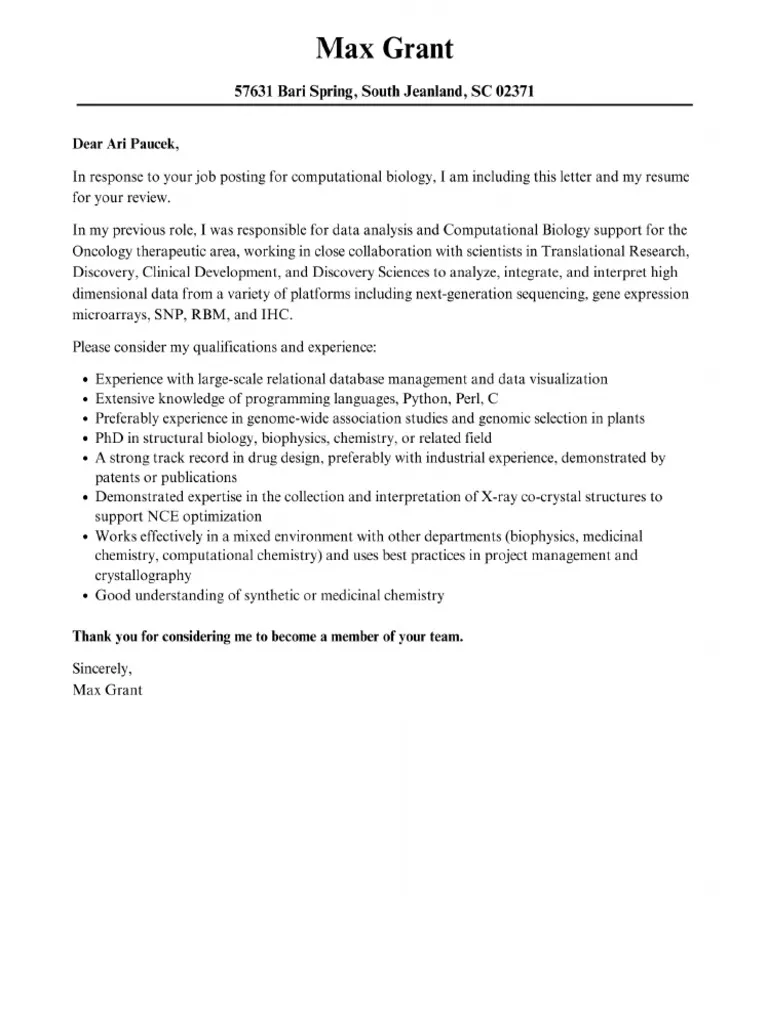
This example showcases a candidate applying for a research scientist position. The candidate emphasizes their experience in conducting research, analyzing data, and publishing findings. The letter highlights specific research techniques and methodologies used in their previous roles, aligning with the job description’s requirements. The applicant also discusses their contributions to ongoing projects and their ability to work in a collaborative team environment. The letter demonstrates the candidate’s dedication to scientific inquiry and their expertise in the field. It also includes their familiarity with different types of research software and data analysis.
Laboratory Technician Cover Letter Example
A lab technician cover letter example focuses on demonstrating the candidate’s technical skills and experience in laboratory settings. It highlights their proficiency in performing laboratory procedures, operating equipment, and maintaining accurate records. The applicant emphasizes their ability to follow protocols, troubleshoot issues, and ensure safety in the lab. They also mention their experience in preparing samples, conducting experiments, and analyzing data. The letter highlights their attention to detail, organizational skills, and commitment to quality control. It shows their understanding of laboratory protocols and their ability to perform different tasks effectively.
Biologist Cover Letter Example
This example highlights a biologist’s skills and experiences, which may include fieldwork, data analysis, and research. The candidate stresses their knowledge of biological principles, their research projects, and their ability to work with various scientific tools and technologies. The letter stresses the candidate’s ability to conduct research, collect samples, analyze data, and create detailed reports. It shows their experience working in different environments, such as laboratories and field sites. It also demonstrates their passion for biological studies and their drive to contribute to scientific advancements.
Additional Tips for a Successful Biology Cover Letter

Keywords to Include
Use keywords from the job description throughout your cover letter. These keywords, like specific laboratory techniques or skills, will help your application pass through Applicant Tracking Systems (ATS) and demonstrate that you have the skills they are looking for. Identify keywords in the job posting related to required skills, technical expertise, software proficiency, and any specific research areas. Include these keywords naturally in your cover letter when describing your experiences and skills. Make sure you are not simply stuffing your letter with keywords, but incorporating them in a meaningful way to accurately reflect your capabilities and experiences.
Addressing Gaps in Your Resume
If there are gaps in your resume, such as periods of unemployment or a lack of experience in a specific area, address them honestly and positively in your cover letter. Explain the reasons for the gaps without making excuses. Instead, focus on what you learned or what you did during that time. For example, if you took time off to care for a family member, mention any relevant skills you gained during that time, such as time management or organizational skills. If you lack experience in a particular area, highlight any related skills or coursework that could be beneficial to the position. Framing these gaps in a positive light can show your resilience and adaptability.
Following Up After Submission
Following up after submitting your cover letter and resume can demonstrate your interest in the position and your proactive nature. However, be mindful of the company’s policy on follow-ups. If the job posting provides specific instructions on when and how to follow up, follow those instructions. If not, wait about a week or two after the application deadline before sending a brief email to the hiring manager. In your email, reiterate your interest in the position and ask if they have any questions about your application. This follow-up serves as a reminder of your application and allows you to reinforce your enthusiasm for the role.