Cover Letter: Why It Matters for Consulting
In the competitive world of consulting, a well-crafted cover letter is your first opportunity to make a lasting impression on potential employers. It serves as more than just an introduction; it’s a crucial tool for showcasing your unique value proposition, highlighting your relevant skills and experiences, and ultimately, securing an interview. A strong cover letter can differentiate you from other candidates, especially in a field where problem-solving, communication, and analytical skills are highly valued. Think of it as your personal sales pitch, designed to convince the hiring manager that you are the ideal candidate for the role and that your expertise aligns perfectly with the firm’s needs and values. Therefore, taking the time to create a compelling cover letter is a strategic investment in your consulting career, one that can significantly increase your chances of landing your dream job.
Understanding the Consulting Industry
Before crafting your cover letter, it’s essential to understand the consulting industry itself. Consulting firms, whether they specialize in management, technology, finance, or other areas, seek individuals who can solve complex business problems, provide strategic recommendations, and deliver measurable results. This industry demands professionals who are adaptable, analytical, and possess strong communication skills. Research the specific consulting firm you’re applying to; understanding their clients, projects, and values will help you tailor your cover letter to demonstrate your suitability for their culture. This involves knowing their areas of expertise, the type of work they undertake, and the skills and qualifications they value most. Familiarize yourself with the firm’s website, recent projects, and any news or publications to gain a deeper insight into their operations. This understanding is essential to show your genuine interest and to align your cover letter with their specific needs.
Key Skills for Consulting Roles

Consulting roles require a specific blend of skills that go beyond technical expertise. Your cover letter should highlight these key competencies. Problem-solving is paramount; demonstrate your ability to analyze complex situations, identify root causes, and develop effective solutions. Communication skills, both written and verbal, are essential for conveying ideas clearly and persuasively to clients and colleagues. Analytical skills, including data analysis and critical thinking, are crucial for making informed recommendations. Leadership skills, such as team management and the ability to influence others, are also highly valued. Adaptability and flexibility are important, as consultants often work on diverse projects with varying requirements. Finally, show your ability to work under pressure and manage multiple tasks simultaneously is vital. By clearly illustrating these skills through concrete examples in your cover letter, you can effectively showcase your qualifications and increase your chances of securing an interview.
Showcasing Your Value
Your cover letter is your opportunity to clearly and concisely articulate the value you bring to a consulting firm. Focus on how your skills, experiences, and achievements align with the firm’s needs and the requirements of the specific role. Think about what makes you stand out from other candidates. Highlight your ability to solve complex problems, your experience in specific industries or functional areas, and your proven track record of delivering results. Instead of simply listing your responsibilities, emphasize the impact of your work. What outcomes did you achieve? How did your actions benefit your previous employers or clients? By quantifying your achievements whenever possible, you can provide concrete evidence of your value and demonstrate your potential to contribute to the success of the firm. Remember, your cover letter should be a compelling narrative that showcases your unique value and motivates the reader to want to learn more about you.
Highlighting Relevant Experiences
When detailing your experiences, concentrate on those most relevant to the consulting role. Consulting firms seek candidates with experience in project management, client relations, data analysis, and strategic planning. If you have experience in a specific industry or functional area, such as healthcare, finance, or technology, be sure to emphasize it. Explain how your past experiences have equipped you with the skills and knowledge necessary to succeed in a consulting environment. Provide specific examples of projects you’ve worked on, challenges you’ve overcome, and results you’ve achieved. Instead of simply listing your job duties, frame your experience in terms of the skills you utilized and the impact you made. For instance, did you lead a team that improved a client’s operational efficiency? Did you develop a strategy that resulted in increased revenue or market share? The more concrete the examples, the more compelling your cover letter will be.
Quantifying Your Achievements

Quantifying your achievements is a crucial step in making your cover letter persuasive. Numbers, statistics, and data provide concrete evidence of your accomplishments and demonstrate your ability to deliver results. Instead of stating, “I improved customer satisfaction,” try, “I increased customer satisfaction scores by 20% through the implementation of a new feedback system.” Instead of saying, “I managed projects effectively,” state, “I successfully managed projects within budget and on time, resulting in a 15% reduction in project costs.” Whenever possible, include specific numbers, percentages, and dollar amounts to quantify your accomplishments. This will allow the reader to quickly understand the value you brought to your previous roles and the potential you bring to the consulting firm. Quantifiable results help you stand out from other applicants and showcase your ability to make a tangible impact.
Structuring Your Cover Letter
A well-structured cover letter is easy to read and effectively communicates your key qualifications. The standard structure includes an opening, body paragraphs, and a closing. The opening paragraph should grab the reader’s attention and state your purpose for writing. The body paragraphs should highlight your relevant skills, experiences, and achievements, providing specific examples to support your claims. The closing paragraph should reiterate your interest in the position, summarize your key qualifications, and express your enthusiasm for the opportunity. The structure should be clear, concise, and logical, with each paragraph building on the previous one. Using headings and subheadings can also make your letter more organized and easier to scan. Aim for a professional tone and ensure a smooth flow of information throughout the document. Good structure not only presents the information clearly but also reflects your organizational skills, which are crucial in consulting.
Formatting Your Cover Letter for Success
Formatting plays a critical role in the overall impact of your cover letter. Choose a professional font, such as Times New Roman, Arial, or Calibri, and maintain a consistent font size (typically 11 or 12 points). Use single-spaced lines and leave adequate margins to ensure the document is easy to read. Break up large blocks of text with bullet points, headings, and white space. Keep the tone professional, avoiding jargon and overly casual language. Tailor the formatting to match the firm’s branding if possible, but prioritize readability and clarity above all else. Proofread your cover letter carefully for any errors in grammar, spelling, and punctuation. A clean and well-formatted cover letter demonstrates attention to detail and professionalism, which are essential qualities in consulting. Be sure that your contact information is clear and easily accessible at the top of the document.
Essential Cover Letter Sections

Your cover letter should include several key sections to effectively showcase your qualifications. The opening statement should immediately grab the reader’s attention and state your purpose for writing, mentioning the specific position you’re applying for and where you found the advertisement. The body paragraphs should highlight your relevant skills and experiences, providing specific examples to support your claims. Include a section dedicated to your key achievements, quantified whenever possible. Address how your skills and experiences align with the firm’s needs and values, demonstrating your understanding of the company and its work. Finally, the closing statement should reiterate your interest, summarize your key qualifications, and express your enthusiasm for the opportunity. Make sure to thank the hiring manager for their time and consideration, and clearly indicate how you can be reached for an interview. Each section should be well-written, concise, and focused on demonstrating your suitability for the role.
Opening Statement
Your opening statement is your first opportunity to capture the reader’s attention and make a strong impression. Start by mentioning the specific position you’re applying for and where you found the advertisement. Immediately highlight your most relevant skills or experiences, showing how they align with the requirements of the role and the needs of the firm. Avoid generic opening lines; instead, personalize your statement and demonstrate your genuine interest in the company. Consider mentioning something specific that caught your eye about the firm or the role, showing that you’ve done your research. Your opening should be concise and compelling, setting the tone for the rest of your cover letter. It should immediately convey your enthusiasm and set the stage for a more in-depth exploration of your qualifications and experiences.
Body Paragraphs
The body paragraphs are the heart of your cover letter, where you provide details about your qualifications and experiences. Use these paragraphs to showcase your skills, highlight your achievements, and demonstrate how your background aligns with the specific requirements of the role and the needs of the consulting firm. Provide specific examples to support your claims, using the STAR method (Situation, Task, Action, Result) to describe your experiences. Focus on results and quantify your achievements whenever possible. Tailor each paragraph to the specific requirements of the job description, ensuring you address the key skills and qualifications mentioned by the employer. Use strong action verbs and clear, concise language. Maintain a professional tone throughout the body paragraphs and focus on how your experiences and skills have prepared you for success in the consulting role.
Closing Statement

Your closing statement should reiterate your interest in the position, summarize your key qualifications, and express your enthusiasm for the opportunity. Reiterate why you are a strong fit for the role and how your skills and experience make you the ideal candidate. Thank the hiring manager for their time and consideration, and make it clear that you are eager to learn more about the opportunity. Provide your contact information, including your phone number and email address, and make it easy for the hiring manager to reach you. Consider adding a call to action, such as, “I am available for an interview at your earliest convenience.” Keep your closing concise, professional, and enthusiastic, leaving the reader with a positive impression of your candidacy and encouraging them to take the next step in the hiring process.
Common Cover Letter Mistakes
Avoiding common mistakes is crucial for making a positive impression. One of the most significant errors is sending a generic cover letter that is not tailored to the specific job or firm. Failing to research the company and the role demonstrates a lack of interest and attention to detail. Another mistake is focusing on your needs rather than the needs of the employer; instead, focus on what you can offer and how you can contribute to the firm’s success. Poor grammar, spelling errors, and typos can damage your credibility and make you appear unprofessional. Overusing jargon or overly complex language can also make your cover letter difficult to read. Finally, not quantifying your achievements is a missed opportunity to showcase your value. Always proofread your cover letter meticulously before submitting it.
Proofreading and Editing
Proofreading and editing are essential steps in ensuring your cover letter is polished and error-free. Read your cover letter carefully, looking for any errors in grammar, spelling, punctuation, and sentence structure. Ask a friend or colleague to review your cover letter, as a fresh pair of eyes can often catch mistakes you might miss. Pay close attention to the tone, ensuring it’s professional and appropriate for the consulting industry. Verify that your contact information is correct and up-to-date. Ensure the formatting is consistent and easy to read. Before submitting your cover letter, review it one final time. A well-proofread and edited cover letter demonstrates your attention to detail, which is a highly valued skill in consulting. This final step can significantly improve the overall impact of your application.
Tailoring Your Letter

Tailoring your cover letter to each specific job application is crucial for demonstrating your genuine interest and suitability for the role. Review the job description carefully and identify the key skills, experiences, and qualifications the employer is seeking. Then, customize your cover letter to highlight how your background aligns with these requirements. Research the consulting firm, their clients, their values, and recent projects to demonstrate your understanding of their work. Show your interest by mentioning specific details about the firm, the role, or the industry. Adapt your tone and language to match the firm’s culture, while maintaining a professional approach. A tailored cover letter shows the hiring manager that you’ve invested time and effort in understanding the role and are genuinely interested in the opportunity.
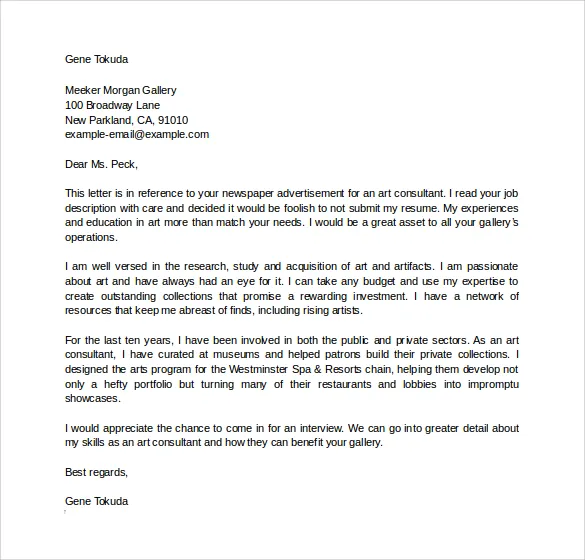
Example Cover Letter
Include a sample cover letter in your application can serve as a practical guide for candidates. The sample should be well-structured, showcase the essential elements discussed previously, and be adaptable to various consulting roles. The example must have a clear opening that states the purpose of writing, a body that highlights relevant skills and experience with quantifiable achievements, and a closing expressing interest and providing contact information. The example should also follow the formatting guidelines discussed, using a professional font, proper spacing, and correct grammar. Provide an example with the company’s name and position to make it more appealing. By providing an example cover letter, candidates can get a clear picture of what is expected from their application, hence making it easier for them to write their own cover letters.
Adapting the Sample for Your Application
Using a sample cover letter is a great starting point, but it’s essential to adapt it to your specific circumstances and the requirements of the job. Don’t simply copy and paste the sample; instead, use it as a template and customize it with your own experiences, skills, and achievements. Replace the sample’s information with your own details, ensuring that you accurately reflect your background and qualifications. Tailor the content to align with the specific job description and the needs of the consulting firm. Modify the language to reflect your personal style while maintaining a professional tone. Proofread the adapted cover letter carefully to ensure it is free of errors. By adapting the sample, you can create a compelling cover letter that effectively showcases your unique value and increases your chances of landing an interview for your consulting job.