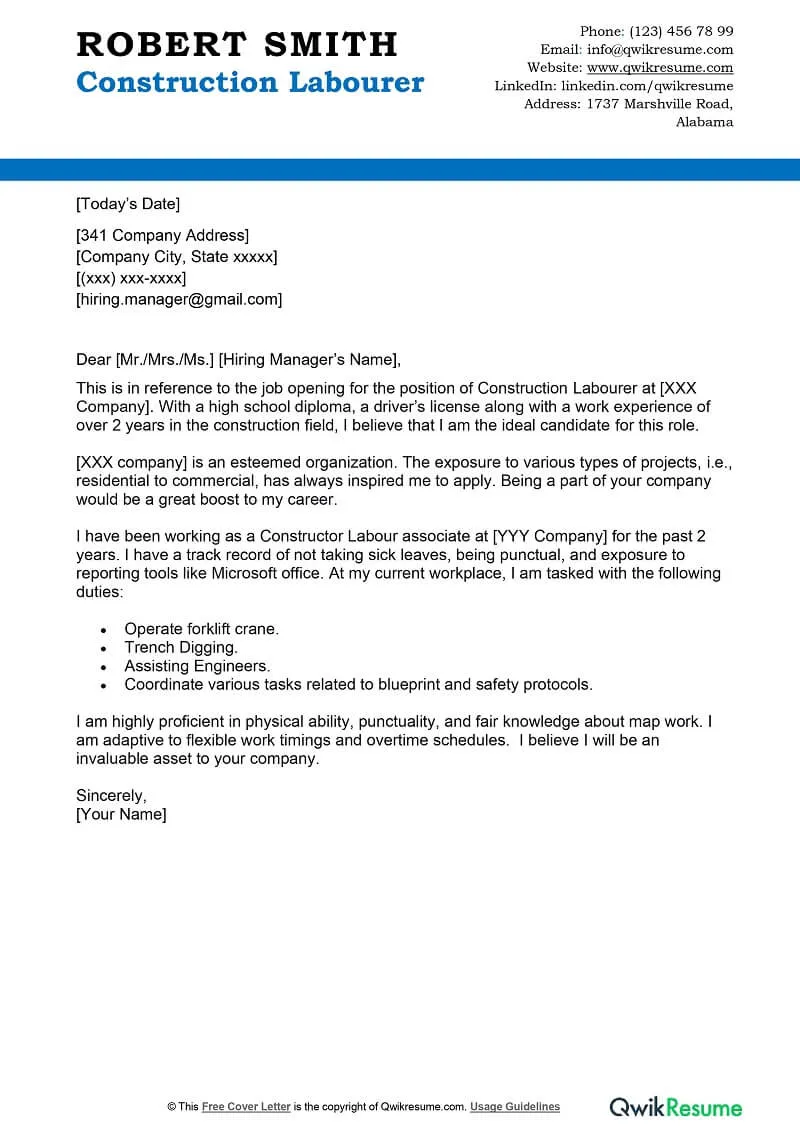
Crafting a Construction Resume Cover Letter
A construction resume cover letter is your first impression on a potential employer. It’s your opportunity to introduce yourself, highlight your relevant skills and experience, and express your enthusiasm for the position. A well-crafted cover letter, tailored to each specific job application, can significantly increase your chances of landing an interview. It provides context to your resume, allowing you to elaborate on your achievements and explain how your qualifications align with the employer’s needs. This guide will provide you with the essential steps and techniques required to write a compelling construction resume cover letter that gets you noticed.
Understanding the Purpose
The primary purpose of a construction resume cover letter is to persuade the hiring manager that you are the ideal candidate for the job. It’s not merely a repetition of your resume; instead, it provides a platform to showcase your personality, communication skills, and genuine interest in the role and the company. A strong cover letter demonstrates that you’ve researched the company, understand their projects, and possess the skills needed to contribute to their success. Your letter must convince the hiring manager to read your resume, and ultimately, to offer you an interview. Your cover letter is an opportunity to set yourself apart from the competition.
Highlighting Relevant Skills

Construction projects demand a diverse skill set. Your cover letter should specifically highlight the skills that align with the job requirements. Review the job description carefully and identify the key skills the employer is seeking. These might include project management, blueprint reading, knowledge of construction codes, proficiency with specific tools or software (such as AutoCAD or project management software), and experience with different construction materials. Emphasize skills related to safety, quality control, and communication as these are often highly valued. Use action verbs to describe your skills, providing concise examples of how you’ve utilized them in past projects.
Showcasing Construction Experience
Your construction experience is the cornerstone of your cover letter. Instead of simply listing your job titles and responsibilities, provide specific details about the projects you’ve worked on. Briefly describe the project, your role, and the results you achieved. For example, you might mention your experience managing a specific construction phase or your involvement in a particular type of building project. If possible, quantify your achievements; for example, ‘Managed a team of 10 workers, completing the project 15% under budget and two weeks ahead of schedule.’ Focus on the experiences that demonstrate your ability to succeed in the role you are applying for.
Structuring Your Cover Letter
A well-structured cover letter is easy to read and conveys your message effectively. Follow a standard business letter format. Begin with your contact information, the date, and the employer’s contact information. The body of your letter should be divided into clear paragraphs: an opening paragraph that states your purpose, one or two body paragraphs that highlight your skills and experience, and a closing paragraph that expresses your interest and calls for action. Keep your letter concise, typically one page in length. Use a professional font like Arial or Times New Roman, and ensure your formatting is consistent and easy on the eyes.
Header and Contact Information

Begin your cover letter with your name, address, phone number, and email address. This should be aligned to the left or the right. Then, include the date, followed by the hiring manager’s name (if known), title, and the company’s address. If you are unsure of the hiring manager’s name, research the company’s website or LinkedIn to find it. Addressing the letter to a specific person makes it more personal and demonstrates that you’ve taken the time to research the company and the position. This shows initiative and attention to detail, important qualities in the construction industry.
Opening Paragraph
Your opening paragraph is your hook, designed to grab the hiring manager’s attention. Clearly state the position you are applying for and how you found the job posting. Briefly mention why you are interested in the role and the company. It can be a concise statement of your key qualifications or an enthusiastic expression of your interest in the project. Avoid generic phrases and instead, try to express your genuine interest in the opportunity. For example, “I am writing to express my keen interest in the Project Manager position advertised on your website. Having closely followed [Company Name]’s work on [Project Name], I am impressed by…”
Body Paragraphs
The body paragraphs are where you showcase your skills and experience in detail. Focus on two or three key accomplishments that are most relevant to the job description. Use the STAR method (Situation, Task, Action, Result) to structure your examples, providing a clear narrative of your contributions. For instance, “In my previous role at [Company Name], I was tasked with [Task]. To address this, I [Action], which resulted in [Result].” Quantify your achievements whenever possible. Use language and terms familiar to the construction industry to demonstrate your understanding of the sector.
Specific Project Examples

Provide specific examples of projects you’ve worked on. Mention the project type (residential, commercial, infrastructure), your role, and your key responsibilities. Highlight any unique challenges you overcame, such as time constraints, budget limitations, or complex design requirements. The more detailed and specific your examples are, the more credible your claims will be. Illustrate how your skills and experience directly translate to the job requirements listed in the job description. Include any technologies, materials, or processes you are familiar with. For example, “Successfully managed the concrete pour for the foundation of a 20-story building, ensuring adherence to strict safety protocols and achieving timely completion.”
Quantifying Achievements
Quantifying your achievements makes your cover letter more impactful. Use numbers to demonstrate your success. Instead of saying “Improved project efficiency,” say “Improved project efficiency by 15%, reducing project completion time by two weeks.” Instead of saying “Managed a team,” say “Managed a team of 20 construction workers.” The more quantifiable your achievements, the more impressive you will appear to the hiring manager. Use metrics such as cost savings, time savings, safety improvements, and quality enhancements. Numbers provide concrete evidence of your capabilities.
Closing Paragraph
In your closing paragraph, reiterate your interest in the position and the company. Express your enthusiasm and thank the hiring manager for their time and consideration. Include a call to action, such as: “I am eager to discuss how my skills and experience can contribute to the success of [Company Name]. I am available for an interview at your earliest convenience.” Reiterate your contact information, just in case it is misplaced. Proofread the entire letter carefully before submitting it to ensure accuracy and professionalism.
Proofreading and Editing

Proofreading is essential. Errors in grammar, spelling, and punctuation can undermine your credibility. Read your cover letter aloud to catch any awkward phrasing or typos. Ask a friend or colleague to review your letter for clarity, accuracy, and overall effectiveness. Ensure that your cover letter is free of any formatting inconsistencies and that it looks clean and professional. Pay attention to the tone of your letter; it should be professional, enthusiastic, and tailored to the specific company and position. Ensure all details are accurate; this includes the correct spelling of the hiring manager’s name and the company name.
Essential Elements of Your Cover Letter
A strong construction resume cover letter includes: a clear statement of the position you are applying for; a concise summary of your relevant skills and experience; specific examples of your achievements, ideally quantified; evidence of your knowledge of the construction industry; a professional and enthusiastic tone; a tailored approach that reflects the specific requirements of the job; and proper formatting, grammar, and spelling.
Key Skills to Include
Include skills most relevant to the job description. This might include project management, blueprint reading, knowledge of building codes, proficiency with construction software (such as AutoCAD, Revit, or project management tools), knowledge of construction materials, scheduling, budget management, and safety protocols. Tailor the skills to the job; if the job emphasizes a specific type of construction, such as residential or commercial, be sure to highlight your experience in that area. Soft skills like communication, teamwork, problem-solving, and leadership are also vital.
Experience and Achievements

Focus on demonstrating your construction experience through specific project examples and quantifiable achievements. Mention project types, your responsibilities, and the outcomes you achieved. Quantify your achievements whenever possible by using metrics such as cost savings, time savings, and quality enhancements. Provide specific examples of projects you’ve worked on, highlighting your role and contributions. For instance, describe your experience with managing budgets, coordinating teams, or ensuring compliance with safety regulations. Demonstrate your ability to deliver results.
Tailoring Your Cover Letter
A generic cover letter is unlikely to impress a hiring manager. Tailor your cover letter to each specific job application by carefully reviewing the job description and highlighting the skills and experience most relevant to that position. Demonstrate that you understand the company’s projects and requirements by referencing them in your letter. Research the company’s values and culture, and align your writing style and tone accordingly. Mention specific aspects of the job or company that excite you, showing your genuine interest. This shows you’ve put in the effort to research the company.
Formatting and Design
Your cover letter should be visually appealing and easy to read. Use a professional font like Arial, Times New Roman, or Calibri. Keep your letter to one page. Use clear headings, bullet points, and ample white space to break up the text and make it more readable. Ensure consistent formatting throughout the document. Save your cover letter as a PDF file to preserve the formatting and ensure it looks the same on any device. Ensure a professional appearance to show you pay attention to detail.
Submission and Follow-Up

Follow the instructions provided in the job posting for submitting your cover letter and resume. If no specific instructions are provided, attach your cover letter and resume to your email. Use a professional subject line for your email, such as “Application for [Job Title] - [Your Name].” After submitting your application, follow up with the hiring manager within a week or two to reiterate your interest and inquire about the status of your application. This shows persistence and initiative. A polite follow-up phone call or email can leave a lasting positive impression.
In conclusion, a well-written construction resume cover letter is essential for making a strong first impression and securing a job interview. By understanding its purpose, highlighting relevant skills and experience, structuring it effectively, and proofreading carefully, you can create a cover letter that showcases your qualifications and demonstrates your enthusiasm for the role. Remember to tailor your cover letter to each specific job and to follow up after submitting your application. Your cover letter should clearly communicate your value to the company.