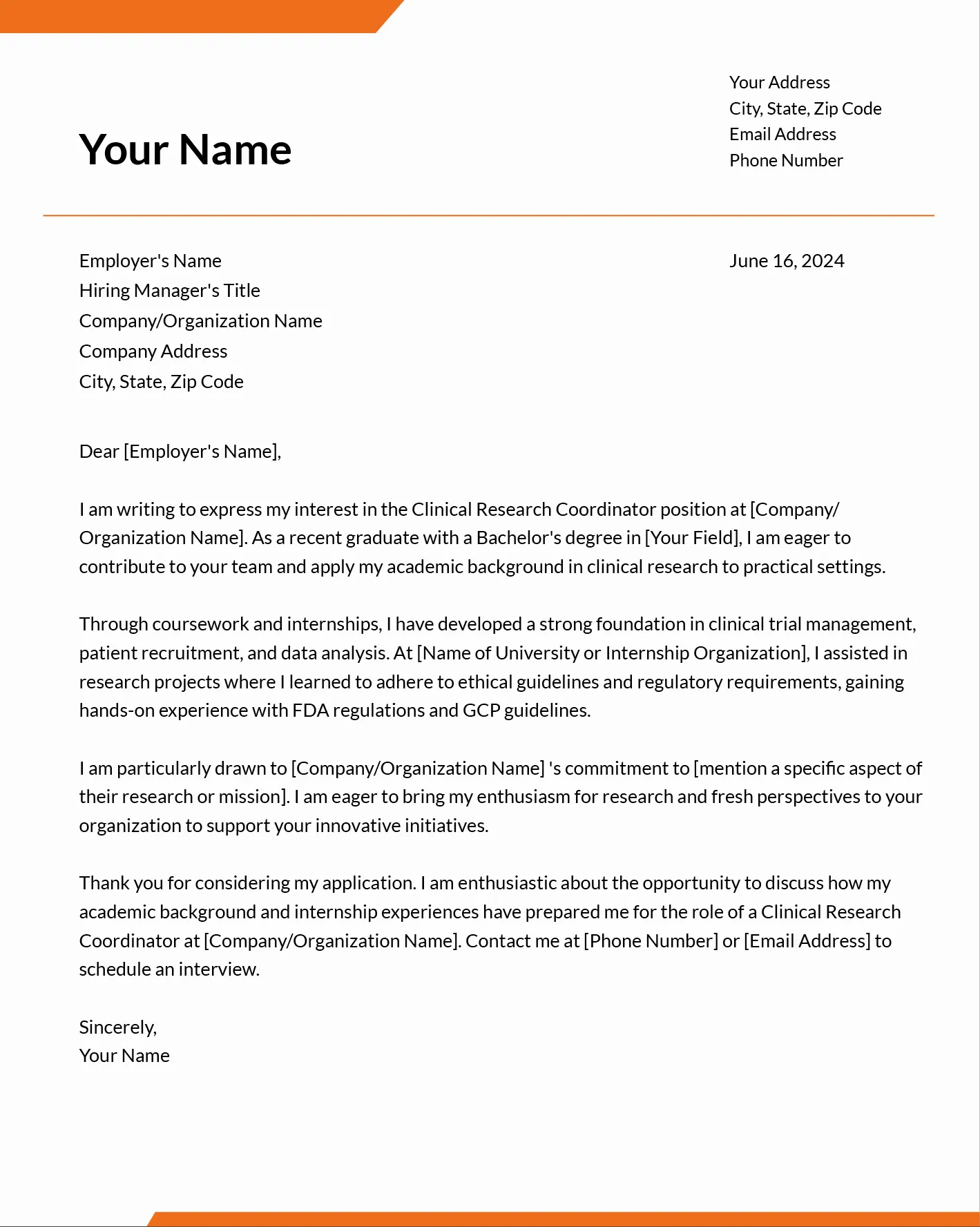
Crafting a Powerful Clinical Research Coordinator Cover Letter
A well-crafted cover letter is your first introduction to a potential employer, and for a Clinical Research Coordinator, it is a critical document. It’s your opportunity to showcase your qualifications, experience, and enthusiasm for the role. A strong cover letter does more than just list your skills; it tells a compelling story about why you are the ideal candidate. This guide will help you create a cover letter that stands out, highlighting the key components, formatting tips, and common pitfalls to avoid, ensuring you make a positive first impression.
Understanding the Purpose of a Cover Letter
The primary purpose of a cover letter is to introduce you to the hiring manager and provide context to your resume. It allows you to elaborate on your skills and experiences in a way that a resume cannot. A cover letter should explain why you are interested in the specific role and the organization, and how your qualifications align with their needs. It’s also an opportunity to demonstrate your communication skills and attention to detail, which are essential for a Clinical Research Coordinator. Think of it as your personal sales pitch, designed to convince the employer to read your resume and ultimately invite you for an interview. A well-written cover letter gives the hiring manager a snapshot of your key skills and highlights the aspects of your experience that are most relevant to the position, creating an immediate connection.
Why a Cover Letter Matters

In the competitive field of clinical research, a cover letter can be the deciding factor in whether you get an interview. Many employers use cover letters as a screening tool to quickly assess a candidate’s communication skills, writing ability, and genuine interest in the position. A cover letter shows that you have taken the time to understand the role and the organization and that you are not just sending out a generic application. It allows you to address any gaps in your resume or explain any career transitions, providing a more complete picture of your qualifications. Moreover, a cover letter gives you the chance to demonstrate your personality and passion for clinical research, setting you apart from other applicants.
Key Components of a Clinical Research Coordinator Cover Letter
Your Contact Information and Date
Start your cover letter with your full name, address, phone number, and email address. This should be at the top of the letter, making it easy for the hiring manager to contact you. Include the date below your contact information, which will indicate when the letter was written. Make sure your email address is professional and appropriate for the job application. Ensure your contact details are current and you regularly check the email account you provide to avoid missing out on important updates or interview invitations. Proper contact information allows the recruiter to easily reach out to you.
Addressing the Hiring Manager

Always address your cover letter to a specific person whenever possible. Research the hiring manager’s name and title and use a formal salutation like “Dear Mr./Ms./Dr. [Last Name].” If you cannot find the hiring manager’s name, use a professional greeting such as “Dear Hiring Manager” or “Dear [Department Name] Team.” Personalizing your cover letter shows that you have taken the time to research the company and that you are genuinely interested in the position. This demonstrates your attention to detail and professionalism, which are important traits for a Clinical Research Coordinator.
Highlighting Your Skills and Experience
The body of your cover letter is where you highlight your skills and experience. Focus on the qualifications that are most relevant to the job description, and provide specific examples of how you have demonstrated those skills in previous roles. Use strong action verbs to describe your accomplishments and quantify your results whenever possible. For a Clinical Research Coordinator, this section should emphasize your knowledge of research protocols, data management, patient interaction, and regulatory compliance. Explain how your skills align with the requirements of the position, and provide evidence of your ability to perform the job effectively. This is your opportunity to shine and show why you are a great fit.
Showcasing Your Research Experience
Detail your experience in research settings, including the types of studies you have worked on, the patient populations you have supported, and the responsibilities you have held. Mention specific research protocols you have followed, databases you have used, and any experience with patient recruitment, data collection, or monitoring. Highlight any experience with clinical trials, observational studies, or other research projects. If you have experience in a particular therapeutic area, be sure to mention it. The hiring manager wants to see that you understand the demands of the role and have practical experience in a research setting.
Mentioning Relevant Certifications

List any relevant certifications, such as Certified Clinical Research Professional (CCRP) or other certifications related to research or healthcare. These certifications demonstrate your commitment to professional development and your knowledge of industry standards. If you have any training in areas like Good Clinical Practice (GCP), HIPAA compliance, or data privacy, be sure to include it. Mentioning specific training courses or certifications can give you an edge over other candidates and show that you are prepared for the job.
Quantifying Your Accomplishments
Use numbers and data to quantify your accomplishments. Instead of saying “Managed patient data,” say “Managed data for over 100 patients, ensuring 100% accuracy.” Instead of “Recruited patients for studies,” say “Recruited an average of 10 patients per month, exceeding recruitment goals by 15%.” Providing specific numbers and metrics makes your achievements more credible and demonstrates your ability to deliver results. This gives the hiring manager concrete evidence of your capabilities and impact in previous roles.
Expressing Your Enthusiasm
Show your enthusiasm for the role and the organization. Explain why you are interested in this particular position and what attracts you to the company. Mention specific aspects of the company’s mission, values, or research focus that resonate with you. Demonstrating genuine interest will make you stand out from other applicants and show that you have taken the time to research the organization. Explain why you are excited about the opportunity to contribute to their team, and what you hope to achieve in the role. This passion is critical to a successful cover letter.
Closing and Call to Action

End your cover letter with a strong closing and a clear call to action. Thank the hiring manager for their time and consideration. State that you are eager to discuss your qualifications further and are available for an interview at their earliest convenience. Provide your contact information again and express your gratitude for the opportunity. The call to action should encourage the hiring manager to take the next step and contact you, making it clear that you are prepared to discuss your application in more detail.
Formatting and Design Tips
Choosing the Right Font and Size
Choose a professional and easy-to-read font, such as Times New Roman, Arial, or Calibri. Keep the font size between 10 and 12 points for readability. Make sure your cover letter is well-formatted with clear margins and spacing. Avoid using overly decorative fonts or a cluttered layout. A clean and organized presentation will make your cover letter more accessible and easier to read, showing you care about creating a positive first impression.
Keeping It Concise and Readable

Keep your cover letter concise and to the point, ideally within one page. Use short paragraphs and bullet points to break up large blocks of text and make your cover letter easier to scan. Focus on the most relevant information and avoid unnecessary details or jargon. A well-structured, concise cover letter is more likely to hold the hiring manager’s attention than a long and rambling one.
Proofreading and Editing Your Cover Letter
Proofread your cover letter carefully for any typos, grammatical errors, or inconsistencies. Have a friend or colleague review your cover letter as well. A single typo or grammatical error can undermine your credibility. Proper grammar and spelling indicate professionalism and attention to detail, both vital qualities for a Clinical Research Coordinator. Make sure that the language and tone are appropriate for the role and the organization.
Common Mistakes to Avoid
Generic Cover Letters

Avoid using a generic cover letter that you send to every job application. Tailor your cover letter to each specific position, highlighting the skills and experiences that are most relevant to that particular role and organization. Customize your letter to match the requirements outlined in the job description. Generic cover letters show a lack of genuine interest and effort, making it less likely that you’ll get an interview. By customizing your letter, you show you’ve taken the time to understand the role.
Typos and Grammatical Errors
Typos and grammatical errors can damage your credibility and make you appear unprofessional. Proofread your cover letter carefully, and use spell-check and grammar-check tools. Have someone else review your cover letter as well. Errors can distract from your qualifications and make it difficult for the hiring manager to focus on your strengths. Always make sure your writing is polished and error-free.
Ignoring the Job Description
Carefully review the job description and address the specific requirements and qualifications that the employer is seeking. Use the keywords and phrases from the job description in your cover letter to demonstrate that you are a good fit. Failing to address the specific requirements of the job can result in your cover letter being overlooked. Demonstrate you have understood the job requirements, and your skills are matching with that requirement.
Clinical Research Coordinator Cover Letter Sample
While a sample is helpful, remember to tailor the sample to your specific experiences and the job you are applying for. Adapt the language and examples to fit your unique qualifications. The sample should be a starting point, not a template to be copied exactly. Use the sample as a guide, and customize your cover letter to make it truly your own. This will help the employer see the real you and understand why you are a good match for the role. This ensures your application is authentic and effectively showcases your skills.