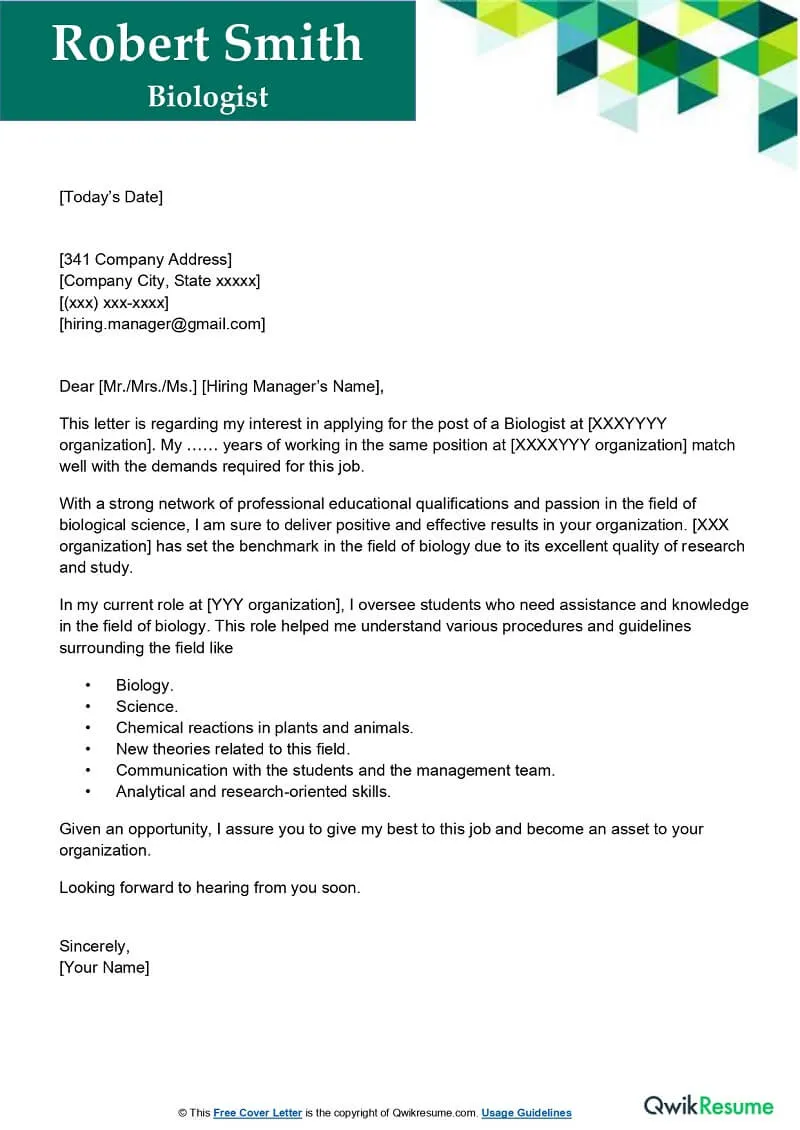
Understanding the Biology Cover Letter
A biology cover letter is a crucial document that accompanies your resume when applying for jobs in the field of biology. It serves as your introduction to a potential employer, offering a chance to highlight your qualifications, skills, and passion for the specific role and the broader field of biology. Unlike a resume, which provides a factual overview of your experience, a cover letter allows you to articulate your interest, connect your experiences to the job requirements, and demonstrate your personality. A well-crafted cover letter can significantly increase your chances of securing an interview by making a strong first impression and showcasing your suitability for the position. It is essential for all job seekers in biology.
Key Components of a Biology Cover Letter
To create a compelling cover letter, you need to understand the core elements that make it effective. Each component plays a specific role in conveying your qualifications and enthusiasm. These elements work together to form a cohesive and persuasive argument, demonstrating why you are the ideal candidate for the job. From the header to the closing, each aspect should be carefully considered and expertly written to grab the hiring manager’s attention and leave a positive impression. By mastering each part, you can significantly enhance your chances of success in the job application process.
Header of a Biology Cover Letter

The header is the first element of your cover letter, and it sets the tone for the rest of the document. It should be professional, clean, and easy to read. The header typically includes your full name, contact information, and sometimes the date. Ensure that your contact information is up-to-date and accurate. This includes your phone number, email address, and, if applicable, your LinkedIn profile URL. The header provides the employer with immediate access to your contact details, allowing them to easily reach out to you if they are interested in your application. Always use a professional email address.
Contact Information
Your contact information should include your full name, address, phone number, and email address. Make sure the email address is professional. Double-check the accuracy of your contact details. If you have a professional online presence, like a LinkedIn profile, you can include a link to it.
Date
The date should be the current date when you are sending the cover letter. It is typically placed below your contact information, either left-aligned or right-aligned, depending on the format you choose. The date is essential for providing context and is usually the first element after the header and is important for tracking and organization.
Recipient Information

This section includes the name, title, and address of the hiring manager or the person to whom you are addressing the letter. If you can find the name of the hiring manager, address the letter to them directly. If you can’t find a specific name, use a general greeting. Researching the hiring manager’s name shows initiative and personalization, making your application stand out.
Salutation
The salutation is your opening greeting. Use ‘Dear Mr./Ms./Mx. [Last Name]’ if you know the hiring manager’s name. If you don’t know the name, use a professional greeting like ‘Dear Hiring Manager’. Avoid generic greetings such as ‘To Whom It May Concern’. A personalized salutation immediately engages the reader and shows you’ve put effort into your application.
Body Paragraphs
The body paragraphs are the core of your cover letter, where you explain why you are a good fit for the job. This section usually consists of three or four paragraphs that outline your skills, experience, and enthusiasm for the role. Each paragraph should have a clear purpose, contributing to the overall argument of why you should be hired. The body paragraphs offer an opportunity to showcase your qualifications, provide specific examples, and demonstrate your understanding of the job requirements. Ensure the body paragraphs are well-structured and engaging, capturing the reader’s attention and highlighting your strengths.
First Paragraph Introduce Yourself

Start with a strong opening that immediately grabs the reader’s attention. State the specific position you are applying for and where you found the job posting. Briefly introduce yourself and express your interest in the position and the company. Mention something that sparked your interest, such as the company’s mission or a project they are working on. This paragraph sets the stage and creates a positive first impression, showing your awareness of the company and position. The goal is to immediately capture the reader’s interest and make them want to learn more about your qualifications.
Second Paragraph Showcase Skills
In this paragraph, highlight your relevant skills and how they align with the job requirements. Review the job description carefully and identify the key skills and qualifications the employer is seeking. Provide specific examples of how you’ve used these skills in previous roles or projects. Quantify your achievements whenever possible to demonstrate the impact of your work. Use keywords from the job description to make your application more ATS-friendly. Showcasing your skills in this way allows the employer to easily see how you meet their needs.
Third Paragraph Highlight Experience
Use this paragraph to delve into your relevant experience. Focus on the experiences that align with the job requirements. Describe your roles and responsibilities, emphasizing your accomplishments and the results you achieved. Use the STAR method (Situation, Task, Action, Result) to provide detailed examples of how you have successfully handled challenges and delivered results. Tailor your examples to the specific requirements of the job, demonstrating your understanding of the role and your ability to perform the necessary tasks effectively. Linking your experience directly to the job description helps the hiring manager see your qualifications at a glance.
Concluding Paragraph

The concluding paragraph is your opportunity to summarize your interest and express your enthusiasm for the position. Reiterate your interest in the role and the company, and mention your confidence in your ability to contribute to the team. Thank the hiring manager for their time and consideration. Include a call to action, such as stating that you are available for an interview and look forward to hearing from them soon. End the cover letter on a positive note, leaving the reader with a memorable impression of your interest.
Closing the Cover Letter
The closing of your cover letter should be professional and polite. Common closings include ‘Sincerely’, ‘Best regards’, or ‘Yours sincerely’. Choose a closing that feels appropriate for the tone of your letter and the company culture. Always follow the closing with a space, then your typed name. This section is critical for wrapping up your letter in a courteous manner and leaving a positive final impression. A proper closing is essential.
Formal Closing
Use a formal closing like ‘Sincerely’ or ‘Best regards’. These are standard and universally accepted in professional communications. Ensure that your closing is consistent with the overall tone and formality of your cover letter. A professional closing contributes to the overall impression you make on the employer. Keep it simple and respectful, showing you value the hiring manager’s time and consideration.
Signature

Leave space for your handwritten signature if you are printing and mailing the letter. If submitting electronically, you can simply type your full name. Make sure your signature is clear and legible, especially if you are printing. The signature signifies your agreement and adds a personal touch. The signature should be professional, clear and easy to read.
Additional Tips for Biology Cover Letters
To write an outstanding biology cover letter, consider these additional tips. Tailor your letter to each specific job, emphasizing the skills and experiences that align with the requirements. Proofread and edit your cover letter meticulously to eliminate any grammatical errors or typos. Use a professional and consistent format, and avoid common mistakes. A well-crafted and tailored cover letter significantly increases your chances of success. Pay attention to details.
Tailoring to the Job Description
Customize your cover letter for each job application. Carefully review the job description and identify the key skills and qualifications the employer is seeking. Use the same keywords and phrases from the job description in your cover letter to demonstrate that you meet their needs. Provide specific examples that highlight how your skills and experiences align with the requirements of the role. Demonstrating a tailored approach shows that you have carefully considered the job and are genuinely interested in the position. Tailoring is a must for every application, customizing the letter to make it relevant to the specific job.
This image shows how to use the job description to tailor your letter and the most important areas of the job to highlight. Use the keywords provided by the employer.
Proofreading and Editing

Always proofread your cover letter before submitting it. Errors can create a negative impression and undermine your credibility. Check for grammatical errors, typos, and formatting inconsistencies. Read the letter aloud to catch any awkward phrasing or unclear sentences. Consider having a friend or family member review your cover letter for a fresh perspective. A polished, error-free cover letter reflects your attention to detail and professionalism. Proofreading ensures your cover letter accurately reflects your skills.
This picture is a proofreading checklist. Check spelling and grammar.
Formatting Guidelines
Use a professional and easy-to-read format. Choose a standard font like Times New Roman, Arial, or Calibri, with a font size of 11 or 12 points. Use single spacing within paragraphs and double spacing between paragraphs. Use clear headings and subheadings to organize your content and make it easier for the reader to scan. Keep your letter concise, ideally one page long. Well-formatted letters are easier to read and create a positive visual impression.
This image provides some basic rules for formatting. Keep it clean and easy to read.
Common Mistakes to Avoid
Avoid common mistakes that can detract from your cover letter. Do not use generic templates without tailoring them to the specific job. Do not include information that is not relevant to the job. Avoid using jargon or overly technical language that the hiring manager may not understand. Do not exceed one page in length. Avoid typos, grammatical errors, and formatting inconsistencies. Be positive and avoid negativity. Avoiding these common mistakes ensures a more polished and professional cover letter.
This image shows some of the common mistakes to avoid when writing a cover letter. Don’t make these mistakes.
Using the Right Tone

Maintain a professional and enthusiastic tone throughout your cover letter. Show genuine interest in the position and the company. Use a positive and confident tone, but avoid being overly assertive or arrogant. Tailor your tone to the company culture and the specific job requirements. A positive tone demonstrates your enthusiasm and makes a better impression.
This image shows examples of how to maintain a positive and enthusiastic tone. Be positive in every way possible.
Examples of Biology Cover Letters
Reviewing examples can help you write a compelling cover letter. Look for well-written cover letters that effectively highlight skills, experience, and enthusiasm. Pay attention to how the writers tailor their letters to the job description and company. Use these examples as a guide, but be sure to personalize your own cover letter to reflect your unique qualifications and experiences. Reviewing various examples will show you how to format and write.