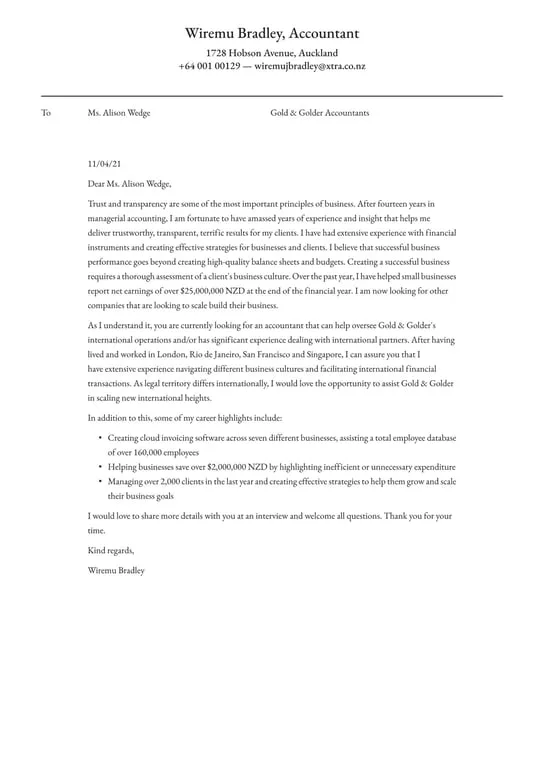
Understanding the Accounting Cover Letter
An accounting cover letter is more than just a formality it’s your first chance to impress a potential employer. It’s your opportunity to introduce yourself showcase your skills and experiences and demonstrate why you are the perfect fit for the job. Unlike a resume which is a factual summary a cover letter allows you to connect with the hiring manager on a personal level. This guide will provide you with top tips to create a cover letter that stands out and lands you an interview. A well-crafted cover letter is crucial in the competitive field of accounting so understanding its purpose and key components is essential for success.
Purpose of an Accounting Cover Letter
The primary purpose of an accounting cover letter is to persuade the hiring manager to read your resume and consider you for an interview. It serves as a personalized introduction that highlights your key qualifications and explains why you’re interested in the specific role and company. A strong cover letter clarifies your career goals and demonstrates your understanding of the employer’s needs. It’s a chance to communicate your personality and enthusiasm which are often missed in a resume. The cover letter provides context to your application allowing you to connect your skills and experience to the job description and company values. By clearly articulating your value proposition you increase your chances of securing an interview.
Key Components of a Cover Letter

A well-structured accounting cover letter typically includes several key components. These elements work together to present a cohesive and compelling narrative about your suitability for the role. Each section serves a specific purpose from establishing your contact information to expressing your enthusiasm for the position. Understanding and incorporating these components will ensure your cover letter is professional and effective. Following the guidelines will help you create a cover letter that captures the attention of hiring managers and sets you apart from other candidates.
Header and Contact Information
Begin with a clear and professional header. Include your full name address phone number and email address. Make sure your email address is professional and easy to read. The header should align with the format of your resume. If you know the hiring manager’s name and title you can include their contact information as well below your header. This establishes your professionalism and makes it easy for the employer to contact you if they are interested in your application. Accuracy and clarity are key in this section to ensure that your application is easy to navigate and that you can be easily reached.
Professional Greeting
Start your cover letter with a professional greeting. If possible address the hiring manager by name using Mr. Ms. or Mx. followed by their last name. This personalized approach shows that you’ve done your research and are genuinely interested in the position. If you are unable to find the hiring manager’s name use a general greeting such as “Dear Hiring Manager” or “Dear [Company Name] Hiring Team.” Avoid using generic greetings such as “To Whom It May Concern.” The tone should be polite and respectful setting a positive tone for the rest of the letter. This initial greeting is your first opportunity to make a positive impression.
Body Paragraph 1 Highlighting Your Value

The first body paragraph is where you make your initial pitch. State the specific position you are applying for and how you learned about it. Immediately convey your enthusiasm for the role and the company. Briefly summarize your most relevant skills and experiences. Highlight how your qualifications align with the requirements of the job description. This paragraph should capture the reader’s attention and establish your suitability for the role. Start with a strong opening statement that grabs the reader’s interest and clearly states your objective. Emphasize what makes you stand out from other candidates.
Showcasing Accounting Skills
In the next body paragraphs, provide specific examples of your accounting skills. Mention relevant software proficiency such as QuickBooks SAP or Xero. Highlight your expertise in areas like financial reporting budgeting auditing or tax preparation. Use action verbs to describe your accomplishments and responsibilities. Show how you have used these skills to achieve positive results in previous roles. Demonstrate your ability to analyze financial data prepare accurate reports and ensure compliance with accounting standards. Be clear and concise emphasizing the skills most important to the job. Tailor the skills you highlight to match the job requirements.
Highlighting Relevant Experience
Describe your relevant experience in detail. Provide specific examples of your accomplishments. Use the STAR method (Situation Task Action Result) to structure your responses. Mention the name of the companies where you have worked your job titles and the duration of your employment. Focus on achievements that are relevant to the job and demonstrate your ability to perform the required duties. Quantify your achievements whenever possible using numbers to illustrate the impact of your work. Explain how your experience has prepared you for the responsibilities of the target position. This shows potential employers that you are ready to take on new responsibilities.
Body Paragraph 2 Demonstrating Achievements

Use the second body paragraph to further demonstrate your achievements. This is an opportunity to go beyond your resume and provide more context and depth to your accomplishments. Discuss any projects or initiatives you led or contributed to and the results they achieved. Highlight any awards or recognitions you received. Show the tangible impact you made in previous roles. Use specific examples that showcase your problem-solving abilities attention to detail and ability to work independently and as part of a team. Show how your skills and experience align with the company’s goals. Quantifying your achievements is essential to prove your impact.
Quantifying Achievements with Numbers
Always quantify your achievements with numbers to make a stronger impact. Instead of saying you improved efficiency say you increased efficiency by 15%. Instead of saying you reduced costs say you reduced costs by $10000. Use metrics and data to support your claims and demonstrate the value you brought to previous employers. Numbers are more persuasive than general statements and they help the hiring manager understand the direct benefits of hiring you. Quantifying your achievements allows the hiring manager to see the direct value you would bring to the position. This approach highlights your accomplishments and gives concrete evidence of your capabilities.
Tailoring the Cover Letter to the Job
Customization is key when writing an accounting cover letter. Generic cover letters are often discarded because they lack specific details and fail to address the needs of the hiring company. Your cover letter should be tailored to each job application. This involves carefully reviewing the job description and identifying the key skills and requirements. Adapt your cover letter to highlight those specific skills and experiences. Show that you understand the company’s goals and challenges and how you can contribute to their success. A tailored cover letter demonstrates your genuine interest in the position and increases your chances of getting noticed. Be sure to demonstrate this in every paragraph you write.
Researching the Company

Research the company to demonstrate your interest and understanding. Visit their website and read about their mission values and recent news. Look at their social media profiles and industry publications. This will give you insights into the company culture and the specific needs of the role. In your cover letter mention something specific that impressed you about the company. This shows that you are genuinely interested in working there and have taken the time to learn about them. Research also enables you to use keywords from their website and job description to show your cover letter directly speaks to the company’s needs.
Matching Skills to Job Requirements
Carefully review the job description and identify the required skills and qualifications. Then align your experience and skills with those requirements. Use keywords from the job description in your cover letter. Give specific examples of how you have demonstrated those skills in the past. By doing this you show that you have the necessary qualifications for the role. Focus on the skills and experiences most relevant to the job. This tailored approach demonstrates that you are a great fit and increases your chances of moving to the next step in the application process.
The Closing of the Cover Letter
Your closing paragraph is your final opportunity to make a positive impression. It should summarize your key qualifications and reiterate your interest in the position. Express gratitude for the hiring manager’s time and consideration. A strong closing paragraph encourages the hiring manager to move forward with your application. You want to leave a memorable impression. The closing of your cover letter sets the tone for the end of the process and should show excitement and professionalism.
Expressing Enthusiasm and Call to Action

Express your enthusiasm for the opportunity. Mention why you are excited about the role and the company. End with a call to action. This can be a direct statement such as “I am eager to discuss my qualifications further” or “I look forward to the opportunity to speak with you.” Provide information on your availability for an interview. Thank the hiring manager for considering your application. Conclude with a professional closing such as “Sincerely” or “Best regards” followed by your full name. Make it easy for the hiring manager to take the next step. A clear call to action ensures the hiring manager knows how to contact you and what you want them to do next.
Proofreading and Formatting
Before submitting your cover letter carefully proofread and format it. Ensure there are no grammatical errors spelling mistakes or typos. A cover letter with errors can create a negative impression and damage your credibility. Check for clarity conciseness and professionalism throughout the document. This is a crucial step. Proofreading shows attention to detail which is vital in accounting. Review the letter multiple times and consider asking someone else to read it as a second pair of eyes. A polished and professional cover letter shows that you take pride in your work.
Common Mistakes to Avoid
Avoid common mistakes that can negatively impact your cover letter. Do not use generic templates without tailoring them to the specific job. Avoid long paragraphs and complex sentence structures that can be hard to read. Don’t include irrelevant information that is not directly related to the job. Do not make any negative comments about previous employers. Avoid exaggerating your skills or lying about your experience. Do not send a cover letter full of typos. Careful proofreading and attention to detail are the keys to success. These mistakes can undermine the credibility of your application and reduce your chances of getting an interview.
Formatting and Font Choices

Use a professional and easy-to-read font such as Arial Times New Roman or Calibri. Keep the font size between 10 and 12 points. Use a standard font for consistency. Ensure your cover letter is well-formatted with clear margins and spacing. Use a clean layout and avoid excessive formatting. Use bullet points and headings to organize information and make it easy to read. This will make it easy for the hiring manager to read and scan through your cover letter. A well-formatted cover letter is more likely to grab the reader’s attention. Use the same formatting as your resume to create a consistent look. Consistency in formatting presents a professional image.
Grammar and Spelling Checks
Thoroughly check your cover letter for grammar and spelling errors. Use a spell checker but also manually proofread the document. Use a grammar checker to identify and correct grammatical errors. Ensure your sentences are clear concise and well-structured. Poor grammar and spelling errors can diminish your credibility. Proofread the document multiple times and consider asking someone else to review it. Good grammar and spelling are essential for making a positive impression. Accurate grammar and spelling are fundamental to presenting a professional image. A clean cover letter demonstrates your attention to detail.
Final Review Before Submitting
Before submitting your cover letter conduct a final review. Ensure that the cover letter is free of errors. Verify that it is tailored to the specific job and company. Confirm that your contact information is accurate. Make sure your resume is attached and that the file name is professional. Check that the cover letter is in the correct format and is easy to read. Make a final decision. Reviewing your cover letter before submitting ensures that you present yourself in the best possible light. The last review is essential for ensuring that your cover letter is polished and professional.