Key Elements of a Successful Academic Advising Cover Letter
A well-crafted academic advising cover letter is your first opportunity to make a positive impression and showcase your qualifications. It’s not merely a formality but a crucial tool for highlighting your skills, experience, and passion for guiding students. This letter should be tailored to the specific job and institution, demonstrating your understanding of the role and your commitment to student success. A compelling cover letter goes beyond simply repeating your resume; it tells a story, painting a picture of you as the ideal candidate. It communicates not only what you’ve done but also how you can contribute to the institution’s advising goals. The most effective letters are clear, concise, and compelling, leaving the hiring manager eager to learn more about you.
Highlighting Your Skills and Experience
Your academic advising cover letter should serve as a roadmap, guiding the reader through your most relevant skills and experiences. Begin by clearly stating your relevant experience, emphasizing experiences that directly relate to the academic advising role. Frame your experience in a way that aligns with the job description, addressing the specific needs and expectations of the position. Show, don’t just tell. Instead of listing skills, illustrate how you’ve utilized them in previous roles. Use action verbs and specific examples to demonstrate your abilities and highlight achievements that set you apart from other applicants. Focus on aligning your qualifications with the needs of the institution, providing the hiring manager a clear sense of the value you can bring to the team.
Showcasing Relevant Skills

The academic advising field demands a unique blend of skills, and your cover letter is the perfect place to highlight them. Focus on skills such as communication, interpersonal abilities, problem-solving, and organizational skills, specifically as they relate to guiding and supporting students. Show how you have used these skills to help students in previous roles. For example, describe your proficiency in providing academic guidance, assisting with course selection, and connecting students with campus resources. Mention your experience in career planning, degree planning, and your ability to manage student advising records accurately. Make your skills clear and provide evidence for each skill. Use specific examples to provide details and facts that support your ability in the area.
Quantifying Your Achievements
While showcasing your skills is important, quantifying your achievements provides concrete evidence of your capabilities. Whenever possible, use numbers and data to illustrate your impact. Instead of saying you improved student retention rates, state the percentage increase achieved. Instead of saying you provided support to students, specify the number of students you assisted and the outcomes. Quantifiable metrics make your accomplishments more credible and demonstrate your ability to produce results. Include details about your history with student success. Be prepared to show data on how you did it. This level of detail not only strengthens your application but also demonstrates a results-oriented approach to your work in the academic advising field.
Demonstrating Passion for Academic Advising
Beyond skills and experience, your cover letter should reveal your passion for academic advising. Express your enthusiasm for helping students achieve their academic and professional goals. Describe how your personal values align with the mission of academic advising. Demonstrate your commitment to student success by highlighting the unique challenges and rewards of this field. Show that you care about helping students and what you’re doing is not just a job, but a way for you to make a difference. It should be evident that you find purpose and fulfillment in guiding students, and you are enthusiastic about contributing to their development. Consider the institution’s unique student advising values.
Expressing Genuine Interest in the Institution

A generic cover letter will not impress. Research the institution and tailor your letter to show a genuine interest in the specific role and the university’s mission. Mention specific programs, initiatives, or values that resonate with you. Demonstrate your knowledge of the institution’s culture and the unique challenges and opportunities it presents. Personalize your letter to demonstrate that you’ve done your homework and are invested in the institution’s success. Express your genuine interest and highlight the impact of your contribution to the university’s mission and goals. Referencing specific values and programs will show that you are the perfect fit.
Tailoring Your Letter to the Specific Role
Every academic advising role is unique. Customize your cover letter to match the specific requirements and expectations outlined in the job description. Carefully analyze the job posting and identify the key skills and qualifications the hiring manager is seeking. Ensure that you address these directly in your letter, using the same keywords and phrases when appropriate. Highlight the qualifications that are most relevant to the role. If the job description emphasizes a particular area of expertise, such as career counseling or student support services, be sure to highlight your experience in those areas. Tailoring your cover letter shows the hiring manager that you have the necessary skills to do the job.
Structuring Your Academic Advising Cover Letter Effectively
The structure of your cover letter is as important as its content. A well-organized letter is easy to read and allows the hiring manager to quickly grasp your key qualifications. Follow a standard business letter format, and make sure you include these things: a clear heading, a concise introduction, a body that highlights your skills, and a compelling conclusion. Adhere to the standard formatting guidelines to ensure your cover letter is easy to read and professional in appearance. A poorly structured cover letter can reflect poorly on your attention to detail and organizational skills. Create a structure that flows from beginning to end, conveying your passion for the role and what you bring to the table.
Formatting and Presentation

Your cover letter’s presentation is the first impression. Use a professional font like Times New Roman, Arial, or Calibri, and maintain a consistent font size throughout the document. Use clear headings and subheadings to break up the text and make it easy to scan. Keep the paragraphs concise and focused, and use bullet points to highlight key skills and achievements. Proper formatting shows professionalism and attention to detail. Avoid any formatting that distracts from the content. Ensure that the layout is easy to follow, with adequate spacing between paragraphs and sections. Proofread for formatting errors to make sure the hiring manager focuses on the content.
Contact Information and Salutation
Start your cover letter with your contact information, including your name, address, phone number, and email address. If possible, address the letter to a specific person, such as the hiring manager. Doing this helps your letter stand out. Use a professional salutation like “Dear Mr./Ms./Mx. [Last Name]” or “Dear Hiring Manager.” Double-check the spelling and accuracy of the recipient’s name. Incorrect information might reflect poorly on your attention to detail. It helps personalize your letter and shows you’ve taken the time to learn about the institution.
Body Paragraphs Best Practices
The body paragraphs are where you showcase your skills, experience, and passion. Start with a strong opening paragraph that grabs the reader’s attention and immediately states your interest in the position. Each subsequent paragraph should focus on a specific aspect of your qualifications. Use strong action verbs to describe your accomplishments. Provide detailed examples of your experience, quantifying your achievements whenever possible. Ensure your writing style is clear, concise, and professional, and use language that demonstrates your understanding of the role of an academic advisor. Keep each paragraph focused and relevant to the specific requirements of the role.
Closing the Letter

The closing paragraph should summarize your key qualifications and reiterate your interest in the position. Briefly restate why you are the best candidate for the job and express your enthusiasm for the opportunity. Show that you’re serious about the job by letting the person know you’re willing to take the next step. Always thank the reader for their time and consideration. Leave a positive and memorable impression on the hiring manager.
Call to Action and Professional Closing
Conclude with a strong call to action, expressing your eagerness to discuss your qualifications further. State your availability for an interview and provide your contact information once again. Use a professional closing such as “Sincerely” or “Best regards,” followed by your typed name. A proactive approach shows enthusiasm and initiative. Proofread your closing to avoid errors and ensure it aligns with your overall tone and message. Ensure your professionalism is reflected in the closing and any errors will be minimized.
Proofreading and Editing Your Cover Letter
Proofreading and editing are critical steps in the cover letter writing process. Take the time to carefully review your letter for errors in grammar, spelling, punctuation, and formatting. A single mistake can undermine your credibility and make a negative impression on the hiring manager. Proofreading helps ensure your professionalism. Make sure that the language is clear, concise, and professional. If possible, ask a friend, mentor, or career counselor to review your letter for feedback. Another set of eyes can catch mistakes you might have missed and offer insights on how to improve your letter. Review your cover letter carefully, and polish it until it’s perfect.
Checking for Grammar and Spelling Errors

Grammar and spelling errors can be detrimental. Thoroughly check your cover letter for any grammatical or spelling mistakes. Use a spell checker and grammar checker to identify potential errors, but don’t rely on these tools entirely. Read your letter aloud to catch any awkward phrasing or errors. Correcting these errors will show that you are prepared for the job. It’s better to get the details right the first time around. Even a single error can make the difference. The importance of this step should not be underestimated.
Ensuring Clarity and Conciseness
Your cover letter should be easy to read and understand. Make sure your sentences are clear, concise, and to the point. Avoid using jargon, overly complex language, or wordy phrases. Aim to communicate your qualifications effectively in a straightforward manner. If you use long paragraphs or complex sentence structures, consider rewriting the letter. Clarity is important for making an impression and communicating your value. If the hiring manager is unsure, they may decide to move on. Concise writing is important. Shorten your language and make sure you’re telling the reader what’s most important.
Reviewing for Tone and Professionalism
The tone of your cover letter should be professional, enthusiastic, and appropriate for the academic environment. Ensure your tone is respectful, positive, and confident, but avoid sounding arrogant or overly casual. Review your letter for any language that might be considered unprofessional, such as slang, informal language, or overly familiar phrases. Maintain a professional tone from the opening greeting to the closing signature. Your cover letter is a professional document. It reflects your ability to communicate effectively and your understanding of workplace communication. Proofread the final draft to ensure that it shows your passion for academic advising.
Examples of Strong Academic Advising Cover Letters

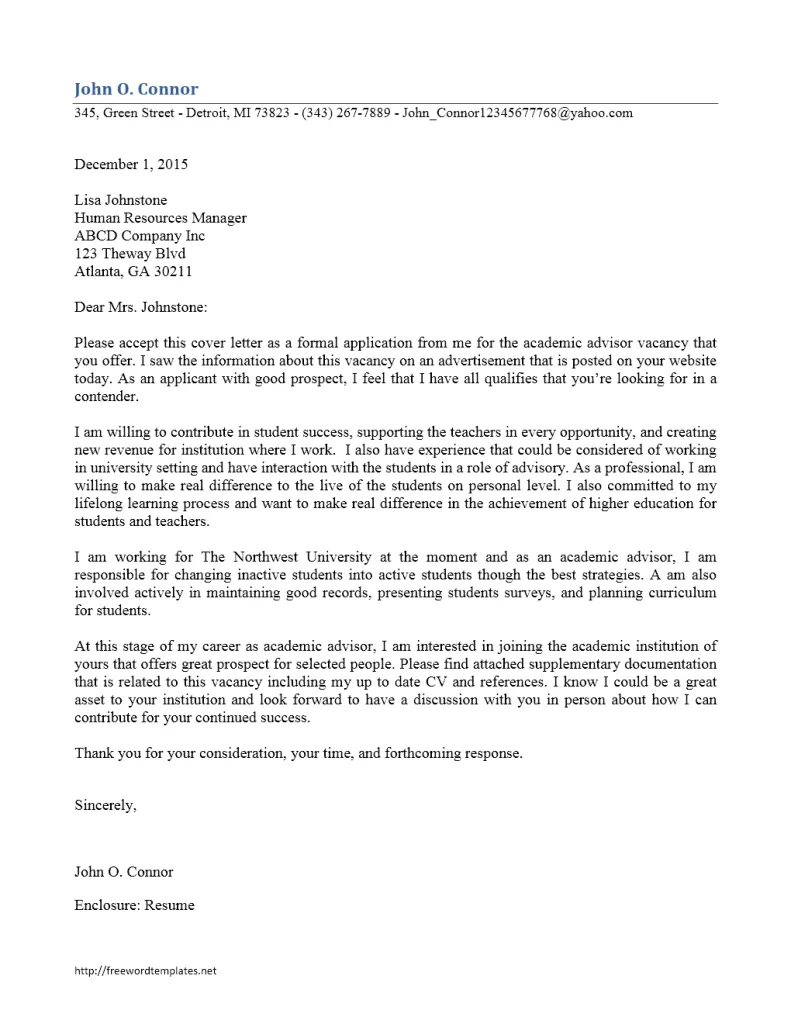
Reviewing examples of successful academic advising cover letters is an excellent way to learn how to structure your own letter. Look for samples online or ask your career counselor. Analyze how experienced candidates highlight their skills, experience, and passion for advising. Study their language, formatting, and the ways they address the specific requirements of the job. Adapt their best practices to create your own compelling cover letter. Analyze the different approaches used in the examples. Doing this will allow you to choose what fits your specific situation.
Analyzing Effective Cover Letter Samples
When reviewing cover letter samples, pay close attention to how the candidates showcase their skills and achievements. Note how they use action verbs, quantify their achievements, and demonstrate their passion for academic advising. Identify the key phrases and language used to highlight the skills and experience required for the role. Evaluate how the samples are tailored to the specific job descriptions and the institutions. Take the time to understand how successful candidates present themselves in the academic advising cover letter and learn from them. Take notes to keep the most valuable information. These examples can be very helpful for your own process.
Identifying Key Phrases and Language
Pay attention to the phrases and language used in the successful cover letter samples. Note the specific terms and keywords used to describe skills, experiences, and qualifications. Analyze the writing style, and pay attention to the tone and language. Use these phrases to effectively showcase your qualifications and experiences in your own academic advising cover letter. Apply the most effective phrases and language to describe your skills and experience. Use these techniques to create a cover letter that shows you are the perfect fit.